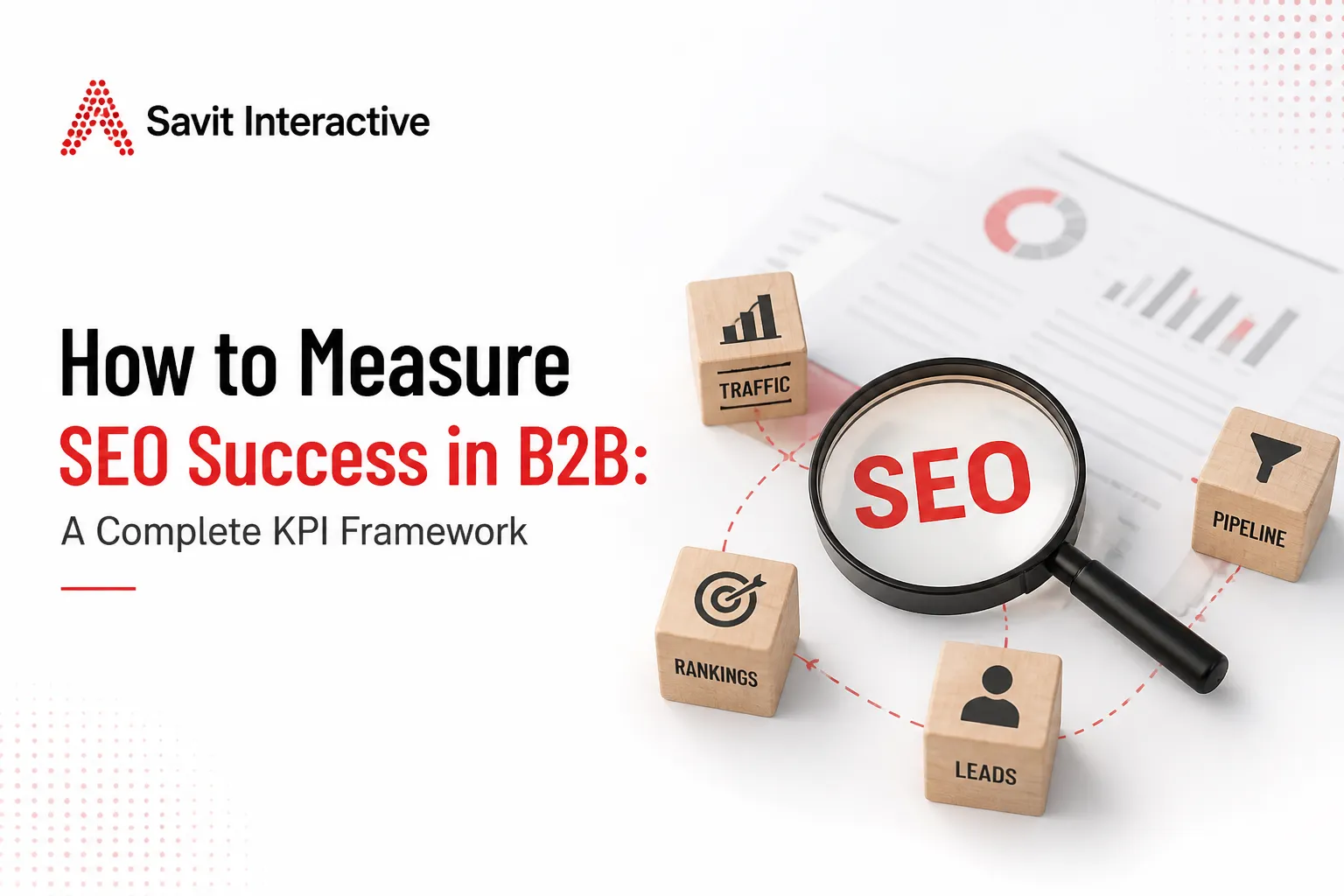
In B2B, SEO success isn’t just about traffic; it’s about influence on pipeline, deal velocity, and revenue. Here’s how to measure what actually moves the business.
Most B2B companies know their SEO is active. They can see traffic numbers in a dashboard and keyword positions in a report. What they often cannot tell is whether any of it is actually working.
That gap is a measurement problem. And in B2B, it is more common than it should be.
The reason is straightforward. B2B SEO operates differently from consumer marketing. Your buyers take longer to decide. Several people are involved in the purchase. The path from a Google search to a signed contract can span three to six months. Standard website metrics were not built with that complexity in mind, and applying them without adjustment gives you a picture that is technically accurate but practically useless.
Research from Mixology Digital found that 40 per cent of B2B buyers begin their purchasing journey via a search engine. That means a significant share of your future customers are finding you, or not finding you, through organic search, before they have ever spoken to anyone at your company. Measuring whether that process is working starts with understanding what to track and when.
Why Does B2B SEO Need Its Own Measurement Framework?
In B2B, proving that SEO is working is harder because the outcomes take longer to appear. A consumer website might see a sale within hours of a visitor landing. A B2B website might see a contact form submission weeks later, a discovery call a month after that, and a proposal another month down the line.
According to 6Sense’s 2025 Buyer Experience Report, B2B buyers spend roughly 70 per cent of their journey identifying a shortlist and a preferred vendor before they ever reach out to sellers. During that time, they are reading your content, visiting your pages, and forming opinions, entirely on their own. If your SEO measurement only captures what happens after a form is submitted, you are missing the majority of the journey.
This is why tracking traffic alone tells B2B businesses almost nothing. A spike in sessions means very little if none of those visitors match your target customer profile. Similarly, ranking for popular search terms sounds impressive until you realise the people searching those terms are not your buyers.
Measurement in B2B search engine optimisation has to follow the buyer through each stage, from first becoming aware of a solution, through evaluating options, to making contact. Here is how that breaks down.
Stage 1: Are the Right People Finding You?
This is the awareness stage. Your SEO work is attracting visitors. The question is whether those visitors could realistically become customers.
What to track here:
- Organic impressions and clicks for industry-specific search terms: not just any keywords, but the terms your target buyers actually use
- Keyword rankings for solution-intent queries: terms like “B2B logistics software for manufacturers” signal far more buying intent than “what is logistics software”
- Branded search volume: when people search your company name directly, it often means your content left an impression during their research. A growing trend here is a good sign
What to look for: Consistent growth in impressions and clicks for terms that your ideal customers would search. If rankings are rising for very broad, generic terms but qualified enquiries are not improving, that is a sign the keyword strategy needs refining.
Stage 2: Are Visitors Engaging with Your Content?
Once visitors arrive, the next question is whether your content is actually helping them. In B2B, buyers spend time on sites that answer their questions clearly. A visitor who reads three pages and downloads a case study is in a very different position to one who bounces after 20 seconds.
What to track here:
| Metric | What it tells you |
|---|---|
| Time on page for solution and service pages | Whether your content holds the attention of serious buyers |
| Pages per session from organic traffic | Buyers in research mode visit multiple pages; a low figure suggests weak content journeys |
| Content downloads (guides, whitepapers, case studies) | A direct signal that a visitor is evaluating your expertise |
| Return visits from organic search | In B2B, buyers often revisit a site several times over weeks before making contact |
What to look for: Visitors spending meaningful time on service pages and downloading content are showing genuine interest. If traffic is healthy but these numbers are flat, the issue is likely content quality or website structure.
Stage 3: Is SEO Generating Qualified Leads?
This is where B2B SEO connects to actual business outcomes. Lead generation in B2B is not about volume. One well-qualified lead from organic search is worth far more than a hundred unqualified ones.
What to track here:
- Marketing Qualified Leads (MQLs) from organic search: visitors who have taken an action that signals genuine buying intent, such as requesting a demo, filling a contact form, or downloading a specific asset
- MQL-to-SQL conversion rate: of the leads organic search generates, how many are good enough for the sales team to follow up? A low rate suggests the content is attracting the wrong audience
- Lead quality by content type: which blog posts, guides, or service pages are producing leads that actually progress? This helps focus future SEO effort on what converts
What to look for: The goal is a steady flow of organic leads that the sales team considers worth pursuing. If lead volume is growing but quality is declining, revisit the intent of the keywords you are targeting.
Stage 4: Is SEO Contributing to Revenue?
This is the question leadership teams care about most, and it is the hardest to answer without the right setup.
What to track here:
- Organic-attributed revenue: what proportion of closed deals involved organic search at some point in the buyer journey? Most CRM tools can show the original or influencing source of a deal
- Customer acquisition cost (CAC) from organic vs. paid: over time, organic search typically delivers a lower CAC than paid advertising. Tracking this comparison justifies continued SEO investment
- Pipeline velocity: how quickly do leads from organic search progress through the sales cycle, compared to other channels?
A practical note on attribution: In B2B, a buyer might find your site through organic search, then return via a LinkedIn ad, then come back direct before filling in a form. No single channel gets full credit. A simple multi-touch model, one that distributes credit across all the touchpoints in a deal, gives a more honest picture than attributing everything to the last click.
What Does a Good Reporting Rhythm Look Like?
A KPI framework only produces value if it is reviewed on a consistent schedule. Different metrics move at different speeds, so they suit different review cycles.
Weekly review:
- Lead volume from organic search
- MQL flow and lead quality
- Conversion rates on high-priority pages
Monthly review:
- Keyword rankings and organic impressions
- Content engagement (downloads, session depth, return visits)
- Branded search trend
Quarterly review:
- Organic-attributed revenue and pipeline contribution
- Customer acquisition cost by channel
- Overall SEO ROI, investment compared to pipeline generated
For this to work, your analytics tools need to speak to each other. Google Search Console tracks search performance. GA4 tracks on-site behaviour. Your CRM, whether HubSpot, Salesforce, or similar, tracks what happens after a visitor becomes a lead. Connecting all three gives you a complete view of the journey from search to sale.
Measure What Matters at Every Stage
Measuring B2B SEO is not about finding a single number that proves it is working. It is about tracking the right signals at each stage of the buyer journey so you can see clearly what is generating pipeline and what needs to improve.
When measurement is set up this way, SEO stops being a cost you justify and starts being a channel you manage with confidence.
At Savit, our approach as a B2B SEO agency in Dubai begins with understanding exactly this: what does success look like at every stage of your buyer’s journey? We do not hand over a standard report at the end of each month. For every client, whether the goal is building awareness in a new market, generating more qualified enquiries, or improving B2B ecommerce SEO performance, we build a KPI framework around the outcomes that matter to that specific business. We track what moves deals forward, surface what leadership needs to see, and adjust the strategy based on what the data actually shows.
If you are looking for the best B2B SEO agency that ties organic search directly to your pipeline and revenue, get in touch with us. Let’s work on what success should look like for your business and build the framework to measure it.