Most B2B organisations measure the success of their SEO efforts through traffic reports. They see an increase in the number of sessions; the monthly report shows a positive trend; and leadership nods along. But then someone looks at the pipeline and discovers that none of those extra visitors turned into a qualified discussion.
This is the most common failure in B2B SEO: optimising for volume instead of intent. A thousand extra monthly visitors are worthless if none of them are procurement managers, operations heads, or business owners evaluating solutions. In B2B, one right visitor is worth more than a hundred wrong ones.
Organic search is responsible for 76% of all trackable B2B website traffic, making it the largest acquisition channel available to most B2B businesses.
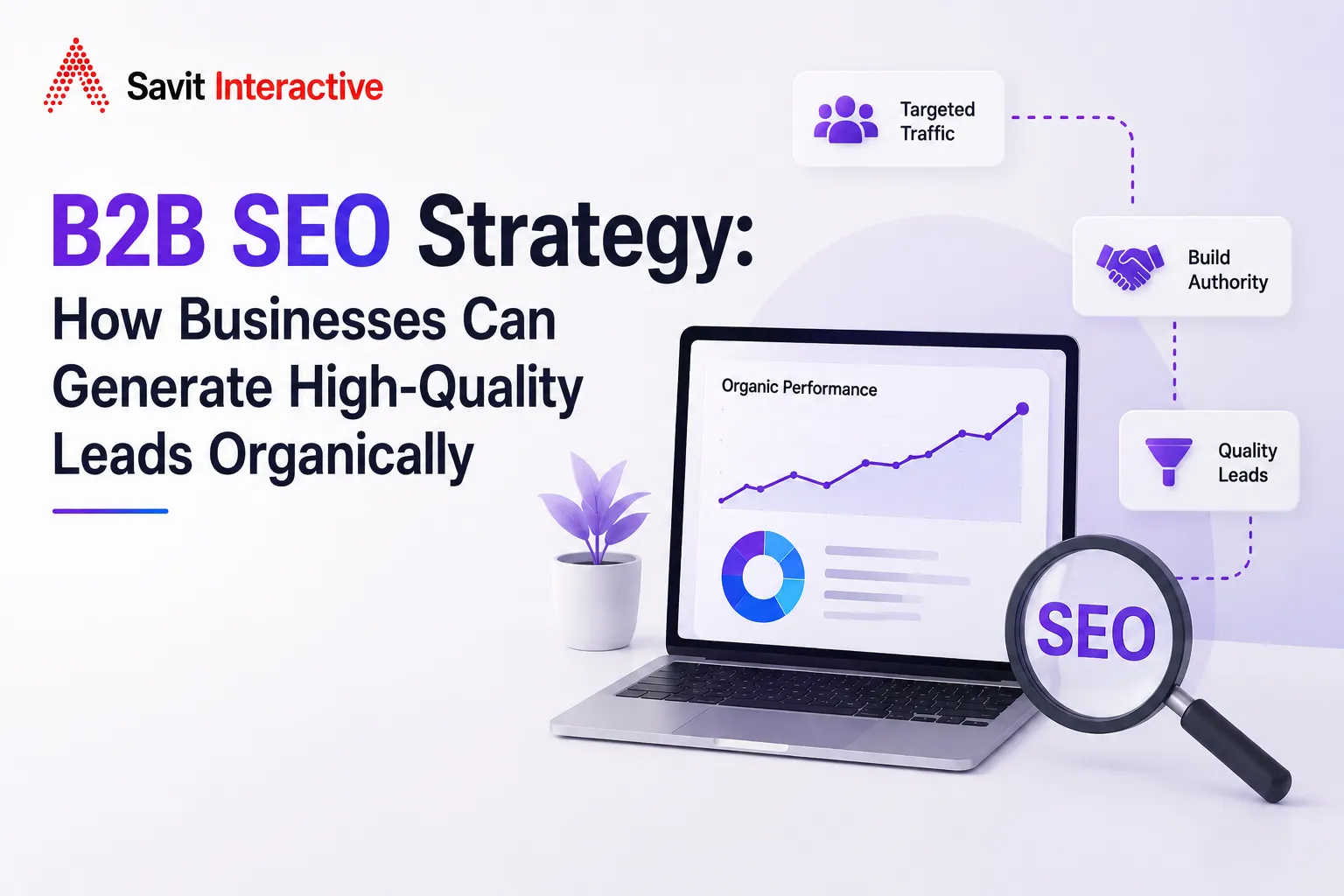
That share of traffic only generates leads if the strategy behind it is built for buyer intent, not just rankings. This blog breaks down how to build that strategy, from technical foundations through to the conversion layer, so that organic search becomes a consistent, compounding source of qualified B2B leads.
Why B2B SEO Produces Better Leads Than Paid Channels
Before getting into the strategy itself, it is worth understanding why organic search deserves the investment in the first place.
81% of B2B marketers say SEO generates higher-quality leads than paid advertising, with organic leads closing at an average rate of 14.6%, compared to just 1.7% for outbound methods.
It’s all a matter of intent. In fact, if a procurement director punches the query “B2B logistics software for distribution companies” into a search engine, they won’t be simply hunting for ideas at leisure. They will be creating a shortlist. Of course, paid ads can be announced to that user, but a natural search result is a real winner in that respect. This difference alters the value of a lead that appears.
Three structural reasons organic search holds an advantage over paid in B2B:
- It compounds over time – A well-optimised page keeps attracting leads after the initial work is done. A paid campaign stops the moment the budget is paused.
- It builds trust before first contact – A buyer who finds a business repeatedly through organic search over several weeks arrives at the first conversation with existing familiarity already established.
- It scales without proportional cost – Growing organic reach does not require doubling spend the way paid channels do when competition increases.
Build the Technical Foundation First
Content and keywords cannot perform on a site that search engines cannot properly understand. Technical SEO is the ceiling. Everything else is built on top of it.
|
Technical area |
What to address |
Why it matters in B2B |
|
Site architecture |
Group pages by service, industry, and solution type |
Helps search engines map relevance; channels link authority to key pages |
|
Page speed and Core Web Vitals |
Compress images, reduce JavaScript, improve server response |
Slow pages cost both rankings and first impressions with decision-makers |
|
Mobile optimisation |
Responsive design, legible text, tap-friendly navigation |
80% of B2B buyers use mobile at work; poor mobile signals poor attention to detail |
|
Schema markup |
Implement service, FAQ, and organisation schema |
Richer search results improve click-through rates from buyer-intent queries |
|
Internal linking |
Connect service, industry, and content pages with purpose |
Distributes authority across the site; keeps research-stage buyers moving deeper |
|
Indexation and crawlability |
Ensure key pages are indexed; fix accidental noindex tags |
Critical pages that cannot be crawled cannot rank, regardless of content quality |
One point specific to B2B SEO services: companies with multiple service lines or industry verticals need a dedicated, indexable page for each. A single “What We Do” overview page is not a scalable SEO asset. Each service and each target industry deserves its own page, built around the specific language buyers in that area use.
Technical SEO is not a one-time project. Quarterly audits catch new issues before they compound and undo ranking progress built over months.
Build a Keyword Strategy Around Buyer Intent, Not Search Volume
This is where B2B SEO strategy diverges most sharply from general SEO practice. A keyword attracting 40,000 monthly searches may drive no useful pipeline. A keyword attracting 300 monthly searches may drive the three conversations that close six-figure contracts in a quarter.
The objective is not to rank for the biggest terms. It is to rank for the right terms.
Map every keyword target to the B2B buying journey:
- Top of Funnel (TOFU): Problem Identification
Buyers at this stage are recognising a problem. They are not ready to speak to anyone yet. They are researching.Target queries that reflect a challenge, not a product: “how to reduce supplier onboarding time,” “why B2B procurement cycles take too long,” “signs your distribution platform is limiting growth.”
Content here builds early awareness. It rarely converts immediately, but it establishes presence during the research phase, which is where most B2B shortlists begin.
- Middle of Funnel (MOFU): Solution Evaluation
Buyers here know what they need in broad terms and are now comparing approaches, platforms, or providers. They are looking for specifics.Target queries like: “best B2B ecommerce SEO platforms for wholesale distributors,” “how to choose a B2B SEO company for professional services,” “HubSpot vs Salesforce CRM for mid-market.”
These buyers are closer to a conversation. Content here should speak directly to outcomes and differentiation.
- Bottom of Funnel (BOFU): Vendor Selection
Buyers at this stage are finalising their shortlist and looking for reasons to choose or eliminate specific providers.
Target queries like: “B2B SEO agency in Dubai,” “B2B SEO consultant for SaaS companies,” “B2B digital marketing agency UAE pricing.”
BOFU pages are your highest-converting pages. They need to be the most tightly optimised, most credibility-rich, and most clearly conversion-focused pages on the site.
Practical keyword rules:
- Add industry and role-specific modifiers: “for manufacturing companies,” “for UAE distributors,” “for HR technology brands”
- Use competitor gap analysis to find high-intent terms where visibility is currently absent
- Avoid keyword cannibalism: one focused page per intent cluster, not multiple pages competing internally for the same term
- Do not chase volume at the expense of relevance. A 200-search-per-month term used by the exact buyer profile you serve is more valuable than a 5,000-search term used by everyone
How Do You Build Content That Converts B2B Visitors into Leads?
Rankings bring visitors. Content is what makes them stay, trust, and act. Companies publishing 16 or more blog posts per month generate 4.5 times more leads than those that publish infrequently (HubSpot, via Oliver Munro, 2026). Volume matters, but structure matters more. Publishing regularly without a deliberate architecture behind the content produces traffic with no commercial direction.
The pillar-cluster model is the most effective content structure for B2B SEO:
PILLAR PAGE
(Comprehensive guide on a core topic, e.g. “B2B SEO Strategy”)
|
|—–> Cluster: “B2B Keyword Research for Lead Generation”
|—–> Cluster: “Technical SEO for B2B Websites”
|—–> Cluster: “B2B Content Strategy: Pillar vs. Cluster”
|—–> Cluster: “How to Measure B2B SEO ROI”
|—–> Cluster: “B2B Link Building Tactics”
Each cluster page covers a specific subtopic in depth and links back to the pillar. This signals to search engines that the site holds genuine topical authority across the full subject area, not isolated pages on unrelated topics.
Content formats that generate leads in B2B:
Solution-focused guides: written for MOFU buyers evaluating options, these should address outcomes the buyer wants, not a list of features
Case studies: specific, results-based, and credible. A case study that names the challenge, the approach, and the measurable outcome builds pre-contact trust more effectively than any headline claim
Comparison pages: “X vs Y” content attracts decision-stage buyers with high commercial intent. These pages consistently punch above their traffic weight in conversion rate
ROI calculators and assessment tools: interactive content converts research visits into engaged, identified prospects
Industry and role-specific landing pages: a B2B ecommerce SEO strategy for a wholesale distributor, for example, requires product category pages optimised with the same rigour applied to service pages; a generic product listing is not a lead-generation asset
Every piece of content needs a clear next step. A guide that ends without a conversion path wastes the traffic it earns. Match the conversion action to the buyer stage: a TOFU reader wants a resource to download; a BOFU reader wants a conversation.
Authority Building: Why Backlinks Still Matter
Domain authority is a long-term trust signal. In B2B, where buyers scrutinise vendors carefully before committing, a site’s credibility in search results reflects on the credibility of the business itself.
B2B-specific link-building approaches that work:
- Industry publication contributions: expert articles or commentary in trade media relevant to the target sector carry both topical relevance and authority
- Partner and integration pages: co-marketing with complementary businesses generates natural, contextually relevant links
- Client case study citations: when a client publishes about results achieved, the link back is earned credibility that no outreach campaign can replicate
- Expert commentary and HARO responses: responding to journalist queries earns links from media and news sources with strong, widely recognised domain authority
- Trade association and professional directory listings: industry bodies and vetted directories provide stable, relevant signals that generalist link sources cannot match
Quality over quantity applies absolutely here. One link from a respected industry publication outperforms fifty from generic directories, in both ranking impact and in how the site appears to any buyer who looks it up independently.
What Happens When a Lead Actually Lands on Your Page?
Most B2B SEO strategies stop at rankings. The smarter ones extend to what happens when the right buyer arrives.
A solution page with a generic headline, a dense block of feature descriptions, and a buried “Contact Us” button is not a lead-generation asset. It is a departure lounge.
What a B2B landing page needs to convert:
- A headline that names the outcome the buyer wants, not the service being provided
- A concise explanation of how the problem is solved, written in the buyer’s language rather than the company’s internal vocabulary
- Social proof near the top: specific results, named client testimonials, recognisable client logos
- A conversion action matched to the buyer’s stage. MOFU visitors respond to guides and case study downloads; BOFU visitors want a demo, a consultation, or a direct conversation
- Credibility signals visible without scrolling: certifications, client numbers, awards, and media mentions
Any experienced B2B SEO expert will confirm that organic traffic without conversion optimisation is a traffic investment with no commercial return. Rankings earn the visit. The page earns the lead.
Measuring the Right Things
The metrics that matter in B2B SEO are not the ones that look best in a dashboard.
Track these instead:
- Organic-sourced MQLs: how many marketing-qualified leads are arriving through organic search each month?
- MQL-to-SQL conversion rate: are organic leads good enough for the sales team to follow up, or are they filtering out at qualification?
- Organic-attributed revenue: what share of closed deals were influenced by organic search at any point in the buying journey?
- Share of voice: how visible is the brand versus competitors for the specific terms that matter most at each funnel stage?
Reporting cadence that works:
Weekly: lead volume, conversion rates, and form completions from organic traffic.
Monthly: keyword rankings, content performance, and branded search trends.
Quarterly: organic revenue contribution, pipeline velocity from organic, and CAC comparison across channels.
CRM integration is not optional here. Without it, organic-to-revenue attribution is guesswork. With it, the channel earns the full strategic credibility it deserves in budget conversations.
Generating high-quality leads through organic search in B2B requires a system, not a series of disconnected tactics. Technical foundations let search engines trust the site. Intent-based keywords attract buyers instead of browsers. Structured content builds authority across the full buying journey. Authority signals establish credibility before the first conversation. Conversion-focused pages turn that visibility into pipeline. Measurement connects every decision back to commercial outcomes.
Each layer depends on the ones beneath it. When the system works together, B2B SEO becomes one of the most cost-efficient, compounding lead channels a business can build.
At Savit, our B2B SEO services are built around this system, shaped by the specific context of each client we work with. As a B2B SEO agency in Dubai, we work across professional services, technology, manufacturing, and distribution sectors, designing strategies that map directly to the buying journeys of each client’s target customers. We do not apply a standard package. Whether a client needs a full-funnel content architecture, technical remediation of a large B2B website, or a B2B ecommerce SEO strategy for a wholesale or distribution-led catalogue, we build the approach around the actual sales cycle, the competitive landscape, and the pipeline outcomes that matter. Every B2B SEO company claims to generate leads. We focus on generating the kind that close.
If you are looking for a B2B SEO consultant or a specialist B2B SEO expert to build an organic strategy that compounds over time, get in touch with us. Let’s start with a clear look at where your buyers are searching and build the visibility to meet them there.