For twenty years, the game was clear. Rank higher. Get clicks. Win traffic. Build revenue.
That model still works. But it is no longer the complete picture, and any business still treating it as the whole story is optimising for a version of search that is shrinking in front of us.
Google now generates its own answers. AI Overviews sit above organic results and summarise information from multiple sources before the user scrolls past the fold. ChatGPT, Perplexity, and Bing Copilot serve full responses with citations inline. Voice assistants skip the list entirely and deliver one spoken answer.
The search results page for 2026 looks nothing like the one for 2022. For businesses that are investing in SEO services in Dubai or in any other market where organic visibility is important, the question has changed. It’s not “what is our ranking? ” anymore. Instead, it’s “where do we show up, and is the AI trusting us enough to be quoting us? ”
This blog explains what changed, what the data actually says, and what businesses should do about it.
What Is AI SEO and How Is It Different from Traditional SEO?
Traditional SEO is about getting your website to rank in Google’s organic results so people click through to it. That has not changed. It still works. It still matters.
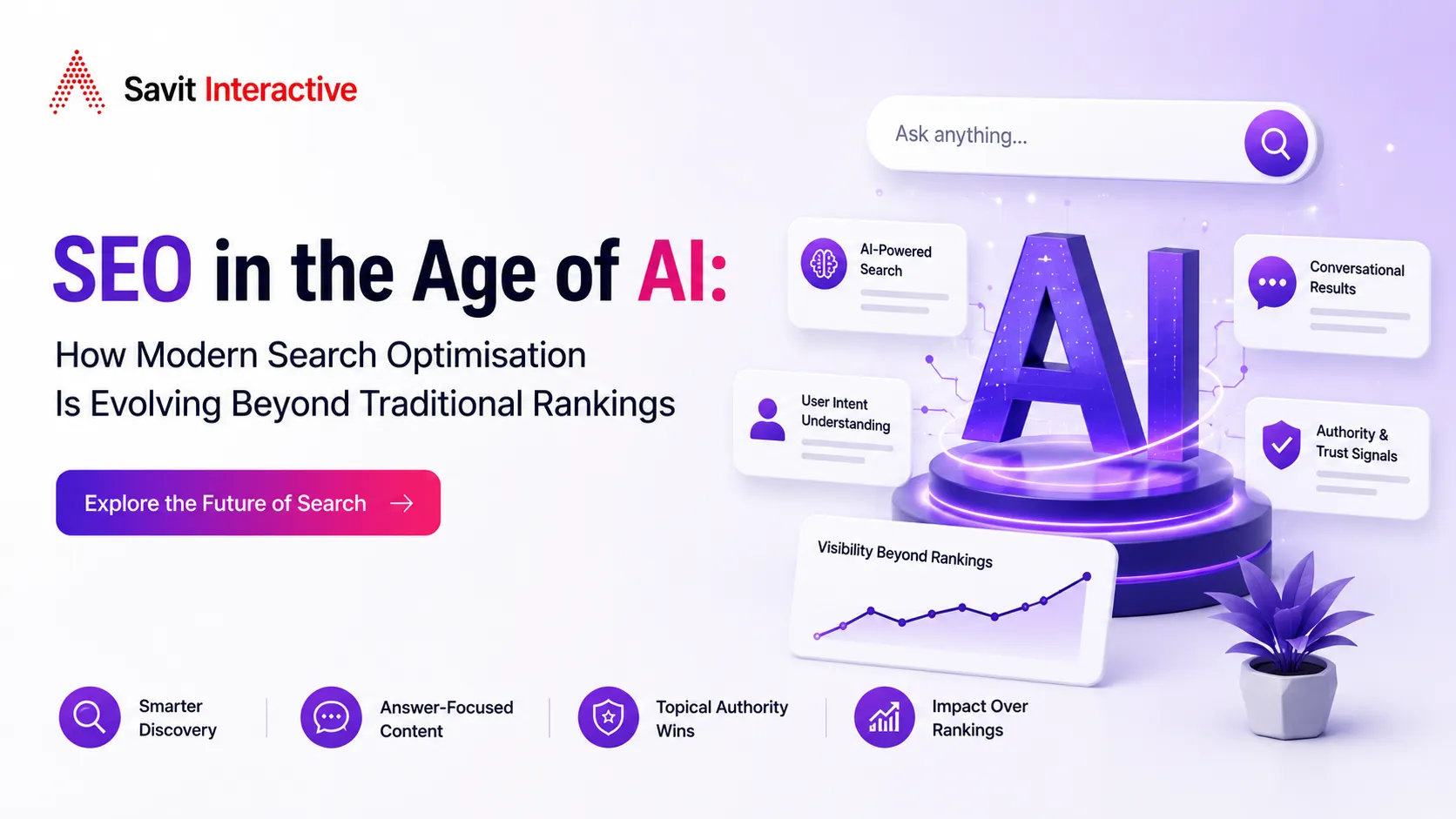
AI SEO is broader. It is the work of making your content visible, extractable, and citable across every AI-powered surface where buyers now look for information. That includes:
- Google AI Overviews, which generate a summary at the top of search results, drawn from multiple sources, before any organic listing appears
- ChatGPT, equipped with browsing and Perplexity, which respond in a conversational manner to questions and also provides sources for their answers inline.
- Voice assistants, that give us one answer instead of ten links.
- Bing Copilot, that combines usual search results and AI-generated responses within one interface.
Two terms have emerged alongside this shift. Answer Engine Optimisation (AEO) focuses on structuring content so it gets selected as the direct answer to a specific query. Generative Engine Optimisation (GEO) focuses on earning citations within AI-generated summaries.
Neither is a separate discipline. Both are extensions of SEO. The foundation is the same. The surface area of where your content needs to perform has expanded.
How Is Search Behaviour Changing?
Here is the data that makes this real.
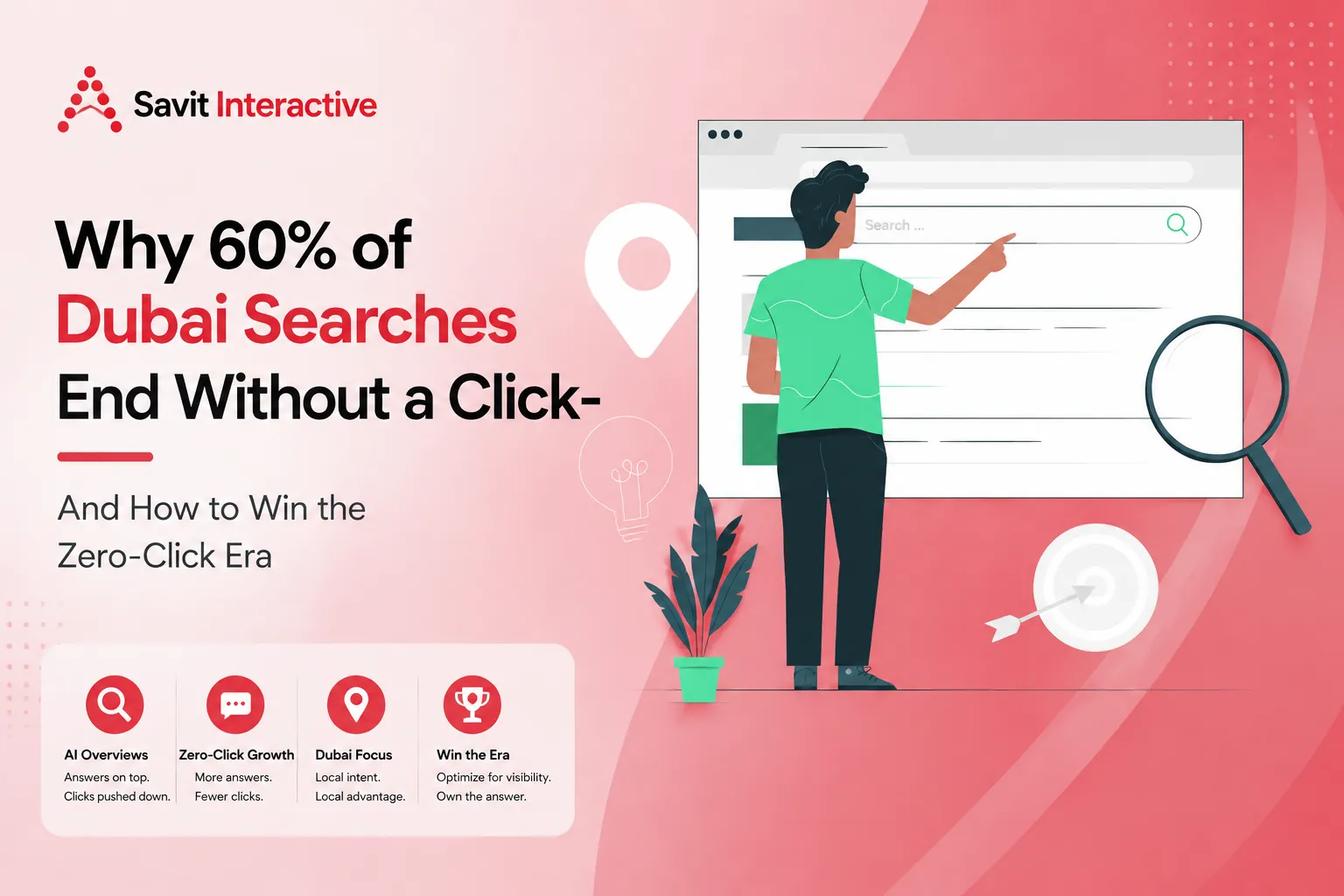
60% of Google searches now end without a click to any external website. When an AI Overview appears on the results page, that number jumps to 83%.
Read that again. On queries where Google generates an AI summary, more than four out of five users get what they need and leave. They never visit a single website.
Position one on Google, the spot every business fights for, now generates a 27.6% click-through rate. In 2022, that same position delivered 31.7%. The erosion is steady and measurable.
So is search dying? No. But where the value sits has moved.
Here is what the data actually tells us when you look past the alarming headlines:
- Informational queries are the most affected. If someone asks “what is schema markup” and Google’s AI Overview answers it on the page, there is no reason to click anywhere. That traffic is gone for everyone.
- Transactional and branded queries still generate strong click rates. Someone searching “SEO company in Dubai pricing” or “best accounting software for SMEs UAE” is comparing providers. They click. They browse. They evaluate. That behaviour has barely changed.
- Being cited in the AI answer changes the equation entirely. This is the critical insight most businesses are missing.
Brands cited inside an AI Overview earn 35% more organic clicks than brands appearing on the same results page but not cited.
Fewer total clicks. But a larger share of whatever clicks remain going to the brands that AI systems trust enough to reference. That is the new competitive advantage. Not position one. Citation.
What Factors Are Shaping SEO in 2026?
Five things are determining which businesses stay visible and which ones gradually disappear from the places buyers are looking.
1. Entity Clarity
AI systems do not process websites the way traditional search crawlers do. They identify entities: brands, products, people, and concepts. When an AI tool needs to reference a business, it looks for the clearest, most consistent signals it can find across the web.
What does it mean in practice? Your brand name, service description, and positioning should communicate the same message everywhere. On your website. In the directories. On your social profiles. In third-party mentions. If you are not consistent, you’re going to confuse AI systems. Being consistent is one of the ways to gain trust.
2. Content That AI Can Actually Extract
AI Summaries will not evaluate your page in its entirety and determine whether it is good. They pinpoint specific parts that can be easily rephrased, such as definitions, direct answers, and factual statements. If your content hides its main points deep within long, complicated paragraphs with no clear structure, it will not be chosen.
What is taken: a brief answer (40 to 60 words) directly after a clear heading, then well-organised supporting detail. This is not a new style. It’s a matter of structure. The essence remains unchanged. The form is different.
3. Citation-Worthiness
This is the factor most businesses have not adjusted to yet.
In the old model, the goal was to rank highest. In the AI model, the goal is to be the source the AI wants to reference. Those are not always the same thing.
A page with strong rankings but vague, generic content is less likely to be cited than a page with specific, clearly sourced, well-structured information that an AI system can confidently attribute.
4. E-E-A-T as a Trust Filter
Google’s E-E-A-T framework (Experience, Expertise, Authoritativeness, Trustworthiness) is not new. What is new is that AI systems use the same trust signals to decide which sources to cite.
Thin content with no author, no credentials, no case studies, and no third-party validation will not be selected by an AI tool that is programmed to reference trustworthy sources. Content that visibly demonstrates who wrote it, what their expertise is, and what evidence supports the claims will be.
5. Brand Presence Beyond Your Own Website
AI models draw information from across the web. A brand that only exists on its own domain is invisible in the broader data layer that AI systems reference.
Being mentioned in industry publications. Appearing in credible directories. Getting cited in client case studies published elsewhere. Having consistent profiles on platforms that AI systems actively crawl. These are the signals that build the kind of off-site presence AI tools rely on when deciding which brands to include in generated answers.
How Should Businesses Adapt Their SEO Strategy?
This is where it gets practical.
Structure Content for AI Extraction
Every important page on your site should lead with a direct, concise answer to the question it targets. Not a preamble. Not context-setting. The answer. Then expand with supporting detail underneath, organised with clear headings that reflect how real people phrase questions.
Implement FAQ schema where it naturally fits. Use Organisation and Service schema on main pages only. These are no longer mere optional SEO features; rather, they are the means through which AI systems interpret the content of a page and decide if it has significant value to refer to.
Build Brand Signals Outside Your Website
If your business only appears on its own domain, AI systems have one data point to work with. That is not enough to earn consistent citations.
Practical steps that move the needle:
- Maintain complete, accurate profiles on Google Business Profile, industry-specific directories, and social platforms
- Pursue mentions and coverage in trade publications, partner websites, and industry roundups
- Ensure your brand name, description, and core services are described identically across every touchpoint
Strengthen E-E-A-T at the Page Level
On every page that matters to your organic strategy:
- Name the author and show relevant credentials where appropriate
- Include case studies with specific, verifiable outcomes rather than generic capability claims
- Display trust signals near conversion points: certifications, client logos, awards, transparent contact information
- Write from demonstrated experience with the subject. AI systems and human readers can both tell the difference between surface-level summaries and content produced by someone who has actually done the work
Do Not Abandon Traditional SEO
This point deserves emphasis.
52% of sources cited in Google AI Overviews already rank in the top 10 organic results.
The pages most likely to be cited by AI systems are, in the majority of cases, the same pages that already rank well through traditional SEO. Strong organic rankings and AI citation are not competing goals. They compound each other.
Technical health. Keyword targeting. Content quality. Backlinks. Internal linking. Page speed. These fundamentals still determine the baseline. AI optimisation builds on top of that baseline. It does not replace it.
Any credible SEO company in Dubai should be integrating AI-layer practices into its core methodology, not selling them as a separate add-on disconnected from the work that already drives rankings.
Does Traditional SEO Still Matter?
Yes. Without qualification.
Here is the honest framing. Traditional SEO used to capture the full value of organic search. In 2026, it captures the majority of that value but not all of it. The additional layer, structuring for AI extraction, building entity clarity, earning AI citations, is what captures the portion that traditional rankings alone can no longer reach.
The businesses that will fall behind are not the ones who invested in traditional SEO. They are the ones who refuse to expand their understanding of what “being visible in search” now means.
A search engine optimisation company that treats AI visibility as optional is already behind. One that builds both layers into a single, integrated approach gives its clients an advantage that will only widen as AI search adoption accelerates.
From Small Brand to Industry Name: The Strategy Behind the Shift
SEO has not been replaced by AI. It has been stretched by it. The fundamentals, content quality, technical strength, authority, and user experience, carry as much weight as they ever did. What has been added is a new surface: the AI-generated answer that now sits between the search query and the organic result for an increasing share of searches.
The businesses adapting fastest are the ones that see this as an expansion of the same discipline, not a disruption that requires abandoning everything they have built. They strengthen traditional SEO. They restructure content for AI extraction. They build brand clarity across every surface where AI tools look for information. And they make sure that when an AI system generates an answer in their space, their brand is the one being cited.
At Savit, our search engine optimisation services in Dubai are built around exactly this integrated approach. We do not treat AI SEO as a separate product bolted onto a traditional strategy. We weave it into everything we build, because the signals that earn AI citations are the same signals that drive strong organic rankings: structured content, clear entity definition, technical rigour, and genuine authority demonstrated across the web. Whether a client needs foundational SEO, content restructured for AI extractability, or a comprehensive visibility programme covering both traditional rankings and AI surfaces, we build around what the business needs and where its audience is actually searching. As the best SEO services in Dubai for businesses navigating this shift, we combine the technical depth of a specialist search engine optimisation company in Dubai with the strategic clarity to connect every piece of work to a measurable commercial outcome.
If you are looking for the best SEO services in Dubai that understand how modern search actually works in 2026, get in touch with us. Let’s look at where your brand is visible today and build a strategy that covers the full landscape.