Here is the cycle most online stores get stuck in. Paid ads bring traffic. Traffic brings sales. Costs rise. Margins shrink. The store spends more to maintain the same revenue. And the moment someone pauses the campaign, even for a week, the traffic drops to nearly zero.
Nothing carries forward. Every sale has a fresh cost attached to it.
Ecommerce SEO in Dubai and across any competitive market breaks that cycle. A product page ranking on page one of Google keeps pulling buyers in through every season. No daily budget required. The work compounds instead of resetting.
This guide covers the full strategy behind that shift: the technical decisions that make a store rankable, the keyword logic that attracts buyers instead of browsers, and the page-level work that turns organic traffic into consistent, growing revenue.
What Is Ecommerce SEO and Why Does It Matter?
SEO for an ecommerce site is, at its simplest, the work of making an online store visible in organic search results when someone is actively looking to buy what the store sells.
That sounds straightforward. It is not.
Unlike optimising a service website or a blog, ecommerce SEO deals with product pages, category listings, and filter-generated URLs, sometimes thousands of them. The intent behind these pages is transactional. A person searching “Sony WH-1000XM5 price UAE” is not researching wireless audio. They want to buy headphones, probably today.
Organic search drives 43% of all ecommerce traffic globally. The first five organic results on any given search page capture 67.6% of all clicks.
That is an enormous share of revenue-ready traffic. If your store ranks well for its core products, you are capturing a portion of that every day without paying for it. If it does not rank, a competitor is collecting those clicks instead. There is no middle ground here.
How Is Ecommerce SEO Different from Regular SEO?
Worth addressing directly, because many store owners have tried applying general SEO advice and found it did not move the needle.
The scale is completely different – A consulting firm might have 25 pages. A mid-sized ecommerce store has 3,000. Product pages, category pages, variant URLs, filter combinations, seasonal landing pages. Each type behaves differently in search and needs different handling.
The intent is sharper – Someone searching “Zara floral midi dress size 10 emerald” has already decided what they want. They need a product page that matches, not a style guide.
Duplicate content is a constant problem – Manufacturer descriptions get copied across every retailer stocking the same product. Filters generate hundreds of near-identical URLs. Neither issue exists for a typical service website, and both will quietly suppress your rankings if you ignore them.
And the job does not end at the click. In ecommerce, a ranking that brings traffic but does not lead to purchases is a cost, not a win. Page speed, checkout friction, mobile usability: these are all part of what a capable e commerce SEO agency has to manage. The ranking earns the visit. Everything after that earns the sale.
Getting the Store’s Technical Foundation Right
Think of this as the plumbing. Nobody sees it when it is working. Everyone notices when it is broken.
1. Site Architecture
Every product and category page should sit within three to four clicks of the homepage. Bury a page six levels deep and search engines may never find it. Neither will your customers.
Homepage
└── /mens-running-shoes/
└── /mens-running-shoes/trail/
└── /mens-running-shoes/trail/nike-pegasus-41/
Flat and logical. That is the goal.
2. URL Structure
|
Tells search engines nothing (Weak URL) |
Tells search engines everything (Strong URL) |
|
/product?id=38471&var=b |
/mens-running-shoes/nike-pegasus-41/ |
|
/cat?filter=blue&sz=42 |
/mens-jeans/slim-fit/ |
Clean URLs are not a cosmetic choice. They directly affect how search engines categorise and rank your pages.
3. Faceted Navigation
Size filters. Colour filters. Price range sliders. Each combination generates a new URL. On a store with 500 products and 8 filter options, that can create thousands of near-identical pages competing with each other. Canonical tags pointed back to the main category page solve this. Pick one method and apply it everywhere.
4. Internal Linking
This one is shockingly neglected. 86% of ecommerce brands lack optimised internal links, including many high-visibility stores.
Good internal linking does two things simultaneously: it helps search engines understand how your products relate to each other, and it keeps shoppers discovering items they would not have found otherwise. Both of those outcomes translate directly into revenue.
5. XML Sitemaps
Separate your sitemaps by type: put products in one, categories in another and blog content in a third. Search engines crawl more efficiently when the structure is organised. Small detail, meaningful impact.
Keyword Strategy: Matching Intent to Page Type
One of the most costly errors in eCommerce SEO is not aligning the page types with the keyword strategy. The mistake is that the store ranks for those terms which look good in the report and yet generate almost no sales if the terms lead to the wrong pages.
Target broad commercial terms for category pages. A page at /womens-dresses/ should be able to rank for “women’s dresses” and other queries useful for the browsing stage. These terms not only have volume but also attract those who are exploring their options.
Product pages should focus on specific, purchase-intent queries. The product page for a particular item should be able to rank for the exact model name, its defining attributes, as well as its variants. Lower volume, higher conversion rate. These buyers already know what they want.
A very important point you have to remember is: never allow a product page and its own category page to compete for the same keyword. When two of your pages are competing against each other in the search results, both lose. Map one intent cluster per page and make it a rule as the catalogue grows.
Another tip: Google autocomplete and product search on Amazon or Noon UAE can show you how buyers describe products. That language is often different from how brands describe them internally. Use the buyer’s words, not yours.
Product Page Optimisation
This is where rankings become money. Or do not.
Unique descriptions are non-negotiable – Every retailer stocking the same product has the same manufacturer copy. Google sees duplicate content and has no reason to rank yours over anyone else’s. You do not need to rewrite every word. A two-sentence editorial note highlighting a specific use case or a practical comparison is enough to differentiate the page.
Title tags need a consistent, useful format – Brand + Product Name + Key Attribute + Category. So: “Samsung 65-inch QLED 4K Smart TV, 2026 Model.” Not “Samsung TV.” Not “Great TV for Sale.” Give search engines and shoppers something specific to work with.
Product schema transforms the maths on click-through rates – Structured data allows Google to show price availability star rating, and return policy directly in the search results. Pages with schema markup can get 20 to 40% more click-through rates than pages without it.On a catalogue of 400 products, even a 20% CTR uplift means a lot more traffic from the same ranking positions. No extra SEO work needed. Just better markup.
Out-of-stock pages shouldn’t be deleted. They need a strategy – Temporarily sold out? Keep the page live. It maintains its ranking and will convert again as soon as stock is back. Permanently discontinued? 301 redirect to the closest relevant product or category. In any case, don’t just discard the search equity the page has earned.
Category Pages: The Most Undervalued Asset in Most Stores
Category pages are the ones that get top positions for the broadest, large-volume commercial keywords. These are the pages that generate the biggest portion of browsing and high-intent traffic. But most retailers consider them just as a grid of product pictures.
That is a missed opportunity.
A category page that competes for serious rankings needs:
- 150 to 300 words of descriptive content above or below the listings. Written naturally, incorporating the primary keyword, explaining what the category covers and who it serves
- Breadcrumb structured data so Google can display the category hierarchy directly in search results
- Proper pagination handling. Large categories spread products across multiple pages. If search engines cannot follow the pagination, they cannot index the full range
The strongest e commerce SEO services results we see consistently come from treating category pages as standalone landing pages, not product containers.
Site Speed and Mobile Performance
Speed is not a background technical issue. It is a revenue issue.
A one-second delay in page load time cuts conversions by 7%. Stores loading in one second convert at 3.05%. At four seconds, conversion drops to 0.67%. That is a 77% reduction from three extra seconds of wait time.
Run those numbers against your monthly organic traffic and average order value. The revenue gap between a fast store and a slow one is not small.
Mobile makes this worse. Between 65 and 75% of all ecommerce search traffic now comes from phones. Google’s mobile-first indexing means the mobile version of your store is what determines your rankings across all devices, desktop included. A site that looks fine on a laptop but stumbles on mobile is being ranked on its weakest version.
Quick checklist:
- Images in WebP format, lazy-loaded, properly compressed
- Core Web Vitals passing on your top 20 product and category pages
- Checkout completing without friction on a 4G mobile connection
- No pop-ups blocking content on smaller screens
- Load time under three seconds for every page that matters
Trust Signals and E-E-A-T for Ecommerce
Google evaluates ecommerce stores on Experience, Expertise, Authoritativeness, and Trustworthiness. For stores selling anything related to health, safety, or high-value purchases, the bar is set higher.
These are the signals that matter most:
- Genuine customer reviews on product pages: Unfiltered. Showing only five-star ratings on products makes the store seem less trustworthy in customers’ eyes than a place where honest comments can be seen.
- Visible return and refund policies: Placed near the purchase decision, not buried in a footer link.
- Transparent business information: Both buyers and search engines check information such as physical address, phone number, and registered business name.
- Expert-reviewed content for technical products: If you sell supplements, electronics, or safety equipment, someone with credentials should be visibly involved in the product information.
- Secure checkout with recognisable trust indicators: SSL, payment logos, security badges. These are table stakes in 2026
Not decorative additions. Functional trust signals that affect both how Google ranks the store and how buyers feel about purchasing from it. Any serious ecommerce SEO company integrates these into page structure rather than treating them as finishing touches.
Measuring What Matters
The wrong metrics can make a failing strategy look healthy. The right ones keep the entire programme honest.
| Track this |
Because it tells you |
|
Organic-attributed revenue |
Whether SEO is generating actual sales, not just visits |
|
Organic-sourced orders |
How many transactions started with an organic search click |
|
Conversion rate from organic |
Whether organic visitors are buying at a viable rate |
|
Keyword rankings for target pages |
Whether the pages that drive revenue are gaining or losing ground |
|
Click-through rate by page |
Whether title tags and schema are earning clicks proportional to ranking |
|
Crawl coverage |
Whether all important pages are indexed and accessible |
One non-negotiable setup requirement: GA4 with properly configured ecommerce tracking. Without it, you are guessing. With it, every strategic decision has a revenue number attached to it.
Build the Channel That Compounds
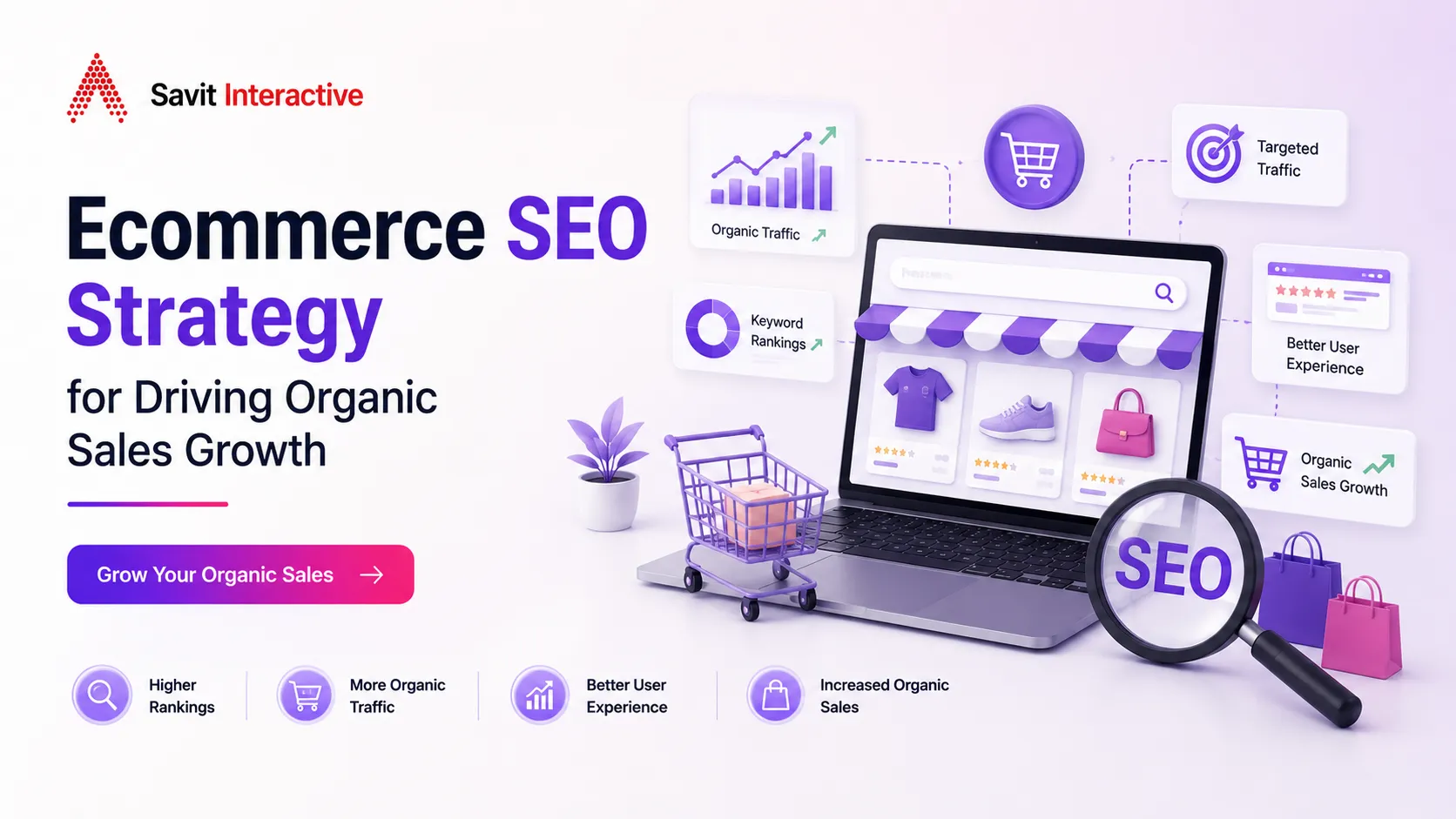
Ecommerce SEO works when every layer supports the next. Technical structure gives search engines something they can read. Keywords bring the right people to the right pages. Product and category optimisation gives those people a reason to buy. Speed keeps them from leaving before they get the chance. Trust signals remove the last hesitation. And measurement tells you whether all of it is actually producing revenue or just producing reports.
Skip a layer and the system underperforms. Build them together and organic search becomes one of the most durable, cost-efficient revenue channels an online store can have.
At Savit, our e commerce SEO services are shaped around the specific store, not a standard package applied to every client. We work across Shopify, WooCommerce, Magento, BigCommerce, and custom-built platforms. Every engagement starts with a technical audit before we touch content or keywords, because there is no point optimising pages that search engines cannot properly find. Whether that means structural remediation for a catalogue with thousands of SKUs, a full product and category keyword strategy for a growing store, or ongoing optimisation as the range expands, we build around what the business actually needs. As an e commerce SEO agency with experience spanning retail, fashion, electronics, and B2B distribution, we connect organic visibility to revenue outcomes, not vanity metrics.
If you are looking for a expert ecommerce SEO consultant or an experienced ecommerce SEO specialist to build organic sales growth that compounds, get in touch with us. We will start with a clear picture of where the store stands and map out a structured plan from there.