Key Highlights
- GEO is the practice of structuring content so AI engines like ChatGPT, Perplexity, and Google AI Overviews cite and recommend your brand. If you are not being cited, you are invisible in the fastest-growing search channel.
- The Princeton KDD 2024 study found that adding statistics to content improved AI citation rates by up to 40%. It is the only peer-reviewed GEO research, and most existing guides barely scratch what it actually found.
- GEO does not replace SEO. 80% of GEO is good fundamental SEO. The remaining 20%, citation-ready structure, sourced claims, entity clarity, is what separates cited brands from invisible ones.
- Two tactics the Princeton study found harmful: keyword stuffing and authoritative tone without substance. Shortcuts do not work here.
- Gartner projects a 25% drop in traditional organic traffic by 2026 as AI channels absorb search demand. Businesses with no GEO strategy are already losing ground.
- A practical GEO strategy starts with content depth, structured data, cross-platform brand consistency, and measuring citations alongside rankings.
When someone asks ChatGPT for the best supply chain software in the UAE, or Perplexity for a list of trusted financial advisers in Dubai, or Google’s AI Overview for a comparison of coworking spaces, the answer is not a list of ten blue links. It is a synthesised response, drawn from a handful of sources, with citations. If your brand is not among those cited sources, you are invisible in the fastest-growing discovery channel in search.
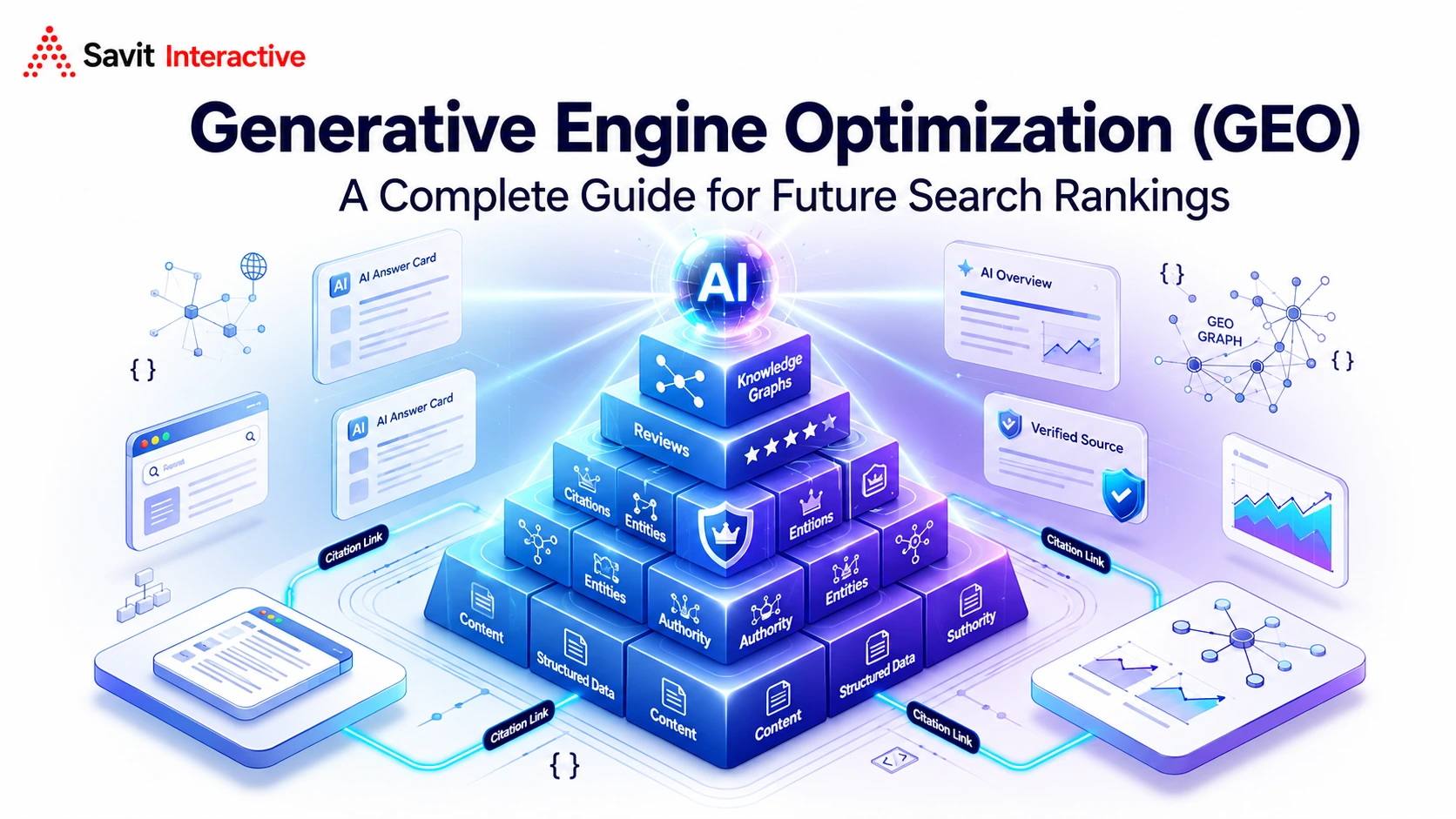
Generative engine optimization is the practice of structuring your content and digital presence so that AI-powered search platforms (ChatGPT, Perplexity, Google AI Overviews, Gemini, Claude) can retrieve, cite, and recommend your brand when answering user queries. The term was first introduced in a 2023 Princeton University research paper and formalised at the KDD 2024 conference.
This is not a future concern. ChatGPT now has over 800 million weekly active users, according to data reported by TechCrunch and confirmed by OpenAI.² Gartner projects that traditional organic search traffic will decline 25% by 2026 as consumers shift discovery to AI channels.³ For businesses in the UAE, where search competition is already intense, AI search engine optimization and GEO are becoming essential layers of any serious digital strategy.
This guide explains what GEO is, how it differs from traditional SEO, what the research says about which tactics actually move citation rates, and how to build a practical generative engine optimization strategy for your business.
How Does GEO Differ from Traditional SEO and Answer Engine Optimisation?
LLM Pulse’s 2026 GEO guide offers a useful framing: “SEO ranks you. AEO selects you. GEO cites and recommends you.”⁴ That single line captures the distinction, but the detail matters.
| Discipline | Goal | Where It Matters | How AI Uses Your Content |
| SEO | Rank in traditional search results | Google organic listings | Crawls and indexes your page |
| AEO (Answer Engine Optimisation) | Get selected for direct answers | Featured snippets, voice search, People Also Ask | Extracts a concise answer block |
| GEO (Generative Engine Optimisation) | Get cited in AI-generated answers | ChatGPT, Perplexity, Gemini, Google AI Overviews | Synthesises your content into a response and attributes it |
The critical point: GEO does not replace SEO. Mersel AI’s 2026 framework cites Jeremy Moser (CEO of uSERP), who puts it bluntly: “80% of GEO is good, fundamental SEO.”⁵ The data backs this up. According to Mersel AI’s analysis, 87% of ChatGPT citations match Bing’s top-10 results, and 93.67% of Google AI Overview citations link to at least one top-10 organic result.⁵
So if your pages do not rank well in traditional search, they are unlikely to be cited by AI engines either. GEO optimization adds a citation-earning layer on top of that SEO foundation. The remaining 20% is what this guide focuses on: the specific structural, sourcing, and entity-level changes that make content citable by generative AI optimization platforms.
The budget split reflects this shift. LLM Pulse projects that GEO will take 40% or more of enterprise SEO budgets by 2027.⁴ For businesses already investing in answer engine optimization and SEO, GEO is the next logical step, not a replacement for either.
What Makes Content More Likely to Be Cited by AI Engines?
This is where most GEO guides rely on agency opinion. This section relies on the only peer-reviewed research that exists.
The Princeton GEO Study (KDD 2024)
The foundational research in this field was published by a team from Princeton University, IIT Delhi, Georgia Tech, and the Allen Institute for AI. They tested 9 content modification tactics across 10,000 queries using GEO-bench, the first standardised benchmark for measuring AI citation rates.¹ The study did not test on one AI engine; it built a generative engine modelled on Bing Chat, then validated the strongest findings on Perplexity as a real-world check.
Here is what they found, ranked by impact.
What Worked
1. Statistics Addition (+30% to +41% citation improvement)
Adding specific, verifiable data points had the single largest impact on AI citation rates. SeenRank’s breakdown of the Princeton study reports a +41% improvement when vague claims like “many studies show…” were replaced with concrete numbers like “a 2022 meta-analysis of 47 studies found…”⁶
Why this works: AI engines are trained to extract factual, verifiable claims. A paragraph with a named source and a specific number gives the system a discrete, attributable claim it can cite with confidence.
2. Quotation Addition (+28% citation improvement)
Including direct quotes from named experts or recognised sources improved citation rates by approximately 28%, according to SeenRank’s analysis.⁶ Like statistics, quotes give the AI engine a discrete, attributable statement it can include in its synthesised response.
3. Cite Sources (+31.4% when combined with other tactics)
Adding authoritative citations within the content was especially powerful as a multiplier. The GEO Community’s detailed analysis of the Princeton findings shows that when source citations were combined with other methods, the average improvement reached +31.4%.⁷ On its own, the tactic was moderate. Combined with statistics or quotations, it amplified everything.
4. Fluency Optimisation + Accessibility (+15% to +30%)
Well-written, accessible content showed meaningful gains. AI systems reward clarity, not complexity. The GEO Community’s analysis notes that the single best-performing combination in the entire study was Fluency Optimisation + Statistics Addition, which outperformed any individual tactic by more than 5.5%.
What Did Not Work
Keyword stuffing: Produced no improvement and, in some cases, actively reduced citation rates. SeenRank’s analysis confirms this was one of two tactics the Princeton team found harmful.⁶
Authoritative tone alone: Writing confidently without substantive backing showed no significant improvement across the full benchmark. The GEO Community notes that AI engines appeared “somewhat robust” to persuasive writing styles. They evaluate the substance of the content, not how assertively it is written.
What This Means for Businesses
Your content needs to be specific, sourced, and clear. If a paragraph makes a claim, it should include a named source, a verifiable number, or a direct quote from a credible authority. This is not about academic formatting. It is about making your content trustworthy enough for an AI system to confidently cite as a source.
For businesses in the UAE, the commercial implication is direct. When a buyer asks ChatGPT or Google’s AI Overview to recommend a provider in a specific category, the AI synthesises its answer from the 2 to 7 sources it trusts most. GEO marketing requires this content quality shift. There is no way around it.
This is the core of what makes AI search engine optimization different from traditional keyword-focused SEO. The signals that matter are specificity, source attribution, and structural clarity, not keyword density or content volume.
How to Build a Generative Engine Optimization Strategy
The research gives us the “what.” This section covers the “how.” A practical generative engine optimization strategy covers four areas.
1. Content Structure: Make Your Pages Citation-Ready
Lead every section with a direct, factual answer in the first one to two sentences. AI engines extract discrete claims; if the answer is buried in paragraph four, it will not be cited.
Include 2 to 3 statistics per page with named sources. The Princeton study proved this is the single highest-impact tactic.¹ Use subheadings that match how users ask questions. “What is the average cost of SEO in Dubai?” is far more extractable than “Pricing Considerations.”
2. Structured Data: Make Your Information Machine-Readable
Implement schema markup across your site: Article, FAQ, HowTo, Product, Organisation, and LocalBusiness are the baseline types.
Structured data helps AI engines confidently interpret what your page contains. Without it, your content may be accurate but functionally invisible because the AI system cannot parse it efficiently. Think of schema as a translation layer between your content and the machines trying to read it.
3. Entity and Brand Consistency: Be Recognisable Across Platforms
AI engines analyse authority from a holistic perspective. Having consistent information on your website, review platforms, Google Business Profile, social media, Wikipedia, and industry directories helps cite sources with great ease.
Per the GoodFirms’ 2026 AI SEO Statistics report, if brand profiles are present on review platforms, they stand a 3x higher chance of being cited by AI systems.⁸ For GEO optimization, this means your brand name, services, contact information, and category must be accurate and consistent across every platform where buyers and AI systems look.
In Dubai, this is particularly important. Multiple business directories, bilingual (English and Arabic) listings, and industry-specific platforms all need to carry the same information. Inconsistency creates ambiguity, and AI systems avoid ambiguity when choosing which brands to cite.
4. Measurement: Track Citations, Not Just Rankings
Growing up in SEO, ranking keywords would be a primary focus, but GEO marketing opens the door to additional measures. KPIs include AI citation frequency, brand mention share across AI platforms, and branded query growth.
Major platforms like Semrush and Ahrefs, as well as specialised tools, now include AI citation tracking. This change in measuring generative AI optimization moves from “are we ranking?” to “are we being recommended?”. If your reports today consist of keyword positions and organic sessions only, then you may not be aware of the new avenues of buyer discovery where people are finding you.
Why GEO Matters Now, Not Later
Generative engine optimization is no longer a future discipline. It is already here. AI engines are not only answering buyer questions but also referencing sources. Those references mean that there is a benefit for the brands in them: not only are they gaining trust but also traffic, something that can no longer be solely ensured by regular rankings.
The research is clear. Content with verifiable statistics, named sources, clear structure, and consistent brand signals is what AI systems cite. Content built on keyword volume and generic copy is what they skip. For businesses in the UAE, a deliberate generative engine optimization strategy is the next layer of visibility.
How Savit Ensures Your Brand Gets Cited by AI
At Savit, we have been building GEO into our SEO methodology since AI-generated search became a real channel. With over 20+ years of search expertise, we recognised early that visibility in AI platforms required a different set of optimisations layered on top of the SEO fundamentals we already deliver.
Our generative engine optimization services in Dubai span every element, including schema markup, implementing structured data, re-structuring content for AI citation ready status, entity and brand authority on social media, building features in SERPs, targeting voice search, as well as AI citation reporting and tracking. Our services always tailor themselves to the business’s vertical, the nature of competition, and their end consumer.
Our GEO marketing approach combines SEO, answer engine optimization, and GEO into one integrated strategy. We ensure your brand is found in traditional search, selected for direct answers, and cited and recommended by the AI platforms where buyers increasingly research.
As part of our broader AI search engine optimization services, generative AI optimization is how we make sure your business stays visible as the way people search continues to evolve.
If you want to understand how your brand currently appears across AI search platforms and where the gaps are, talk to our GEO team for a free visibility audit.