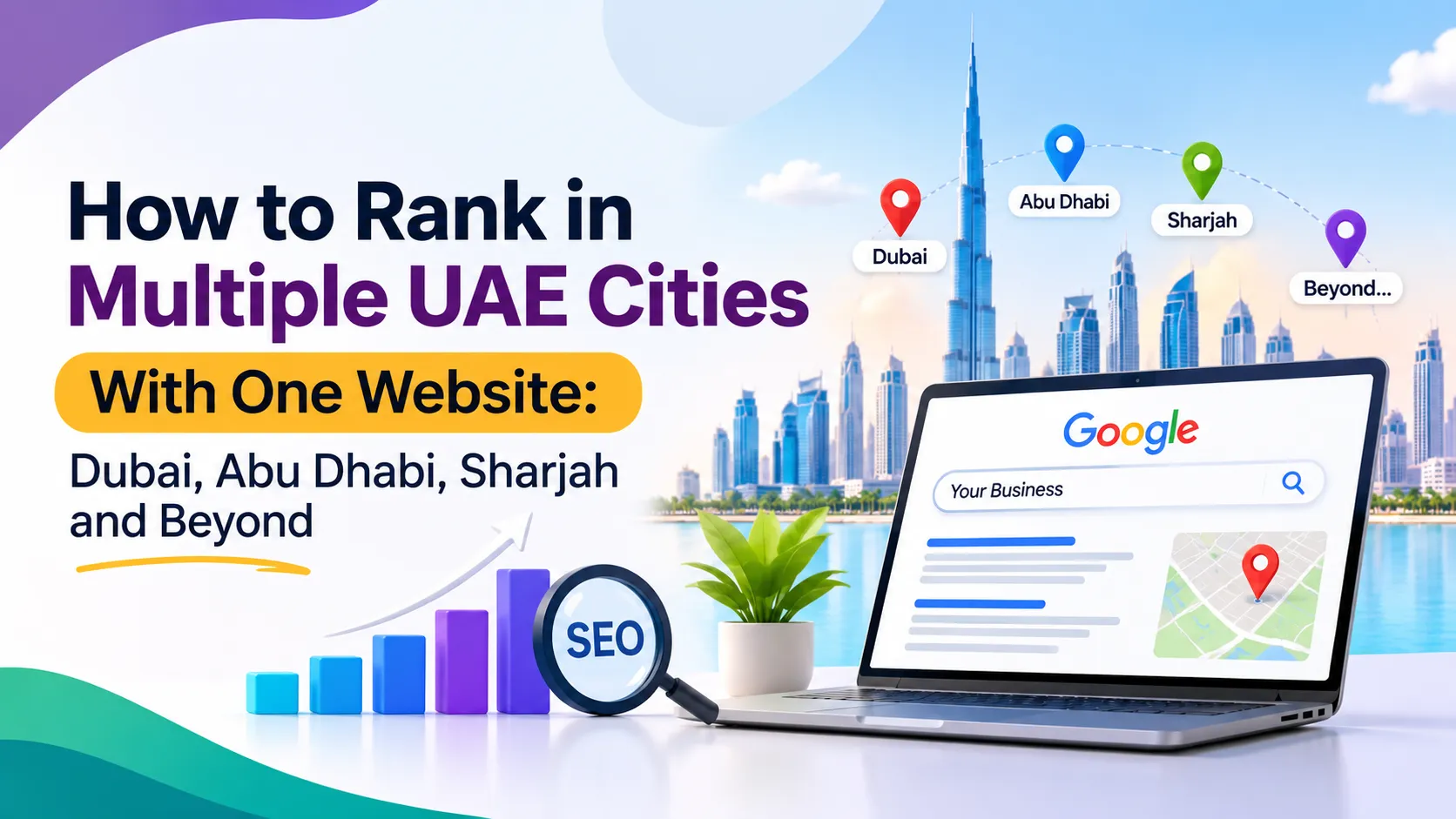
There are three ways to chase visibility across the Emirates from a single site, and one of them is named in Google’s spam policies.
Key Highlights
- Google defines doorway abuse to include pages targeted at specific regions or cities that funnel users to one page.
- A service-area business gets one profile, not one per city, and may list up to 20 service areas.
- Service areas cannot be set as a radius, and the whole area should not extend more than about two hours of driving time from base.
- Every UAE business must have a physical address to operate, and licensing runs through a separate authority in each emirate.
- Bulk verification of Google profiles needs ten or more locations from the same business, and service-area businesses are excluded from it.
- A business with no permanent on-site signage is not eligible as a shop front and must be listed as a service-area business.
- Google can de-verify accounts that stop actively managing their profiles.
Three Routes, and Only Two of Them Are Safe
The first route is a page for every city, built from one template with the place name swapped. It is quick, it is cheap, and it is the approach Google describes in its spam policies as doorway abuse. The policy language is specific: doorway abuse covers “having multiple domain names or pages targeted at specific regions or cities that funnel users to one page.” If your Sharjah page and your Ajman page differ only by a noun and both push the same enquiry form, that is the pattern being described.
The second route is service areas, which is the mechanism Google actually built for a business that travels to customers. One profile covers the whole area you serve, and the published rules are tight enough to plan around. The third is a genuine physical presence in each emirate, which works well and costs considerably more than either of the others, because in the UAE a second location is a licensing matter before it is a marketing one. Choosing between the three is the first real decision in local search engine optimisation here. Most briefs that reach a local SEO company in Dubai asking for “pages for all seven emirates” are really asking which of these three the business can honestly support.
Can One Site Rank in Dubai and Abu Dhabi at Once?
Yes, with a caveat that decides everything that follows. One website can rank across several emirates, and plenty do. What one website cannot do is manufacture a local presence it does not have, because the local results that matter for “near me” searches are driven by a Business Profile, and a Business Profile needs a real address.
That is the split worth holding onto. Organic results for a query like “accounting services Abu Dhabi” are winnable from a Dubai-based site with a genuinely useful page about accounting in Abu Dhabi. The map pack for the same query is far harder, because distance from the searcher is a factor you cannot write your way around. Good local SEO services separate those two ambitions in the proposal rather than quoting one price for both.
So the honest answer to a client asking for both is that organic city visibility is a content and relevance problem, while map visibility is a presence problem. The first is work. The second is a business decision about whether to open somewhere.
Where the City-Page Shortcut Becomes a Policy Problem
Google’s spam policies name two patterns that location pages fall into when they are produced carelessly. Doorway abuse, as quoted above, covers city-targeted pages that funnel users to one destination. Scaled content abuse covers pages “generated for the primary purpose of manipulating search rankings,” with one listed example being pages where the content “makes little or no sense to a reader but contains search keywords.”
Neither policy forbids city pages. What they describe is city pages with nothing in them. The test a page has to pass is whether a person in Sharjah would find it more useful than the generic service page, and if the only Sharjah-specific words on it are in the title and the heading, the answer is no. That is also, incidentally, why so many local SEO services in Dubai proposals promising forty location pages in month one should be read sceptically.
Google also warns against “creating substantially similar pages that are closer to search results than a clearly defined, browseable hierarchy.” A city page that is really a filtered list with no editorial substance sits inside that description, which is a useful way to audit what you already have.
Service Areas, and the Rules Google Publishes
For a business that travels to customers, service areas are the sanctioned route, and Google documents the limits precisely enough that there is nothing to guess at.
You can set up to 20 service areas, defined by cities, postcodes or other area types. You cannot set a service area as a radius distance around your business. The whole area should not extend more than about two hours of driving time from where the business is based, which in practice covers a great deal of the UAE from a single Dubai base but will not stretch credibly to every emirate for every trade.
Two distinctions change how your profile should be configured. A service-area business visits or delivers to customers and does not serve them at its own address, and Google states it can have only one profile covering its whole service area. A hybrid business serves customers at its address and also travels, so it can show its shop front address, set staff availability hours and hold a service area at the same time. One rule catches people out: a business without permanent on-site signage is not eligible as a shop front and should be listed as a service-area business, with the address removed from the profile if customers are not served there.
Do You Need a Licence in Every Emirate?
This is the part a generic local SEO guide leaves out, and in the UAE it is the constraint that decides the strategy. Government guidance is unambiguous that all businesses in the UAE must have a physical address to operate, and licensing is handled emirate by emirate rather than nationally.
The authorities differ by emirate: the Department of Economic Development in Abu Dhabi, the Department of Economy and Tourism in Dubai, the Economic Development Department in Sharjah, departments of economic development in Ajman, Umm Al Quwain and Ras Al Khaimah, and Fujairah Municipality in Fujairah. Premises must satisfy both the emirate’s economic department and the local municipality’s land planning rules, a rental agreement for an office or warehouse must be provided, and Dubai also requiring the lease to be registered with Ejari, with a lease contract attested by the Real Estate Regulatory Agency required for the licence.
Read against Google’s rules, that produces a clear sequence. A second Business Profile needs a real address in that emirate, a real address needs a registered lease, and a registered lease follows a licence from that emirate’s authority. Any local SEO agency in Dubai that offers to create profiles for emirates where you hold no licence and no premises is proposing something that will not survive verification, and a suspended profile costs more than the rankings it was chasing.
Which Route Fits Which Business?
The decision usually makes itself once the business model is on the table rather than the keyword list.
| Business type | Route that fits | What it needs |
| Mobile services, no customer visits | One service-area profile, up to 20 areas | Address removed from the profile, areas within about two hours’ drive |
| Shop or clinic plus home visits | Hybrid profile | Permanent signage, staff hours, service areas alongside the address |
| Genuine branch in another emirate | A separate profile per location | A licence and registered lease in that emirate |
| Single base, wide organic ambition | Substantive city pages, no extra profile | Real local content per page, honest expectations on the map pack |
| Ten or more real locations | Bulk verification through a business group | A spreadsheet covering every profile managed |
| No signage, no licence elsewhere | Service areas only | Acceptance that the map pack in other emirates is out of reach |
Local search engine optimisation gets simpler once the row is settled, so pick the one that describes the business as it is today rather than as it is planned to be, and treat any affordable local SEO agency that skips this step as quoting for the wrong job. A local SEO company in Dubai worth its fee will tell you which row you are in before discussing packages, because the row determines what can be promised. That single habit separates the best local SEO company in Dubai from the one with the longest deliverables list.
Managing Branches Without Losing Control
For a business with several real locations, the mechanics are documented and worth following exactly. Profiles are organised into business groups, and when the main owner of a group is verified, all eligible profiles in that group are verified too, provided none is owned by someone else.
Bulk verification has a threshold and several exclusions. It requires a spreadsheet of ten or more profiles from the same business, and duplicate, suspended or disabled profiles do not count towards that minimum. Agencies holding more than one business in a single account cannot bulk verify. Service-area businesses are not eligible for it at all. Uploading the spreadsheet does not itself submit a verification request, which has to be sent separately, and Google notes that you may be required to provide evidence if your chain size differs from the number of profiles in the account.
What many businesses still file mentally under local SEO Google My Business is now profile maintenance under a different name, and two ongoing obligations deserve a place in whoever’s job description owns it. Google may de-verify accounts that do not actively manage their profiles, and it revokes bulk verification where it finds abuse. The practical reading is that multi-location listings are a maintenance commitment rather than a setup task, which is the honest case for buying local SEO marketing services rather than treating the work as a one-off project.
What Makes a City Page Worth Publishing?
Something a person in that city could not get from your main service page. That is the whole bar, and it is higher than a find-and-replace.
Named local specifics: The communities, free zones or industrial areas you actually serve, the travel time from your base, the parking or access situation if customers visit.
Real local proof: Projects completed in that emirate, named where the client permits it, with the detail that makes them checkable.
Local operational facts: Which days your team is in that emirate, how quickly you can reach it, whether you hold the licences that particular work requires there.
Pricing or packaging differences: If a callout to Ras Al Khaimah costs more than one to Deira, say so rather than leaving it to a phone call.
Language appropriate to the audience: Arabic alongside English where the customer base expects it, on its own crawlable URL rather than swapped in at the same address.
A page with four of those five is a legitimate location page. A page with none of them is the thing Google’s policy describes, whatever it is called internally. This is also where the gap shows between local SEO packages in Dubai sold by page count and work sold by outcome, because the first rewards volume and the second rewards substance.
A Twelve-Week Build for Multi-City Visibility
Sequence it so the expensive decisions come after the cheap diagnosis.
Weeks one to three, establish what you can legitimately claim: List the emirates where you hold a licence and premises, confirm whether you are a service-area, hybrid or shop front business under Google’s definitions, and check whether permanent signage exists at each address. Decide the route before writing anything.
Weeks four to six, configure the profile correctly: Set service areas by city or postcode within the two-hour guidance, remove the address if customers are not served there, and complete categories, hours and attributes. For multi-location businesses, organise profiles into a business group and establish who maintains them.
Weeks seven to ten, build only the pages you can fill: Write city pages for the emirates where you have genuine local substance, and leave the others until you do. Three strong pages outperform nine thin ones, and they carry no policy risk.
Weeks eleven to twelve, baseline and review: Record profile performance per location and organic impressions per city query before judging anything. Treat those windows as a working order rather than a promise, since premises, licensing timelines and the amount of genuine local material available will all stretch or compress them.
How Should You Measure Multi-City Performance?
Per location and per query, never as one national total. A single organic traffic line across all emirates hides the thing you are trying to learn, which is whether Abu Dhabi is working at all.
Separate the two ambitions in the report. Organic performance for city queries is one line, measured on impressions and average position for terms carrying the place name. Profile performance is a second line, measured per location on calls, direction requests and messages. They move at different speeds and respond to different work, and merging them is how a programme that is half working gets judged as entirely broken.
Then allow for the honest ceiling, which is the least popular sentence in any local search engine optimisation report. Where you hold no premises in an emirate, map pack visibility there is largely out of reach, and a report that keeps measuring it is measuring a decision rather than a performance. The best local SEO services set that expectation in the first month, which is less satisfying than a dashboard promising everything and considerably more useful by month six.
The Honest Limits of One Website in Seven Emirates
One website can carry genuine visibility across the UAE, and the ceiling is set by presence rather than by effort. Organic city visibility is earned with real local content. Map pack visibility follows a licence, a lease and an address. Any plan that blurs those two is selling the easier half and charging for both, whichever local SEO company in Dubai puts it in front of you.
At Savit Interactive UAE, we start multi-city briefs by mapping what the business can legitimately claim before anyone writes a page, because a suspended profile undoes a quarter of work in an afternoon. Our UAE operation runs from Meydan in Dubai through the registered entity Astra Marketing LLC FZ, working with businesses in Abu Dhabi, Sharjah, Ajman and Ras Al Khaimah and supporting clients expanding into Saudi Arabia, Qatar, Oman, Bahrain and Kuwait. With over 5,000 clients worldwide and a 4.6 Google rating behind the group, our preference is to tell a client that three emirates are realistic this year and the fourth needs an office, rather than to bill for seven city pages that will not hold.
Footnotes and References
[1] Google Search Central. “Spam policies for Google web search.” Google defines doorway abuse to include having multiple domain names or pages targeted at specific regions or cities that funnel users to one page, and defines scaled content abuse as many pages generated for the primary purpose of manipulating search rankings.
[2] Google Business Profile Help. “Manage your service areas for service-area and hybrid businesses.” Google states that up to 20 service areas can be set by city or postcode, that a service area cannot be defined as a radius, that the area should not extend more than about two hours of driving time from the business, and that a business without permanent on-site signage is not eligible as a shop front.
[3] Google Business Profile Help. “Verify multiple locations.” Google sets a minimum of ten or more profiles from the same business for bulk verification, excludes service-area businesses, notes that uploading a spreadsheet does not send a verification request, and states that accounts which do not actively manage their profiles may be de-verified.
[4] The United Arab Emirates Government portal, u.ae. “Steps to start a business on the mainland.” The portal states that all businesses in the UAE must have a physical address to operate, names the licensing authority for each emirate, and sets out the rental agreement requirements including registration with Ejari in Dubai.