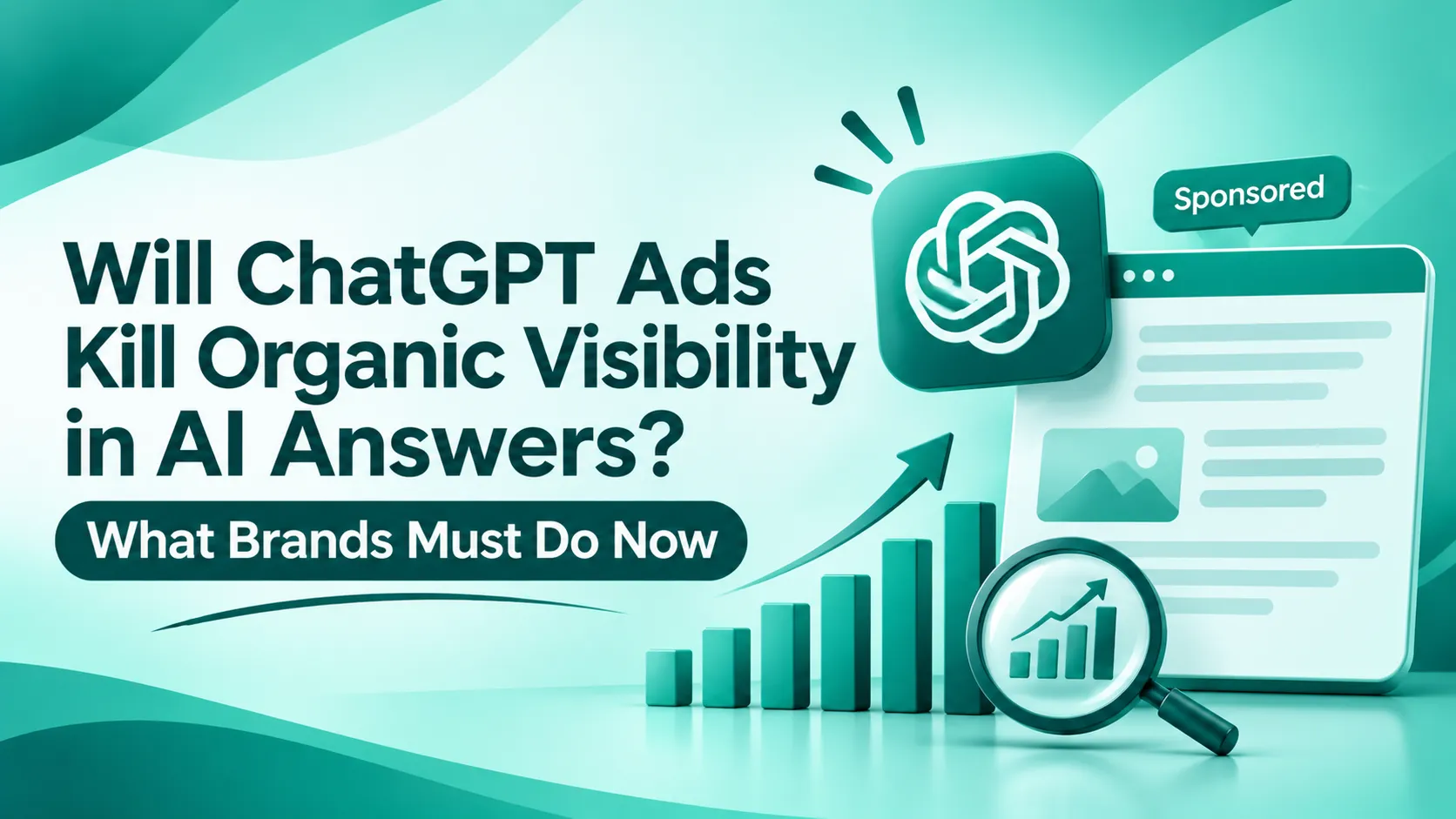
The short answer is no, and the longer answer is less comfortable than the headline suggests, because the real squeeze is not placement but measurement.
Key Highlights
- OpenAI states plainly that advertising does not influence the answers ChatGPT provides, and that ads are labelled and kept separate from them.
- ChatGPT ads are shown to logged-in adults on the Free and Go tiers, while Plus, Pro, Business, Enterprise and Education accounts see none.
- Self-service buying through OpenAI’s Ads Manager began rolling out to India, Europe, the Middle East and North Africa on 31 August 2026.
- Google ads can appear above, below or within AI Overviews, and advertisers can neither opt out nor target that placement directly.
- Ads within AI Overviews run in English in twelve named markets, and the United Arab Emirates is not one of them.
- Google says it does not currently offer segmented reporting for ads shown within Search AI Overviews.
- Blocking OAI-SearchBot removes a site from ChatGPT’s search answers, which makes it the single organic lever fully under your control.
What OpenAI Actually Built, and What It Deliberately Left Alone
OpenAI began testing ads inside ChatGPT on 9 February 2026, starting in the United States with logged-in adult users on the Free and Go tiers. Paying tiers were excluded from the start: Plus, Pro, Business, Enterprise and Education accounts see no ads at all. Free users who would rather not see them can opt out in exchange for fewer daily messages. Later updates extended the pilot to Canada, Australia and New Zealand, then to the United Kingdom, Mexico, Brazil, Japan and South Korea.
Two design decisions matter more than the rollout. The first is that ads are matched to the topic of the conversation, to past chats, and to past interactions with ads, with memory listed as a factor, and the most relevant advertiser shown first where several qualify. The second is the separation: ads are, in OpenAI’s words, clearly labelled as sponsored and visually separated from the organic answer.
What OpenAI left alone is the answer itself. It states that ads do not influence the answers ChatGPT gives, repeated in its August announcement as advertising not influencing the answers ChatGPT provides. Any PPC advertising company promising to change what a model says about a brand by buying inventory is describing a product that does not exist on this platform.
Sponsored Answers Are Not the Same as Sponsored Links
The distinction is actually pretty important because it changes what you’re asking for in the first place. Anyone planning PPC advertising in Dubai around these surfaces needs to be clear on this before putting together the media plan, not after. A sponsored link basically sits alongside the answer and tries to win the click. A sponsored answer would be something quite different- the system recommending you because you paid for that recommendation. Neither OpenAI nor Google currently sells that kind of placement.
Google’s position is structurally similar but mechanically different. Ads can show above, below or within AI Overviews, and ads appearing within an overview are reported as Top Ads. They are matched using both the user’s query and the content of the AI Overview itself, and they must be relevant to that content. So the overview’s substance shapes which ads qualify, while the ads do not shape the overview.
That’s really the honest version of the threat, and it’s a lot narrower than what you’ll hear in plenty of pitches from a PPC agency in Dubai. Nobody is paying their way into the recommendation itself. What they’re actually buying is the space around it. And when the answers are long and the screen is small, that space is simply harder to come by than it was on a traditional search results page.
Can an Advertiser Buy a Place in the Answer Itself?
Not according to either platform’s documentation, and the mechanism explains why. On the Google side, eligibility runs through the existing auction: text, Shopping, local and app ads from Search, Shopping, Performance Max and App campaigns can serve above or below an overview, and text and Shopping ads from Search, Shopping and Performance Max campaigns can serve within one. Existing campaigns are automatically eligible when they win the auction and address both the query and the overview’s information.
On the ChatGPT side there is a quieter detail with real consequences. OpenAI documents a separate crawler, OAI-AdsBot, which checks the safety of landing pages submitted as ads and may use the content of those pages to decide when an ad is relevant. It visits only pages submitted as ads, and its data is not used to train foundation models.
Read that twice if you run paid search. Your landing page copy is now an input into whether your ChatGPT ad is considered relevant to a conversation, which means the page is no longer only a conversion asset. For anyone comparing pay per click advertising companies this year, the question of who writes the landing page and who writes the ad has stopped being a division of labour and become a single brief.
Google Quietly Removed the Opt-Out
This is the part that catches advertisers who assume placement is a choice. Google states that advertisers cannot opt out of serving ads in AI Overviews, and cannot directly target AI Overview placements either.
No opt-out: If you run eligible Search, Shopping or Performance Max campaigns, your ads can appear in these surfaces whether or not that was the plan.
No direct targeting: You cannot build a campaign that buys only this placement, so the usual lever of isolating a placement to test it is unavailable.
Broad matching encouraged: Google recommends broad match or keywordless targeting, such as AI Max for Search, to catch the longer queries these surfaces attract.
Sensitive verticals excluded: Adult, alcohol, gambling, finance, healthcare and political categories are excluded from serving within overviews.
That is an awkward brief for PPC services in Dubai sold on placement control, because the control being sold does not exist on this surface. The practical effect is that control has moved from the media buyer to the creative and the landing page. When you cannot choose the placement or exclude it, the only remaining levers are relevance and quality, which is where any serious pay per click advertising in Dubai conversation should now start rather than finish.
Does a Paid Slot Push Organic Citations Further Down?
On the screen, yes. But that’s really a layout issue, not some kind of ranking penalty. If there’s an ad sitting above an answer and another one below it, there’s simply less room for the links and citations around that answer, especially on a phone. The citation hasn’t been pushed down in the rankings. There’s just more stuff crowding it.
The bigger headache comes when you try to measure what actually happened. Someone might read an AI answer, notice a sponsored listing, and then come back later through a branded search and convert. Your reports will probably count that as branded demand, with no obvious sign that the AI surface played a part. If that person clicks an organic citation instead, at least you get a referrer to work with.
So, really, paid placement on AI surfaces probably isn’t going to kill organic visibility. The bigger problem is figuring out where the traffic actually came from. PPC companies in Dubai that keep paid and organic completely separate in their reports can end up with numbers that look nice and tidy, but still miss a pretty important part of the story.
Who Gets Cited Once the Space Above Is Sold
The organic half of the question has a clearer answer than the industry pretends, because Google published guidance on it in May 2026 and it is unusually blunt.
Google’s position is that optimising for generative AI features is still search engine optimisation, and that the acronyms being sold around it describe the same discipline. It dismisses several of the tactics built on the opposite assumption: llms.txt files, breaking content into chunks for machines, rewriting pages with AI to make them more quotable, AI-specific structured data, and manufactured brand mentions placed to be picked up.
What you’re left with is pretty unglamorous, but it holds up. Pages that crawlers can actually reach, content that answers the question it says it will answer, information that’s accurate and can be backed up, and a website whose technical setup isn’t getting in the way. If that sounds almost exactly like the advice from five years ago, well, that’s kind of the point Google is making.
The Robots Rules That Decide Whether ChatGPT Can See You
Here the controls are specific, published and frequently misconfigured. OpenAI documents four crawlers with independent settings.
| Crawler | What it does | Effect of blocking it |
| OAI-SearchBot | Surfaces websites in ChatGPT’s search features | Site will not be shown in ChatGPT search answers, though it can still appear as a navigational link |
| GPTBot | Crawls content that may train OpenAI’s foundation models | Signals that content should not be used for training |
| OAI-AdsBot | Checks the safety of submitted ad landing pages and may use their content to judge ad relevance | Not documented by OpenAI |
| ChatGPT-User | Handles user-initiated visits and app actions | Not used to decide whether content appears in search, and robots.txt rules may not apply |
Two points deserve emphasis. OpenAI recommends allowing OAI-SearchBot and its published IP ranges, and a robots.txt change takes roughly 24 hours to show up in search behaviour. And because the settings are independent, a site can allow OAI-SearchBot for visibility while disallowing GPTBot for training, which is the configuration most UAE businesses actually want and few have in place.
Three Numbers No Platform Will Give You This Year
Before signing a retainer that promises AI visibility reporting, know what cannot be reported.
Placement-level spend in AI Overviews: Google states it does not currently offer segmented reporting when ads show within Search AI Overviews, and says more will be announced later.
Conversation-level data from ChatGPT: Advertisers do not see chats, chat history, memories or personal details. They receive aggregate performance data such as views and clicks.
Share of voice inside an answer: No platform publishes how often a brand is named in generated answers, so every tool offering this figure is sampling prompts and estimating.
A proposal that reports all three with confidence is reporting a model, not a measurement. That is not automatically useless, as long as the deck says which it is.
Where Gulf Advertisers Stand in November 2026
Availability is where UAE planning diverges sharply from the global commentary, so it is worth being precise about each surface.
Ads above or below AI Overviews are available in all 200 plus markets where AI Overviews run, so a Dubai advertiser is already in that pool. Ads within AI Overviews are a different matter: Google lists them as running in English on mobile and desktop in Australia, Canada, India, Indonesia, Kenya, Malaysia, New Zealand, Nigeria, Pakistan, Philippines, Singapore and the United States. The UAE does not appear on that list.
For ChatGPT, OpenAI said on 31 August 2026 that ChatGPT Ads had reached a one billion dollar annualised revenue run rate, was available in more than 40 countries through its ads solutions team and partners, and was launching self-service buying through Ads Manager in India, Europe, the Middle East and North Africa. CPC and outcome-optimised bidding account for the majority of campaigns, with a pixel and a conversions API as the measurement tools.
So the realistic position for PPC services in Dubai right now is full access to the surrounding placements on Google, no access to the in-overview placement, and newly opened self-service access on ChatGPT through a regional rollout rather than a country-by-country announcement. Any agency quoting in-overview performance for a UAE account should be asked which market the data came from.
Budgeting for Both Routes to the Same Answer
The temptation is to create a new budget line called AI and fund it from somewhere vague. The more defensible approach treats the answer as one destination with two entrances, one bought and one earned, and asks what each entrance costs to hold.
On the bought side, nothing new needs funding on Google, because eligibility is automatic and the money is already in Search, Shopping and Performance Max. What needs funding is creative and landing page work good enough to win relevance checks you cannot see. On ChatGPT, a genuinely new budget is required, and it should be sized as a test with a defined read-out date rather than as an always-on channel.
On the earned side, the spend is editorial and technical: crawler access, accurate pages, and content that answers questions without being rewritten to flatter a machine. Honest PPC marketing in Dubai will tell a client that this half usually costs less and takes longer, which is why it gets cut first and should not be.
What Would Change on Monday Morning
Five things, in rough order of how little they cost.
Check your robots.txt against the four OpenAI crawlers: Allow OAI-SearchBot, decide GPTBot deliberately, and expect about a day before search behaviour reflects the change.
Read your own landing pages as relevance inputs: If OAI-AdsBot may use that content to judge whether your ad fits a conversation, thin pages are now a media problem.
Stop reporting AI surfaces as a separate channel: Record the ambiguity instead, and note which conversions could have originated in a surface that leaves no referrer.
Size a ChatGPT test, not a ChatGPT strategy: Pick two offers, a fixed budget and a date to decide, given the audience is free-tier and go-tier users rather than your whole market.
Ask every provider which market their AI data describes: The twelve-market list for in-overview ads is the quickest way to find out whether a PPC service in Dubai is quoting its own account data or somebody else’s case study.
Who Should Own AI Visibility, Paid and Organic?
One team, in our view, because the controls now overlap. The landing page that converts paid traffic is also an input into ad relevance on ChatGPT, the robots.txt file that governs training also governs search visibility, and the content that earns a citation is the same content that makes an ad eligible inside an overview. Split that across two suppliers and the gaps appear exactly where the money does.
At Savit Interactive UAE, our AEO and GEO work sits inside the same strategy as SEO and Google Ads rather than beside it as an add-on, which is the arrangement this particular problem requires. Our UAE operations run through Astra Marketing LLC FZ from Meydan in Dubai, with transparent monthly reporting that states plainly which figures are measured and which are modelled, because on AI surfaces that difference is currently the whole argument. If the position across these surfaces is unclear for your own site, our free digital marketing audit is a sensible place to establish it before any budget moves.
Footnotes and References
[1] OpenAI. “Testing ads in ChatGPT.” Published 9 February 2026 with later updates, setting out the Free and Go tier rollout, the exclusion of paying tiers, how ads are matched to conversation topic and past interactions, the sponsored labelling and visual separation from the organic answer, the exclusion of under-18 accounts and sensitive topics, and the statement that ads do not influence the answers ChatGPT gives.
[2] OpenAI. “Expanding access to AI with ChatGPT Ads.” Published 31 August 2026, reporting a one billion dollar annualised revenue run rate, availability in more than 40 countries through its ads solutions team and partners, self-service Ads Manager launching in India, Europe, the Middle East and North Africa, and CPC and outcome-optimised bidding accounting for the majority of campaigns.
[3] OpenAI. “Overview of OpenAI crawlers.” Documentation covering OAI-SearchBot, GPTBot, OAI-AdsBot and ChatGPT-User, the independence of each robots.txt setting, the recommendation to allow OAI-SearchBot, the roughly 24-hour lag after a robots.txt change, and the statement that sites opted out of OAI-SearchBot will not be shown in ChatGPT search answers.
[4] Google Ads Help. “About ads in AI-powered experiences in Google Search.” Google’s documentation that ads can show above, below or within AI Overviews, that advertisers cannot opt out or directly target the placement, which campaign types are eligible, the twelve English-language markets where ads within AI Overviews run, the excluded sensitive verticals, and the absence of segmented reporting for that placement.
[5] Google Search Central. “Optimizing for generative AI features.” Google’s May 2026 guidance that optimising for generative AI features remains search engine optimisation, together with its dismissal of llms.txt files, content chunking, AI rewriting, AI-specific structured data and inauthentic brand mentions as tactics for visibility in these features.