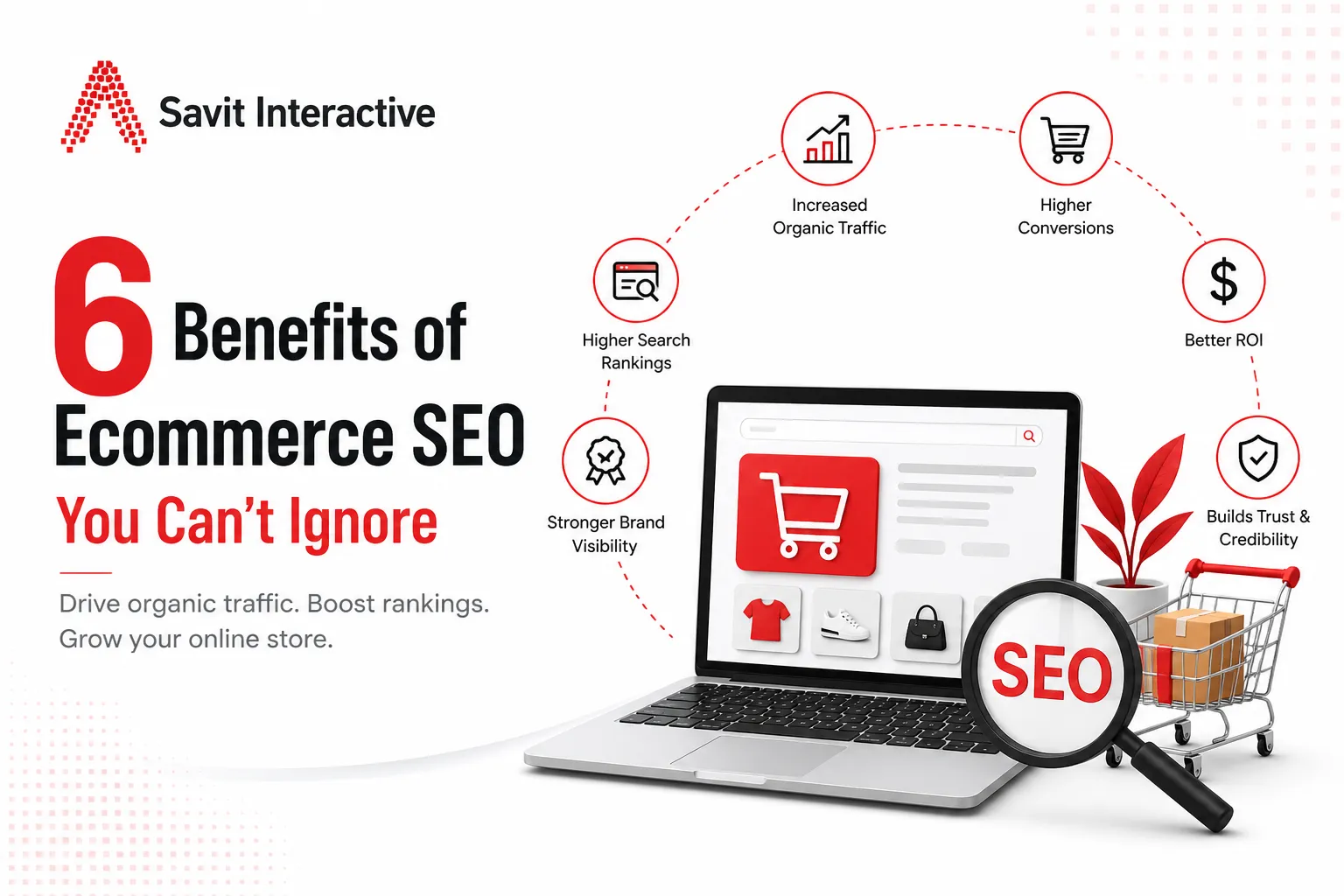
Ecommerce SEO shapes more than traffic; it influences demand quality, conversion efficiency, and long-term growth. Here are six benefits that matter most.
Running an online store today means competing for attention at every turn. More products, more rivals, and advertising costs that keep climbing. The standard response for many store owners is to spend more on paid ads, and that works, until the budget tightens and the traffic disappears overnight.
That is the fundamental problem with building a store entirely on paid acquisition. It costs money every single day to stay visible, and the moment spending stops, so does the traffic. There is no residual value, no asset left behind.
Ecommerce SEO services exist to solve this problem. Done well, search engine optimisation builds a layer of organic visibility that compounds over time, brings in shoppers who are actively looking to buy, and reduces dependence on channels that require constant financial input just to break even.
Here are six benefits that make ecommerce SEO worth prioritising.
1. It Attracts Shoppers Who Are Already Looking to Buy
The gap between paid traffic and organic traffic comes down to one thing: intent.
When someone sees an ad, they were not necessarily looking for your product. It was placed in front of them. When someone types a specific query into Google and clicks through to your store, they came looking. That distinction matters enormously for conversion.
According to the 2026 Charle Agency report, organic search drives 43% of all ecommerce traffic, and organic visitors convert at an average rate of 2.8%, outperforming both social media and email as acquisition channels.
A 2.8% conversion rate may not sound dramatic, but applied across a steady stream of high-intent visitors, it represents significant revenue. And unlike paid traffic, that stream does not switch off when a campaign ends.
2. It Improves the Shopping Experience at the Same Time
Here is something most store owners do not realise when they first look at SEO: optimising for search and improving the shopping experience are largely the same job.
Google tracks how users behave after they land on a page. Pages that load slowly, have unclear navigation, or feel cluttered on mobile receive worse signals, and weaker rankings. So when you work to improve your search performance, you are simultaneously improving how shoppers feel when they browse your store.
The practical work involved in solid ecommerce SEO services – faster load times, cleaner product descriptions, logical category structures, mobile responsiveness – makes the store better for every visitor, whether they arrived through search, social, or a direct link.
The SEO improvement and the user experience improvement happen together. That overlap is where the real value sits.
Why Does Ecommerce SEO Bring Better Customers Than Paid Ads?
This question comes up regularly, and the answer is in how organic search actually filters its traffic.
When a shopper finds a product page through Google’s organic results, a sequence of steps has already happened:
- They typed a specific query that reflected a genuine need
- Google assessed your page as relevant and trustworthy enough to rank
- The shopper chose your result from the options presented
Each step functions as a filter. By the time someone lands on your product page from organic search, they have self-selected to a significant degree. Paid ads bypass those filters entirely; the ad appears regardless of whether the viewer was actively searching for anything related.
23.6% of ecommerce orders come directly from organic search traffic (SeoProfy, 2025). For most stores, that is a meaningful share of total revenue being driven by a channel that does not require daily spend to sustain.
3. It Keeps Delivering After the Budget Stops
A paid campaign stops generating traffic the moment it is paused. A well-optimised product page, on the other hand, can continue ranking and pulling in visitors for months with no additional spend.
This is the compounding nature of ecommerce SEO. Effort invested today accumulates into an asset that grows in value over time. Consider what that looks like in practice:
|
Channel |
What happens when you stop spending |
| Google Ads / Meta Ads | Traffic stops immediately |
| Marketplace listings | Visibility tied to fees and algorithm changes |
| Ecommerce SEO | Rankings and organic traffic persist, with maintenance |
The rankings you build this quarter can still drive revenue next season. The category pages you optimise this year can hold authority across your entire product range as it expands.
Ecommerce SEO does require ongoing attention: strategies need refreshing as search behaviour shifts and competitors catch up. But the foundational traffic it builds is structurally more durable than any paid channel.
4. It Builds Trust Before a Shopper Even Clicks
Appearing on the first page of Google for relevant product searches does something beyond just generating clicks. It signals credibility.
Shoppers have come to associate strong organic rankings with legitimate, established businesses. When your store consistently appears at the top for queries relevant to your products, that visibility tells potential customers something about your standing in the category, before they have read a single line of your copy.
This effect is amplified when SEO is applied with a local focus. A store ranking well for location-specific queries in the UAE, for example, signals relevance to a shopper searching locally, making them more likely to trust and choose that store over a less visible competitor.
Does Ecommerce SEO Actually Cost Less Than Paid Advertising?
Over a short time horizon, paid advertising can look like the cheaper option: results come quickly and the cost-per-click is measurable from day one.
Over time, the comparison shifts.
The cost of paid traffic scales with competition. As more advertisers bid on the same product keywords, cost-per-click rises. Category growth makes the paid channel increasingly expensive to maintain. SEO works differently: the cost of optimising a page is largely fixed, and once a ranking is earned, maintaining visibility does not become more expensive as competition increases.
SEO delivers an 8x return compared to PPC’s 4x return over time, with positive ROI typically achieved within six to twelve months of consistent effort (Charle Agency, 2026).
For a growing ecommerce business, that makes the long-term economics of ecommerce SEO services considerably more favourable than sustaining an ad budget that grows alongside the cost of competition.
5. Does Ecommerce SEO Actually Cost Less Than Paid Advertising?
Many online stores operate partly, or primarily, through third-party marketplaces. These platforms offer reach but extract fees, control the customer relationship, and can alter their rules at any point.
Building strong organic visibility through search gives a store a direct acquisition channel that no platform controls. When a customer finds your product through Google and purchases on your own website, the data, the relationship, and the margin stay with you.
This matters particularly in the UAE and wider GCC market, where marketplace dependency among ecommerce businesses is common. A focused approach to digital marketing in Dubai that prioritises organic search visibility helps brands build and own their customer relationships progressively, rather than remaining permanently reliant on channels they do not control.
It Makes Every Other Marketing Channel Work Better
Ecommerce SEO improvements rarely stay confined to search performance. The work done to optimise a store for organic discovery tends to improve its performance across every channel.
- Faster, cleaner product pages convert better from paid traffic too
- Well-structured category pages improve quality scores in Google Shopping campaigns
- Content built for search gives social media teams material with genuine utility
- Technical improvements in site speed and mobile performance lift the experience for all visitors regardless of how they arrived
This cross-channel effect means that investment in a capable SEO agency or SEO company for an ecommerce store is rarely a narrow decision. The improvements made for search performance raise the floor across the entire business.
What Makes Ecommerce SEO Worth the Wait?
The most common reason ecommerce businesses hold back on SEO is the timeline. Paid ads produce results in days. SEO takes months before meaningful rankings appear, and that wait can feel difficult to justify when short-term targets are pressing.
The answer to this is straightforward: what you are building is an asset, not a campaign.
Every ranking gained, every product page properly optimised, every piece of content published with genuine buyer intent contributes to a growing body of organic visibility. That visibility becomes progressively harder for competitors to displace. It belongs to the business in a way that paid traffic never does.
Paid advertising builds nothing that persists once spending stops. Ecommerce SEO builds something that compounds. The longer and more consistently it is worked on, the more valuable and defensible it becomes.
What Long-Term Ecommerce Growth Requires
Taken together, these six benefits make a clear case. Ecommerce SEO attracts buyers with genuine intent, improves the shopping experience, builds persistent organic traffic, earns brand credibility, lowers long-term acquisition costs, and strengthens every other marketing channel connected to the store.
For any online business serious about sustainable growth, ecommerce SEO services belong at the centre of the strategy, not on the margins.
At Savit, our ecommerce SEO services are designed around what each business actually needs. We do not apply a single template across every store. Whether a client runs a niche product brand, a large catalogue, or a growing ecommerce platform across the UAE, we build the strategy around their specific products, audience, and competitive position. As the best SEO agency in Dubai for ecommerce businesses operating in the region, we focus on the work that builds lasting organic visibility: technical foundations, product page optimisation, keyword strategy, and content that serves real buyers.
If your store is ready to build something more durable than a paid campaign, get in touch with us. Let’s map out what the right ecommerce SEO strategy looks like for your business.