Key Highlights
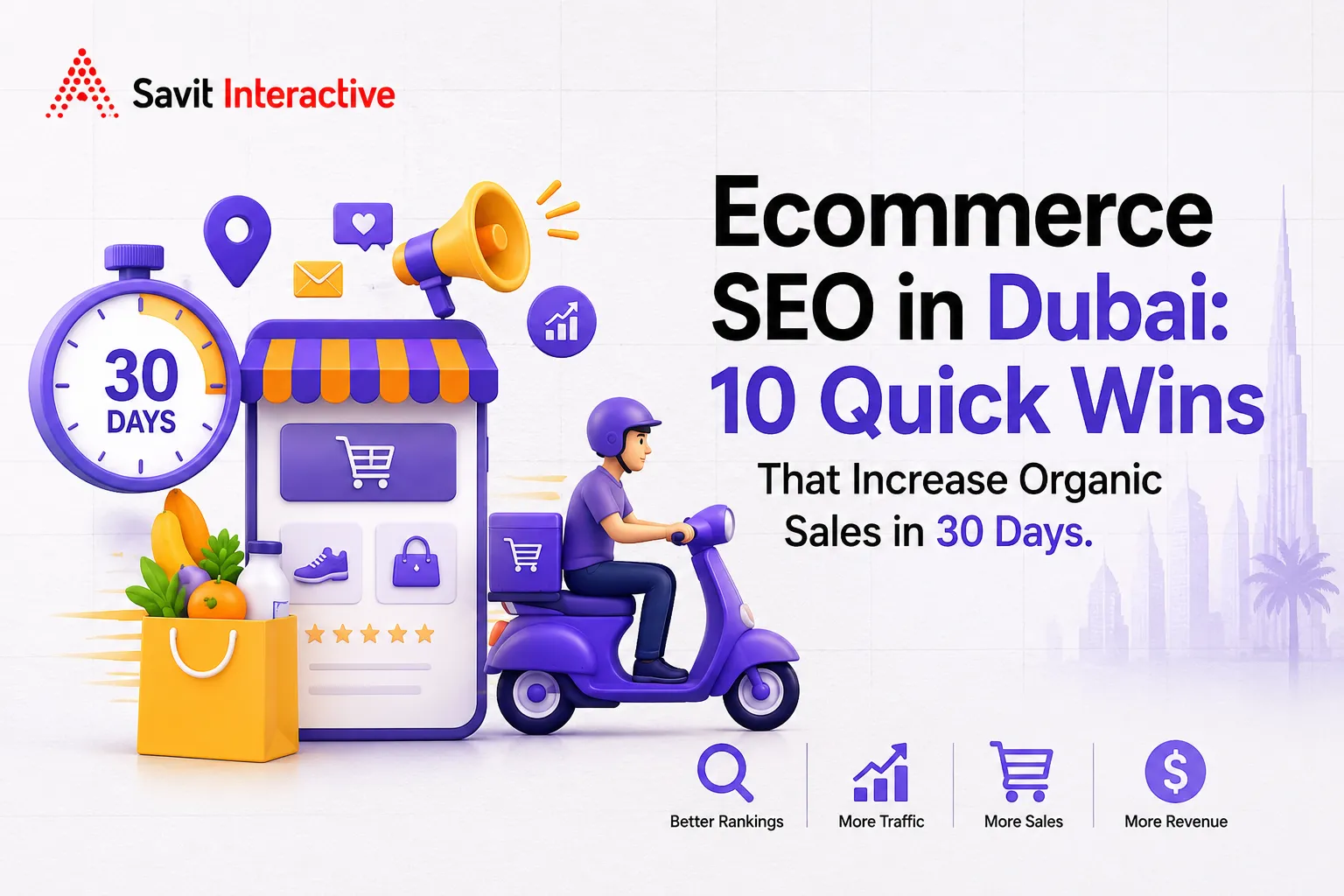
- SEO is a long-term game, but a handful of targeted fixes can lift organic sales within 30 days.
- Most Dubai stores lose sales to slow pages, weak product titles, duplicate content, and clunky mobile checkouts, not lack of traffic.
- 10 wins across three stages: fix what’s broken, optimise what already ranks, convert that traffic into sales.
- Each win includes a clear action step you can implement without a specialist.
- Includes how to measure results, so you know the changes are actually working.
SEO is a long-term investment. That is true. Building organic authority for an online store takes months, sometimes over a year, to fully compound. But that does not mean every SEO action requires six months of patience before anything moves.
Some changes, when applied to the right pages, can shift traffic and revenue within weeks. For stores investing in Ecommerce SEO in Dubai, where mobile usage dominates and buyer intent on product searches runs high, these quick wins carry even more weight.
BrightEdge data, cited across multiple industry analyses in 2026, shows that organic search drives 43% of all ecommerce traffic globally. In the UAE, where internet penetration stands at 99% and 79% of all ecommerce orders are placed on smartphones, the opportunity to capture organic buyers is enormous. But only if your store is built to be found.
SEO for Ecommerce website growth is a long game. The 10 actions below, however, are the parts of that game you can start winning this month.
Why These Quick Wins Matter for Online Stores in Dubai
Organic search is the highest-converting free traffic source available to ecommerce businesses. Smart Insights data, cited by BloggersIdeas and Ringly.io in their 2026 compilations, puts the average ecommerce organic conversion rate at 2.8%, higher than social media (0.7% to 1.5%) and most paid channels.
In the UAE specifically, the market conditions amplify this. Google commands approximately 99% of mobile search. Dubai alone accounts for roughly 60% of the country’s total ecommerce activity. Most online shoppers in this market are searching with clear purchase intent, on mobile, and expecting fast, relevant results.
The 10 wins below are not shortcuts. They are high-leverage fixes that remove friction, improve how search engines read your store, and make it easier for buyers to find and purchase your products. Many of these are standard practice for experienced E commerce seo services providers, but they are frequently overlooked by store owners managing SEO in-house. Each one can be implemented within a week and begin showing impact within 30 days.
10 Quick Ecommerce SEO Wins That Increase Organic Sales
Fix the Technical Issues Slowing Your Store Down
1. Improve Page Speed on Your Top Product and Category Pages
Page speed is both a ranking factor and a trust signal. Shawn the SEO Geek’s 2026 ecommerce SEO analysis cites research showing that a one-second delay in load time can reduce conversions by 7%.Separately, Google’s own data confirms that 53% of mobile users leave a site that takes longer than 3 seconds to load.
Quick action: Run your top 10 revenue-generating pages through Google PageSpeed Insights. Compress images, defer non-critical JavaScript, and enable browser caching. Start with the pages that already receive organic traffic. Those are the ones where speed improvements translate directly into recovered sales.
2. Fix Crawl Errors and Broken Links
Dead product pages (404 errors) waste crawl budget and frustrate shoppers who land on them from search. In ecommerce, where product turnover is constant, broken links accumulate fast if left unchecked.
Quick action: Run a crawl using Screaming Frog or Google Search Console. Redirect discontinued product URLs to the most relevant active page or parent category. Make this a weekly habit, not a quarterly task.
3. Make Sure Your Key Pages Are Indexed
Pages that are not indexed do not exist in Google’s eyes. If your best-selling products are blocked by a noindex tag, a misconfigured robots.txt, or unresolved duplicate content issues, they cannot rank. A capable E commerce seo agency will check this before touching anything else, and so should you.
Quick action: Open Google Search Console’s indexing report. Filter for “not indexed” pages and review the reasons. Fix noindex tags, canonical errors, and crawl blocks on every revenue-generating page.
Optimise the Pages That Already Get Traffic
Once the technical foundation is clean, the next step is improving what you already have. The wins below focus on pages that are already receiving impressions or traffic but underperforming on clicks and conversions. This is where SEO services Ecommerce stores invest in most heavily, because the returns are immediate and measurable.
4. Rewrite Product Titles and Meta Descriptions with Buyer Keywords
Your product page title is the first thing a searcher sees in results. If it reads “SKU-4827-BLK” instead of “Men’s Black Running Shoes, Size 42, Nike Pegasus 41,” you are losing clicks to a competitor who wrote a better title. Good SEO for Ecommerce website pages starts here: with titles that match what real buyers type into Google.
Quick action: Identify your top 20 product pages by impressions in Google Search Console. Rewrite each title to include the product name, a key attribute (size, colour, material), and a buying modifier. Write meta descriptions that give the searcher a clear reason to click your listing instead of the one above or below it.
5. Write Unique Descriptions for Your Top-Selling Products
Manufacturer descriptions are duplicated across every retailer stocking the same item. Google deprioritises duplicate content. If 50 stores carry the same description for the same product, none of them stand out.
Quick action: Rewrite descriptions for your top 20 products. Include material, use case, sizing detail, and at least one sentence that answers a question a buyer would ask before purchasing. This single change can shift rankings on competitive product terms within weeks.6. Add Product Schema Markup
Product schema tells Google the price, availability, rating, and review count of your products. This data appears directly in search results as rich snippets, which increase click-through rates significantly. According to Ahrefs data cited across multiple 2025 compilations, the first five organic results capture 67.6% of all clicks.⁷ Rich snippets help your listing stand out within that competitive set.
Quick action: Use JSON-LD to implement Product schema on all product pages. Include name, price, currency, availability, aggregate rating, and review count. Most platforms (Shopify, WooCommerce, Magento) support this through plugins or built-in settings.
7. Strengthen Internal Linking from Category Pages to Products
Internal links tell search engines which pages matter most on your site. Outerbox, in its 2026 ecommerce SEO analysis, describes internal linking as one of the most underutilised quick wins in ecommerce.⁸ The logic is simple: every internal link is a pathway for both crawlers and customers.
Quick action: Ensure every product page is linked from its parent category. Add “related products” or “customers also viewed” sections to product pages. Link from blog posts to relevant product and category pages using descriptive anchor text. Professional SEO services for Ecommerce websites treat internal linking as a daily discipline, not a one-time setup.
Turn Organic Traffic into Actual Sales
8. Add Customer Reviews to Product Pages
Reviews provide fresh, unique content that Google can index. They also build trust with buyers comparing products across multiple stores. Statista data, cited by Popupsmart in its 2026 conversion rate report, found that users who actively interacted with user-generated content experienced a 102.4% increase in conversion.⁹
Quick action: Enable and display reviews on your top product pages. If your store is new, email past buyers and request a review. Even 5 to 10 genuine reviews per product can make a visible difference in both rankings and conversion.
9. Optimise Your Category Pages, Not Just Products
Category pages often carry more ranking potential than individual products because they target broader, higher-volume keywords. “Women’s running shoes” attracts far more searches than “Nike Pegasus 41 size 38.”
BigCommerce’s 2026 ecommerce SEO guide recommends optimising category pages first because they rank better for broad keywords and provide more stable, long-term traffic than individual product pages.¹⁰
Quick action: Add a 100 to 150 word introduction to each major category page. Include the primary keyword, describe what the category contains, and address what the buyer is looking for. Write it for the person shopping, not for a search engine. Any experienced SEO Ecommerce agency will tell you that well-optimised category pages often drive more organic revenue than product pages alone.
10. Align Your Checkout for Mobile Buyers
In the UAE, 79% of ecommerce orders are placed on smartphones.² If your checkout is clunky on mobile, you are losing sales from traffic you already earned through SEO. This is where organic effort meets conversion reality.
Quick action: Test your full checkout flow on a mobile device. Reduce form fields to the minimum. Enable express payment options (Apple Pay, Google Pay, Tabby, Tamara). Make sure the “buy now” button is visible without scrolling. The goal is zero friction between the search result and the completed purchase.
How to Track Whether These Wins Are Working
Implementation without measurement is guesswork. After making these changes, track four metrics over the next 30 days:
- Organic sessions by page group. Are your optimised product and category pages receiving more traffic? Segment by page type so the signal is clear.
- Click-through rate. Check Google Search Console. Did rewritten titles and schema markup increase CTR on the pages you changed?
- Indexed page count. Confirm that previously blocked pages are now indexed and receiving impressions.
- Organic revenue. The bottom line. In your analytics platform, isolate revenue from organic traffic and compare it to the 30 days before the changes.
If your store sees a 10% to 15% increase in organic sessions on the pages you optimised, and CTR improves on rewritten titles, the changes are working. From there, the task is to scale the same approach across the rest of your catalogue. Any SEO Ecommerce agency worth working with will track these metrics continuously, and the best SEO services for Ecommerce websites are built around this cycle of implementation, measurement, and scaling.
Small Changes Help in Winning Big
SEO is a long-term investment. The organic authority you build today compounds over months and years. But within that long-term framework, specific technical fixes, on-page improvements, and conversion optimisations can produce real, measurable results within 30 days.
The 10 wins in this blog are not hacks or workarounds. They are foundational practices that many online stores in Dubai overlook because paid ads feel faster. The stores that combine paid acquisition with solid SEO services Ecommerce foundations are the ones that grow sustainably. Organic traffic is the only channel that keeps delivering after you stop spending on it.
How Savit Helps Ecommerce Stores Increase Organic Sales in Dubai
At Savit, we apply exactly these principles as the starting point for every ecommerce SEO engagement. With over 25 years of experience, we have optimised online stores across Shopify, WooCommerce, Magento, BigCommerce, and custom-built platforms, each with its own technical demands and SEO requirements.
Our E commerce seo services cover the full catalogue: product pages, category structure, internal linking, metadata, and site speed, built around how real buyers in Dubai search and make decisions. We start with a technical audit and keyword strategy, then move into on-page optimisation, content development, link building, and ongoing performance tracking.
As a trusted E commerce seo agency in Dubai, we focus on what matters to store owners: qualified traffic, improved conversion rates, and measurable revenue growth. Ecommerce SEO in Dubai requires an approach that accounts for the market’s mobile-first behaviour, multilingual search patterns, and competitive product landscape. That is what we build for.
If your online store is getting traffic but not enough sales, or if your products are not showing up for the searches that matter, talk to our ecommerce SEO team for a free audit. We will show you where the quick wins are and how to build from there.