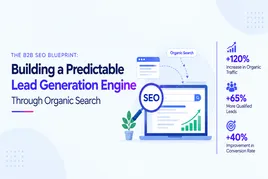
B2B SEO is not simply about ranking higher. It is about putting the right information in front of the right buyer, at the right stage, and turning that visibility into qualified business opportunities
Key Highlights
- B2B SEO works best when it is built around buyer intent, not search volume alone.
- A strong strategy connects search demand, content, commercial pages, conversions, and sales.
- Different decisionmakers often search for the same solution in different ways.
- Informational content can attract buyers early, while commercial pages help convert them later.
- Technical SEO gives search engines a strong foundation for crawling and understanding your website.
- Internal linking can guide visitors from research content to relevant solutions.
- SEO reporting should go beyond rankings and traffic to include qualified leads and pipelines.
- AI-powered search is changing how B2B buyers research and compare vendors.
- Predictable SEO comes from a repeatable process, not promises of a fixed number of leads.
What Is B2B SEO and Why Does It Matter for Lead Generation?
B2B search engine optimization is the process of improving a business website so it appears when other businesses search for relevant problems, products, services, and solutions.
For B2B companies, the goal is not simply to attract more visitors. The goal is to attract the right visitors.
A B2B buyer may spend weeks researching before contacting a sales team. They may read articles, compare providers, review case studies, check pricing, and discuss options with other people in their company.
That makes organic search an important part of the buying journey.
According to HubSpot’s 2026 B2B SEO guide, a strong B2B SEO strategy connects organic visibility with qualified demand, conversions, pipeline, and revenue rather than focusing only on page views.
This is where B2B SEO services need to go beyond keyword rankings. A useful strategy should help a business capture search demand and create a clear path from the first search to a sales conversation.
Why B2B SEO Is Different From B2C SEO
B2B and B2C SEO share the same basic foundations. Both need good content, technical health, relevant keywords, and a website that works well.
The difference is the buyer.
B2B purchases often involve more research, larger budgets, longer sales cycles, and several decision-makers. One person may use the product, another may approve the budget, and someone else may review security or technical requirements.
That makes organic search an important part of the buying journey.
According to HubSpot’s 2026 B2B SEO guide, a strong B2B SEO strategy connects organic visibility with qualified demand, conversions, pipeline, and revenue rather than focusing only on page views.
This is where B2B SEO services need to go beyond keyword rankings. A useful strategy should help a business capture search demand and create a clear path from the first search to a sales conversation.
Why B2B SEO Is Different From B2C SEO
B2B and B2C SEO share the same basic foundations. Both need good content, technical health, relevant keywords, and a website that works well.
The difference is the buyer.
B2B purchases often involve more research, larger budgets, longer sales cycles, and several decision-makers. One person may use the product, another may approve the budget, and someone else may review security or technical requirements.
| B2B SEO | B2C SEO |
| Business buyers | Individual consumers |
| Longer buying cycles | Often shorter buying cycles |
| Multiple decisionmakers | Usually fewer decisionmakers |
| Demos, enquiries and consultations | Purchases and sign-ups |
| Lower but more specific search volume | Often higher search volume |
| Pipeline and revenue |
Sales and transaction volume |
For this reason, SEO for B2B marketing should focus on intent and business value instead of chasing large traffic numbers.
How Organic Search Fits into the Modern B2B Buying Journey
A B2B buyer rarely starts with a company name.
They often start with a problem.
For example, a business may search for ways to reduce operating costs. Another may search for software that improves reporting. A marketing team may look for ways to generate more qualified leads.
At this point, the buyer may not know which provider to choose.
The journey then becomes more specific.
They may search for:
- Possible solutions
- Product categories
- Service providers
- Comparisons
- Alternatives
- Pricing
- Case studies
- Reviews
- Implementation information
This creates three broad stages:
- Awareness: The buyer understands the problem.
- Consideration: The buyer researches and compares solutions.
- Decision: The buyer is ready to evaluate providers or take action.
A strong SEO strategy should have content for all three.
The B2B SEO Lead Generation Engine: From Search to Revenue
Think of B2B SEO as a connected system rather than a list of tasks.
Search demand → Search intent → Content → Commercial page → Conversion → Qualified lead → Sales opportunity → Revenue
Each stage has a role.
Keyword research identifies demand. Intent tells you what the searcher wants. Content answers questions. Commercial pages explain the solution. Conversion paths turn visitors into enquiries. CRM data shows whether those enquiries become opportunities.
This is the foundation of a strong B2B search engine optimization strategy.
The process also creates a useful feedback loop.
If certain topics attract qualified leads, create more useful content around those topics. If a page attracts traffic but no enquiries, improve its intent match or conversion path.
Step 1: Define Your Ideal Customer Profile and B2B Buyer Personas
Before researching keywords, decide who you want to attract. Your Ideal Customer Profile should describe the type of company that is most likely to buy from you.
Then identify the people involved in the decision. A technology purchase, for example, may involve:
- Marketing
- IT
- Finance
- Procurement
- Senior management
Each person may have different concerns. The IT manager may search for security information. Finance may search for pricing. A marketing manager may focus on features and ease of use.
A B2B SEO agency in Dubai working with a business should understand these differences before building its keyword strategy.
Step 2: Map the B2B Buyer Journey Before Choosing Keywords
Keyword research becomes more useful when it starts with the buyer.
Ask what the customer is likely to search at each stage.
| Stage | Search intent | Content opportunity |
| Awareness | “How do I solve this problem?” | Guides and educational articles |
| Consideration | “Which solution is best?” | Comparisons and solution pages |
| Decision | “Which provider should I choose?” | Service pages and case studies |
| Evaluation | “Can I trust this provider?” | Reviews, proof and case studies |
| Action | “How do I get started?” | Demo, consultation or pricing page |
This prevents a common problem: creating lots of blog content without enough content that supports sales.
Step 3: Find High-Intent B2B Keywords That Can Drive Qualified Leads
Search volumes are useful. But it should not be the only deciding factor.
A keyword with 100 searches may bring more value than one with 10,000 searches if those 100 searches come from people actively looking for a solution.
Useful B2B keyword groups often include:
- Service searches
- Product searches
- Pricing searches
- Comparison searches
- Alternative searches
- Industry-specific searches
- Use-case searches
- Provider searches
The important question is not simply, “How many people search this?”
Ask instead:
“Could this search lead to a business conversation?”
That shift can completely change a B2B SEO strategy.
How to Separate Search Volume from Real B2B Buying Intent
Imagine a company that sells enterprise cybersecurity software. A broad term may bring thousands of visitors looking for general information. A more specific search such as an enterprise security solution for a particular industry may receive fewer searches but show much stronger buying intent.
The second keyword could be more valuable.
A useful keyword evaluation should consider:
- Relevance
- Search intent
- Buyer stage
- Commercial value
- Competition
- Current rankings
- Conversion potential
The goal is to build a keyword portfolio that supports revenue, not just traffic.
Step 4: Build a Keyword-to-URL and Buyer-Intent Map
Once keywords are selected, assign them to specific pages.
Do not send every keyword to the homepage.
An informational query may need a blog. A service query may need a landing page. A comparison query may need a dedicated comparison article.
A simple structure is:
- Problem query → Educational content
- Solution query → Solution page
- Service query → Service page
- Comparison query → Comparison content
- Decision query → Case study or commercial page
This also helps reduce keyword cannibalization.
Step 5: Create Content for Every Stage of the B2B Sales Funnel
B2B content should do more than fill in a blog calendar. Different buyers need different information. At the awareness stage, they need answers.
During consideration, they need comparisons. At the decision stage, they need proof. That proof can include case studies, customer results, technical details, expert opinions, reviews, demonstrations, and implementation information.
According to Google’s current Search guidance, creating helpful, reliable and original content remains important for visibility in both traditional Search and its newer generative AI features.
This makes quality more important than simply publishing more pages.
What B2B Content Should You Create at Each Buying Stage?
A balanced B2B content plan can include:
- Educational guides
- Industry articles
- Research reports
- Case studies
- Comparison pages
- Product pages
- Service pages
- Use-case pages
- Implementation guides
- FAQs
- Pricing information
The best format depends on the search intent.
A person searching for “what is CRM automation” needs a different page from someone searching for “CRM automation software pricing.” The topic may be similar.The intent is not.
Step 6: Build Commercial Landing Pages That Turn Organic Traffic into Leads
Blog posts can bring people in. Commercial pages help turn relevant visitors into leads. A strong landing page should quickly explain:
- What you offer
- Who it is for
- Which problem it solves
- What makes the solution useful
- Why the business is credible
- What the visitor should do next
The call to action should also match intent.
A first-time researcher may prefer a guide. A decision-stage visitor may be ready to request a consultation. This is where B2B SEO services should connect with conversion optimization.
Step 7: Create Topic Clusters and Build Topical Authority
B2B businesses often serve several industries or use cases. Publishing unrelated articles can make the website difficult to understand. Topic clusters provide a better structure.
Start with a main service or solution page. Then create supporting content around related questions, problems, use cases, comparisons, and industries.
Link these pages together. This helps users discover more information and creates a clearer content structure for search engines.
Step 8: Use Internal Linking to Move Buyers From Information to Action
Internal links can help guide the buyer.
For example:
- An educational article can link to a solution page.
- The solution page can link to a case study.
- The case study can link to a consultation page.
This creates a simple journey:
Learn → Understand → Compare → Trust → Contact
Internal links should always be useful. Adding links just for the sake of SEO can make content harder to read.
Step 9: Strengthen Technical SEO Before Scaling Content
Technical SEO provides the foundation.
Important areas include:
- Crawlability
- Indexation
- Site structure
- Page speed
- Mobile usability
- Canonical tags
- Redirects
- Broken links
- Structured data
- Internal linking
If important pages cannot be crawled or indexed properly, even strong content can struggle to perform.
Google’s guidance for AI-powered Search also confirms that existing technical SEO practices remain relevant.
Step 10: Build B2B Authority Through Digital PR, Backlinks and Original Research
B2B buyers want evidence. A website can build authority through relevant backlinks, industry publications, expert contributions, original research, partnerships, and useful case studies. The focus should be on relevance and quality. Original research can be especially valuable.
For example, a company could publish an industry survey, customer benchmark, market report, or analysis based on its own data. If other websites reference that research, it can support both visibility and authority.
How to Make B2B SEO Content More Credible and Trustworthy
B2B buyers often make expensive decisions. They need reasons to trust what they read.
Content should make it clear where important information comes from. Use credible sources for statistics. Explain technical claims. Add expert insights where possible.
Avoid generic content that simply repeats information already available across many websites.
Google’s current guidance warns against scaled content created mainly to manipulate rankings and stresses that content should provide value to users. For B2B brands, this means useful experience and original information can become important differentiators.
How AI Search and Answer Engines Are Changing B2B SEO
Searching is changing. Buyers can now ask AI tools to explain a problem, compare providers, summaries options, and recommend solutions. That does not make traditional SEO irrelevant.
Google’s latest guidance says its generative AI Search features continue to rely on core Search ranking and quality systems.
For B2B brands, the practical lesson is simple. Create content that answers real questions clearly. Use direct explanations. Add original insights. Support important claims. Make pages easy to understand. Good SEO and useful content still provide the foundation.
How to Optimize B2B Content for Google AI Overviews and Answer Engines
There is no reliable shortcut that guarantees a brand will appear in an AI-generated answer.
Instead, focus on making your content useful and easy to understand.
Helpful practices include:
- Clear headings
- Direct answers
- Original research
- Expert commentary
- Case studies
- Detailed comparisons
- Industry-specific information
- Reliable sources
- Strong internal linking
Google has also stated that many commonly promoted “AEO” or “GEO hacks” are not required for appearing in its generative AI features.
So, the focus should remain on strong SEO fundamentals.
How to Turn Organic Traffic into Qualified B2B Leads
Traffic does not automatically become revenue.
The website needs a clear conversion path.
A visitor may:
- Read an article
- Visit the service page
- Download a resource
- Submit a form
- Enter the CRM
- Become a qualified lead
- Move into the sales pipeline
The SEO team should be able to understand this journey.
Without that connection, it is difficult to know which organic traffic is actually valuable.
What Conversion Paths Should B2B SEO Pages Have?
Different pages should have different calls to action.
| Page | Possible next step |
| Educational article | Download a guide |
| Industry page | Read a case study |
| Service page | Request a consultation |
| Product page | Book a demo |
| Comparison page | Speak with an expert |
| Pricing page | Request pricing |
| Case study | Contact sales |
This creates a more natural user journey. Not every visitor needs to be pushed toward a sales call.
Connecting SEO With CRM, Marketing Automation and Sales
This is one of the most important parts of a B2B SEO system. Suppose a prospect first discovers your website through organic search. They download a guide and enter your CRM.
A few weeks later, they return through a branded search and request a consultation.
If your systems are connected, the business can see that organic search played a role in the journey. That information is valuable.
It can show which topics attract target companies, which pages assist conversions, and which organic leads eventually become opportunities. The findings can then improve future SEO work.
How to Measure B2B SEO Beyond Rankings and Organic Traffic
A stronger measurement system looks at the complete funnel.
| Level | Metrics |
| Visibility | Impressions, rankings, clicks |
| Engagement | Engaged sessions, returning visitors |
| Conversion | Enquiries, calls, demos |
| Lead quality | MQLs, SQLs, qualified accounts |
| Sales | Opportunities, win rate |
| Revenue | Pipeline and closed-won revenue |
The aim is to connect SEO activity with business outcomes. That is a much stronger way to explain SEO’s value to business leaders.
How to Calculate the Business Value and ROI of B2B SEO
B2B SEO can have a long sales cycle.
A visitor may discover a website today and become a customer several months later.
This makes attribution more complex.
A useful approach is to compare organic-sourced or organic-influenced pipelines against the investment in SEO.
Businesses can also track:
- Organic lead value
- Lead-to-opportunity rate
- Opportunity-to-customer rate
- Customer value
- Organic revenue
- Cost per qualified lead
Use more than one attribution model where possible. First-touch attribution can show how SEO introduced a prospect. Multi-touch attribution can show how organic content supported the wider journey.
Why B2B SEO Cannot Promise Instant or Fixed Lead Volumes
SEO should not be sold as a fixed monthly lead machine.
Search demand changes. Competitors have improved. Rankings move. Search features change.
A responsible strategy focuses on building the conditions that support sustainable organic growth. That means better content, stronger pages, technical health, relevant authority, improved conversion rates, and better measurement.
Predictability comes from having a repeatable process. It does not come from guaranteeing the same number of leads every month.
Common B2B SEO Mistakes That Create Traffic but No Pipeline
Some businesses attract visitors but struggle to generate opportunities.
- Common reasons include:
- Chasing search volume instead of intent
- Publishing blogs without commercial pages
- Targeting irrelevant keywords
- Creating several pages for the same search intent
- Ignoring existing content
- Measuring only rankings
- Using generic content
- Having weak calls to action
- Failing to connect SEO with CRM data
- Ignoring decision-stage searches
The biggest mistake is treating SEO as separate from sales. If SEO attracts the wrong audience, more traffic will not solve the problem.
How to Build a 90-Day B2B SEO Lead Generation Plan
The first month should focus on research and foundations. Audit the website. Define your ICP. Research competitors. Analyze search intent. Review current rankings. Identify technical issues. Study existing conversions.
During the second month, focus on execution. Build the keyword map. Improve priority commercial pages. Fix technical problems. Create internal links. Start publishing high-priority content.
During the third month, focus on improvement. Review early performance. Expand useful content clusters. Improve conversion paths. Build authority. Connect organic lead data with CRM reporting.
The goal after 90 days is not necessarily massive traffic growth. The goal is a system that can be measured and improved.
How to Scale the B2B SEO Engine From 3 Months to 12 Months
Once the foundation is working, the scale is based on evidence. Look at which pages attract qualified visitors. Review which topics generate enquiries. Find pages that rank but do not convert. Identify content gaps.
Then expand into new industries, use cases, comparison searches, product topics, and decision-stage content. This creates a compounding effect.
Over time, the website can become a larger source of qualified organic demand.
B2B SEO Strategies for SaaS, Technology, Manufacturing and Professional Services
Every B2B industry has different search behaviors.
- A SaaS company may need product comparisons, integration pages, feature content, alternatives, and pricing information.
- A manufacturer may need technical product pages, specifications, applications, compliance information, and industry guides.
- A professional services company may benefit from service pages, case studies, expert guides, and industry-specific content.
- A technology company may need content around integrations, security, implementation, and use cases.
The strategy should follow what the target buyer needs to know before making a decision.
When Should a Business Build an In-House B2B SEO Team or Hire an Agency?
An in-house team can work well when a company already has SEO, content, development, analytics, and marketing expertise.
An agency can be useful when the business needs specialist skills or additional execution capacity.
The choice should come down to capability.
Ask:
- Can the internal team handle technical SEO?
- Can it produce expert content?
- Can it build authority?
- Can it measure qualified leads?
- Can it connect SEO with sales data?
If several answers are no, an agency may provide the wider expertise needed.
How to Choose the Right B2B SEO Agency for Lead Generation
Do not choose an agency only because it promises rankings. Ask how it defines success.
A strong agency should explain:
- How it researches buyer intent
- How it maps keywords to pages
- How it handles technical SEO
- How it creates B2B content
- How it improves conversion paths
- How it measures lead quality
- How it connects SEO with pipeline
- How it approaches AI search
- How it reports results
The best B2B SEO agency for one business may not be the right choice for another.
Look for a partner that understands your industry, buyers, sales cycle, competition, and commercial goals.
Building a Predictable B2B Lead Engine Through Organic Search
B2B SEO works best when it is treated as a complete business system. Rankings and traffic are useful signals, but the bigger goal is to attract the right buyers, answer their questions, build trust, create clear conversion paths, and connect organic activity with sales.
A predictable organic engine does not mean promising the same number of leads every month. It means creating a process that can be measured, improved, and scaled. When search demand, content, commercial pages, conversion tracking, CRM data, and sales work together, organic search can become a strong long-term source of qualified business opportunities.
At Savit Interactive, we believe B2B search engine optimization should be connected to business outcomes from the start. We look beyond rankings and ask whether organic search is reaching the right buyers and supporting real opportunities. Our suggestion is simple: start with your ideal customer, understand how that buyer searches, map content to the buying journey, strengthen the pages closest to revenue, and measure what happens after the click. For businesses looking for a B2B SEO agency in Dubai, this approach can provide a much stronger foundation than simply buying a package of monthly SEO tasks.
Footnotes
[1] According to Google Search Central, the SEO fundamentals used for traditional Google Search also remain relevant for AI Overviews and AI Mode. Google states that there are no additional technical requirements or special optimizations needed to appear in these AI features. Google Search Central – AI features and your website
[2] According to HubSpot’s 2026 B2B SEO Strategy Guide, effective B2B SEO should focus on buyer intent, audience clarity, content aligned with the buying journey, technical SEO, authority, and conversion paths rather than traffic alone. HubSpot’s 2026 B2B SEO guide