Key Highlights
- Learn the most common B2B SEO mistakes that prevent businesses from achieving sustainable organic growth.
- Understand why SEO for B2B companies requires a different approach than B2C SEO.
- Discover how high-intent keywords and buyer-focused content can generate more qualified leads.
- Explore the essential elements of a successful B2B SEO strategy, from technical SEO to content optimisation.
- Find out which SEO metrics matter most and why rankings alone don’t define success.
- Learn how partnering with an experienced SEO agency for B2B can help drive long-term business growth.
B2B buyers don’t make purchasing decisions overnight. They spend time researching solutions, comparing vendors, reading industry content, and evaluating options before they ever speak to a sales representative. This makes B2B SEO one of the most effective channels for attracting qualified prospects throughout the buying journey.
In fact, research by BrightEdge found that organic and paid search together account for 68% of all trackable website traffic, while B2B businesses receive an average of 76% of their trackable traffic from search alone.
Yet, many businesses struggle to achieve the results they expect from SEO. Despite investing in content and website optimisation, they often fail to improve rankings, attract qualified leads, or convert organic visitors into customers. The problem is rarely a lack of effort; it is often a result of common SEO mistakes that hold back long-term growth.
Unlike B2C SEO, SEO for B2B companies requires a focused strategy that aligns with longer buying cycles, multiple decision-makers, and intent-driven content. Without the right approach, even the best products or services can remain difficult to discover online.
In this blog, we’ll explore common B2B SEO mistakes that can limit organic growth and how businesses can achieve better long-term results.
Why B2B SEO Requires a Different Approach
Unlike B2C customers, B2B buyers rarely make quick purchasing decisions. They spend time researching solutions, comparing vendors, and consulting multiple stakeholders before choosing a product or service. This means SEO for B2B marketing should focus on educating buyers and building trust throughout the decision-making process rather than simply driving website traffic.
A good B2B SEO strategy focuses on search intent rather than search volume. Although high search volume keywords will give you more visibility, businesses usually perform well when they target keywords whose value is high because the decision makers are seeking industry-specific solutions.
Key Differences That Shape B2B SEO
| B2B SEO Focus | Why It Matters |
| Longer buying cycles | Buyers research extensively before making a purchase. |
| Multiple decision-makers | Different stakeholders evaluate solutions from different perspectives. |
| High-value keywords | Intent-driven keywords generate more qualified leads than broad, high-volume searches. |
| Informational and commercial intent | Buyers move from learning about a problem to comparing vendors before making a decision. |
| Tailored SEO strategy | Generic SEO tactics often fail because they don’t reflect how B2B buyers search and evaluate businesses. |
Being aware of these distinctions enables companies to develop effective SEO strategies to target the right audience, address all stages of the buying process, and achieve organic growth.
With this foundation in place, let’s look at the common mistakes that often prevent SEO for B2B companies from delivering the expected results.
10 Common B2B SEO Mistakes That Hold Back Organic Growth
- Targeting High-Volume Keywords Instead of High-Intent Keywords
One of the most common mistakes businesses make when selecting keywords is choosing high-search-volume ones. While these types of keywords can bring about higher numbers of traffic to your site, they do not necessarily mean that your website will get more inquiries.
Think about it this way:
- Broad keyword: “CRM software”
Attracts a wide audience with different search intentions.
- Intent-driven keyword: “CRM software for manufacturing companies”
Targets businesses actively looking for a solution, making it more likely to generate qualified leads.
An effective B2B SEO strategy focuses on keywords that reflect business needs and buying intent rather than popularity. By targeting relevant long-tail and industry-specific keywords, SEO for B2B companies can attract decision-makers who are more likely to convert into qualified leads.
Key takeaway: Instead of asking, “How many people search for this keyword?” ask, “Will this keyword bring the right audience to my business?”
- Ignoring the Customer Buying Journey
Many businesses create content without considering where their audience is in the buying journey. Some prospects are just beginning to understand a problem, while others are actively comparing solutions or evaluating vendors. Publishing only promotional content or only educational blogs can leave important gaps in your B2B SEO strategy.
A well-rounded content strategy should support buyers at every stage:
| Buyer’s Stage | Content That Works Best |
| Awareness | Blogs, industry guides, educational articles |
| Consideration | Comparison pages, case studies, webinars |
| Decision | Service pages, testimonials, product demos, contact pages |
By creating content that matches user intent at each stage, businesses can nurture potential customers and increase the chances of converting organic visitors into qualified leads.
Best practice: Map your content to the buyer’s journey rather than creating it solely based on topics or keywords.
- Publishing Content Without a Clear SEO Strategy
It is crucial to publish blog posts regularly, although this alone does not ensure success. The lack of a B2B SEO strategy results in disconnected content that does not support business objectives.
Some common signs of an unfocused content strategy include:
- Publishing blogs without keyword or competitor research.
- Covering random topics that don’t relate to your products or services.
- Targeting the same keywords across multiple pages.
- Missing internal links between related content.
- Not updating older content that has lost relevance.
A successful SEO for B2B marketing approach treats content as part of a larger strategy. Every page should have a clear purpose, support a specific stage of the buyer’s journey, and contribute to building topical authority over time.
Remember: Creating more content doesn’t always improve rankings. Creating the right content with a clear strategy delivers better long-term results.
- Overlooking Technical SEO Issues
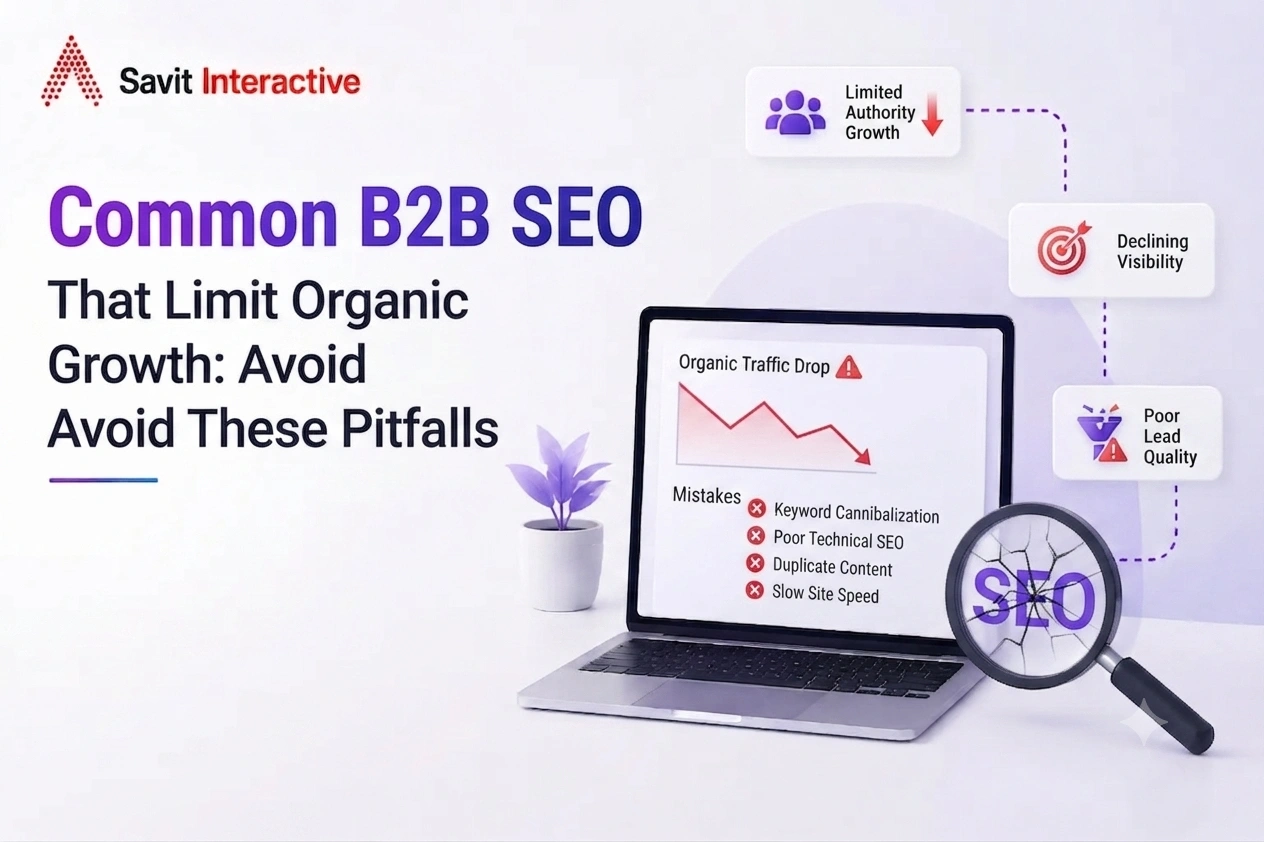
Despite having very useful content on your site, it may still be difficult to achieve good rankings if your website has SEO issues. This is because slow loading, broken links, lack of mobile usability, and crawl errors prevent search engines from indexing your site.
Common technical SEO issues to watch for:
- Slow page loading speed
- Broken links and 404 errors
- Duplicate content
- Missing or incorrect meta tags
- Poor mobile responsiveness
- Crawl and indexing issues
Regular technical SEO audits help identify and resolve these issues before they affect your website’s visibility. A technically sound website not only improves search rankings but also encourages visitors to stay longer and explore more pages.
Keep in mind: Strong content performs best when it’s supported by a technically healthy website.
- Creating Content for Search Engines Instead of Decision-Makers
Many businesses focus so much on keywords that they forget who they’re actually writing for. While optimisation is important, decision-makers are looking for content that answers their questions, solves real business challenges, and helps them make informed decisions.
Instead of writing content just to rank, ask yourself:
- Does this content address a real customer pain point?
- Does it demonstrate industry expertise?
- Does it help readers make a business decision?
- Does it naturally guide them to the next step?
When content is created with the audience in mind, keywords fit naturally, engagement improves, and trust grows over time. This is exactly what SEO for B2B companies aims to achieve, attracting the right visitors and turning them into qualified business opportunities.
Expert insight: Search engines reward content that provides genuine value because that’s exactly what users are looking for.
- Neglecting Product and Service Pages
Most companies put in a lot of effort into creating blog content, yet forget about the pages that actually drive enquiries and conversions. Though blogs assist in bringing in customers, buying decisions are usually made on product or service pages.
An optimised service page should clearly answer questions such as:
- What does the product or service offer?
- Who is it designed for?
- What problems does it solve?
- What makes your business different?
- How can a potential customer get in touch?
For businesses focusing on B2B ecommerce SEO, product pages should also include detailed specifications, industry applications, certifications, FAQs, and other information that helps business buyers evaluate solutions with confidence.
The right approach: Treat your product and service pages as high-value SEO assets, not just sales pages.
- Weak Internal Linking Structure
Internal links do more than connect web pages; they help search engines understand your website structure and guide visitors towards relevant information. Without a clear internal linking strategy, valuable pages may receive less visibility, and users can struggle to find the information they need.
Here’s the difference a strong internal linking strategy makes:
| Without Internal Linking | With Internal Linking |
| Pages remain isolated | Related content is connected logically |
| Search engines struggle to understand page relationships | Improves crawlability and topical authority |
| Visitors leave after reading one page | Users discover more relevant content and stay engaged |
| Important pages receive less authority | Link equity is distributed across key pages |
A well-planned internal linking strategy improves navigation, strengthens topical authority, and helps search engines discover and prioritise important pages across your website.
Best practice: Every new blog or landing page should naturally link to relevant service pages and related content wherever it adds value.
- Ignoring Local SEO Opportunities
Most B2B firms often believe that local SEO is important only for restaurants and retailers. But firms catering to specific cities, regions, or countries also have something to gain from their local SEO efforts. If you are offering services to businesses in Dubai or in the entire UAE, you stand to gain from your local SEO efforts.
Don’t overlook these local SEO opportunities:
- Optimise your Google Business Profile.
- Create location-specific service pages.
- Maintain consistent business information across online directories.
- Encourage genuine customer reviews.
- Use local keywords naturally within your website content.
Having a strong local presence not only increases visibility but also enables you to reach out to local decision-makers seeking your services.
Remember: If your customers search locally, your SEO strategy should too.
- Measuring Rankings Instead of Business Results
Achieving first-page rankings is an important milestone, but rankings alone don’t guarantee business growth. A keyword may rank well and still fail to generate enquiries, qualified leads, or revenue.
Instead of focusing only on rankings, track metrics that reflect real business performance.
| Don’t Measure Only | Measure Instead |
| Keyword rankings | Qualified organic traffic |
| Website visits | Lead enquiries and conversions |
| Clicks | Conversion rate |
| Impressions | Revenue or pipeline influenced by organic search |
A successful B2B search engine optimization strategy aligns SEO performance with business objectives. Regularly reviewing meaningful metrics helps businesses understand what’s working, identify opportunities for improvement, and make smarter marketing decisions.
Key takeaway: SEO success isn’t measured by where you rank; it’s measured by the business results you achieve.
- Applying B2C SEO Tactics to B2B Businesses
There is no single SEO strategy that works across all types of businesses. What works perfectly well for B2C companies might prove ineffective for B2B companies, and vice versa.
Before planning your SEO efforts, ask yourself:
- Are we targeting business decision-makers or individual consumers?
- Does our content answer industry-specific questions?
- Are we creating resources that support a longer buying journey?
- Are we optimising for lead generation instead of impulse purchases?
An effective SEO for B2B marketing strategy focuses on building credibility, addressing business challenges, and nurturing prospects over time rather than driving quick sales. Adapting your SEO approach to match B2B buyer behaviour leads to better engagement, stronger relationships, and sustainable organic growth.
What works better: Build your SEO strategy around how business buyers research and make decisions, not around tactics designed for consumer markets.
What an Effective B2B SEO Strategy Looks Like
Avoiding common mistakes is only one part of improving organic performance. To generate qualified leads and achieve sustainable growth, businesses need a well-defined B2B SEO strategy that aligns with their goals, target audience, and buying journey. Instead of treating SEO as a one-time activity, it should be an ongoing process that continuously improves your online visibility and supports business growth.
A successful strategy is built on the following elements:
- Intent-driven keyword research:
Focus on keywords that reflect what your ideal customers are searching for at different stages of the buying journey, rather than simply targeting the highest search volumes.
- High-quality, relevant content:
Publish blog posts, landing pages, guides, and service pages that help solve customers’ queries and business problems and show your industry expertise.
- Strong technical foundation:
Make sure that your website has a good loading speed, is mobile-friendly, crawlable, and technically sound.
- On-page optimisation:
Optimise page titles, headings, meta descriptions, URLs, and content so that both search engines and users clearly understand what each page offers.
- Internal linking and topical authority:
Use internal linking within your site to aid navigation, create links between content, and let the search engines know what pages matter.
- Continuous monitoring and optimisation:
Regularly track keyword performance, organic traffic, lead generation, and user behaviour to identify opportunities for improvement and refine your SEO efforts.
No single tactic can deliver lasting results on its own. Businesses that succeed with B2B search engine optimization take a long-term approach, where content, technical SEO, and continuous optimisation work together to attract qualified traffic and convert it into meaningful business opportunities.
How SEO Supports Long-Term Growth for B2B Businesses
Unlike paid advertising, where visibility often stops when the budget runs out, B2B SEO is a long-term investment that continues to deliver value over time. A well-executed strategy improves rankings, builds authority, attracts the right prospects, and supports steady growth.
Here’s how effective SEO creates long-term business impact:
- Builds trust and credibility: Consistently appearing in search results and publishing valuable content positions your business as a reliable industry resource.
- Generates qualified leads: Optimising for relevant, intent-driven keywords attracts businesses that are actively looking for solutions like yours.
- Reduces customer acquisition costs: As organic visibility grows, businesses become less dependent on paid advertising to generate enquiries.
- Supports every stage of the buyer’s journey: From educational content to service pages, SEO helps engage potential customers from their first search to their final decision.
- Delivers sustainable results: Unlike short-term campaigns, SEO continues to drive traffic and leads through continuous optimisation and high-quality content.
According to HubSpot, SEO remains one of the top channels marketers use to improve website performance and generate high-quality leads, making it an essential part of long-term digital marketing success.
Key takeaway: Businesses that invest in SEO consistently are better positioned to attract, engage, and convert high-value customers over time.
Why Choosing the Right B2B SEO Partner Matters
Even with the right plan, getting steady SEO results takes time, skill, and regular updates. That’s why many businesses choose to work with an experienced SEO agency for B2B that understands their industry, audience, and growth objectives.
Before choosing an SEO partner, ask these questions:
- Do they have experience working with B2B businesses?
- Do they create customised SEO strategies rather than a one-size-fits-all approach?
- Do they provide transparent reporting with business-focused metrics?
- Do they offer expertise in technical SEO, content strategy, and on-page optimisation?
- Do they focus on long-term growth instead of quick ranking promises?
The best B2B SEO agency doesn’t simply improve keyword rankings; it works as a strategic partner, helping businesses attract qualified leads, strengthen their online presence, and achieve measurable business outcomes.
Choosing an agency that understands your market and business goals ensures your SEO investment contributes to sustainable growth rather than short-term wins.
Turn Your B2B SEO Strategy into a Growth Engine
Building a successful B2B SEO strategy isn’t about chasing rankings or publishing more content. It’s about understanding how your customers search, what information they need, and how your website can guide them from research to decision-making. By avoiding common SEO mistakes and focusing on a structured, long-term approach, businesses can improve their online visibility, attract qualified leads, and create sustainable organic growth.
At Savit, we help businesses move beyond basic SEO practices with customised strategies designed around their industry, audience, and business objectives. From in-depth keyword research and technical SEO to content optimisation and ongoing performance monitoring, our team focuses on delivering measurable results that support long-term growth.
Whether you’re looking to strengthen your existing SEO efforts or build a strategy from the ground up, we’re here to help your business achieve meaningful and lasting success through smarter B2B search engine optimization.