Key Highlights
- Google Search Console now tracks AI Overview impressions, helping businesses measure visibility in AI-powered search results.
- Appearing in Google AI Overviews builds brand authority, even when users don’t immediately click your website.
- AI impression data helps identify which content Google considers trustworthy and valuable for AI-generated answers.
- Tracking AI visibility alongside SEO metrics enables smarter content optimization and long-term search performance.
- Strong SEO fundamentals combined with generative engine optimization and answer engine optimization improve success in the evolving AI search landscape.
Google Search is changing faster than ever. With the rise of Google AI Overviews, users are getting direct answers to their questions before they even scroll through traditional search results. As a result, businesses are beginning to see changes in how their websites are discovered, viewed, and clicked.
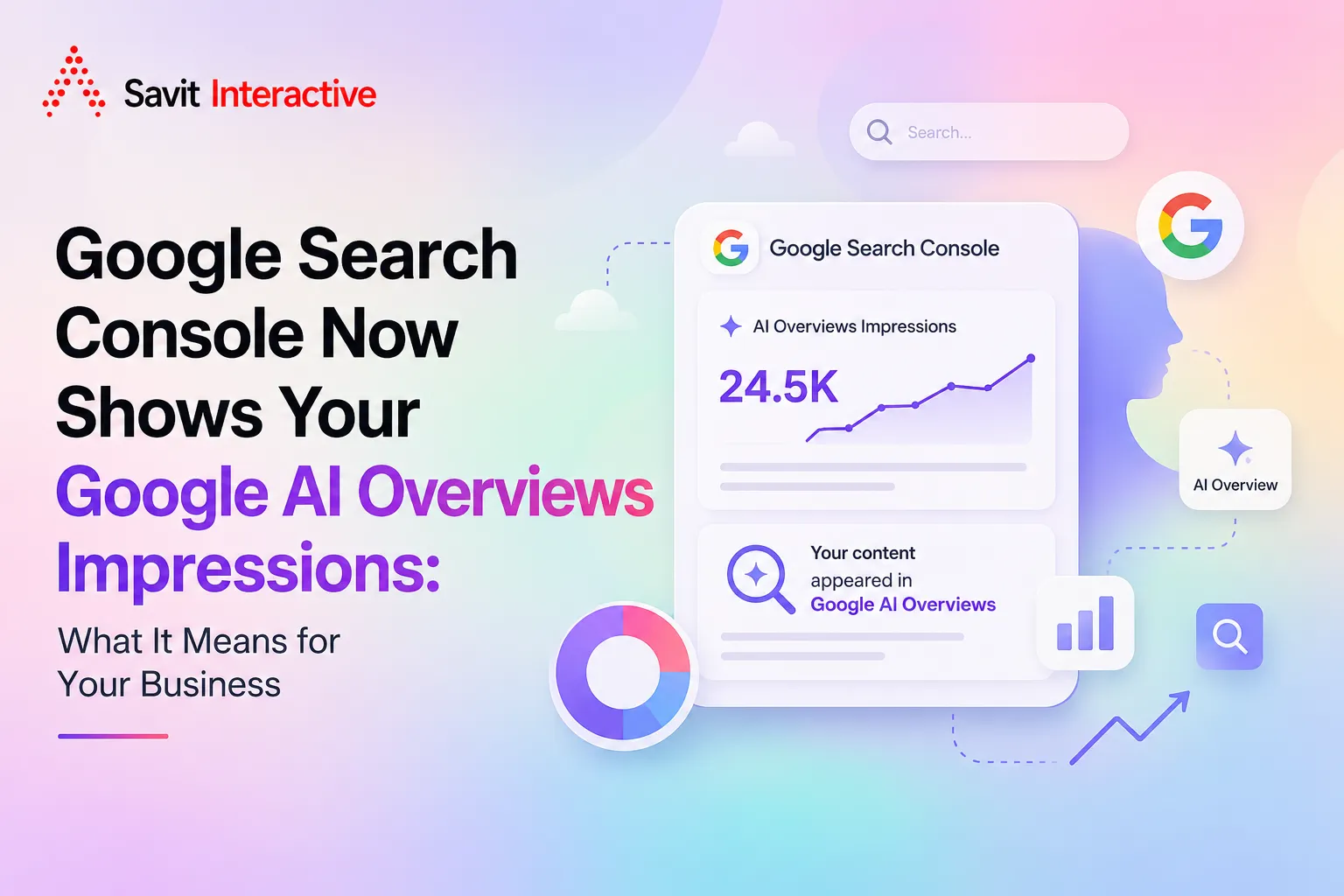
To help website owners understand this shift, Google has introduced AI Overviews impression reporting in Google Search Console. This update gives businesses a new way to measure their visibility in AI-powered search experiences. Instead of focusing only on rankings and clicks, you can now see how often your content appears within AI-generated answers.
For businesses investing in SEO, this is an important step. It helps you understand whether your content is becoming part of Google’s AI-generated responses and how your overall search presence is evolving.
Understanding Google’s Latest Search Console Update
Google recently expanded Search Console reporting to include impressions from AI-powered search experiences, including AI Overviews. This means website owners can now see how often their content is shown as part of Google’s AI-generated responses alongside traditional search results.
According to Google Search Central, Google has introduced dedicated Search Generative AI performance reports that allow website owners to measure impressions from AI Overviews, AI Mode, and other AI-powered search experiences. These reports help businesses understand how often their content appears in Google’s AI-generated responses.
This update reflects an important reality. Search is no longer just about ranking first. It’s also about becoming a trusted source that Google’s AI chooses to reference. For businesses, this creates a new performance metric that goes beyond clicks and rankings.
What Are Google AI Overviews Impressions?
An impression simply means your content was displayed to a user.
With Google AI Overviews, the meaning is slightly different.
When a user searches for information, Google may generate an AI-powered summary at the top of the search results. If your website is one of the sources referenced in that summary, Google records an impression.
For example:
- A customer searches for “best SEO strategy for small businesses.”
- Google displays an AI Overview.
- Your website is cited within that answer.
- Your page receives an impression, even if the user doesn’t click your website.
This gives businesses valuable insight into how often Google considers their content trustworthy enough to include in AI-generated answers.
How Google Counts AI Overviews Impressions and Why It Matters
Many marketers assume impressions only matter when they lead to clicks. That isn’t always true anymore.
According to Google Search Console Help, an impression is counted when a link from your website appears within a supported AI feature in Google Search. The report currently tracks impressions across AI Overviews and AI Mode, helping businesses understand their visibility even if users don’t immediately visit the website.
This creates opportunities for:
- Better brand awareness
- Higher trust
- Increased authority
- Future branded searches
A Google Search Central and AI Overview reporting helps website owners understand how their content performs within Google’s AI search experiences. Instead of measuring success only through clicks, businesses should also monitor visibility.
AI Overviews vs Traditional Organic Search: What’s the Difference?
Traditional SEO and AI-powered search work differently, although both rely on quality content.
Here’s how they compare.
|
Traditional Search |
AI-Powered Search |
|
Focuses on rankings |
Focuses on trusted sources |
|
Users click website links |
Users often read AI summaries first |
| CTR is a major metric |
Visibility becomes equally important |
|
Rankings drive traffic |
Citations build authority |
|
Blue links dominate |
AI-generated answers appear first |
This doesn’t mean traditional SEO is disappearing. Instead, businesses now need to optimize for both search results and AI-generated responses.
This is where generative engine optimization and answer engine optimization are becoming valuable additions to existing SEO strategies.
Why This Update Is Important for Businesses and Marketers
This update is more than another Search Console feature. It changes how businesses evaluate SEO success.
Here are a few reasons why.
- Better understanding of AI visibility
Businesses can now identify whether Google trusts their content enough to include it in AI-generated answers. - More informed content decisions
Instead of guessing which articles perform well, marketers can identify pages that appear frequently within AI Overviews. - Stronger reporting
SEO reports become more meaningful because they include AI visibility alongside traditional metrics. - Preparing for future search
Google continues to invest heavily in AI-powered search experiences.
Businesses that monitor AI impressions today will have a better understanding of future search behaviour.
What AI Overviews Impression Data Can Tell You About Your Content Performance
AI impression data isn’t just another number.
It can reveal valuable patterns.
For example, you may discover that:
- Educational blogs receive more AI visibility than product pages.
- Long-form content is cited more often.
- Question-based articles perform better.
- Certain industries gain more AI exposure.
This information helps businesses improve future content planning. It also helps identify content that Google already considers authoritative. Instead of rewriting everything, marketers can improve high-performing pages an strengthen their topical coverage.
Key Metrics to Track Alongside AI Overviews Impressions
AI impressions should never be viewed in isolation. For a complete picture, monitor them alongside other important SEO metrics.
Organic Clicks
Track whether AI Overview impressions are driving users to visit your website. A rise in impressions with stable or growing clicks indicates that your content is attracting attention while still encouraging users to learn more.
Click-Through Rate (CTR)
Monitor how often users click on your pages after seeing them in search results. Since AI Overviews can answer questions directly, a lower CTR doesn’t always mean poor performance. Instead, evaluate it alongside impressions and traffic trends.
- Organic Traffic
Keep an eye on your overall organic traffic to understand whether your website continues to attract visitors from Google Search. This helps you assess the broader impact of AI-powered search on your website. - Branded Searches
If more users begin searching for your business name after seeing your content in AI Overviews, it signals growing brand awareness and trust. An increase in branded searches often reflects stronger online visibility. - Average Position
Traditional rankings are still an important SEO metric. Tracking your average position alongside AI impressions helps you understand whether your content is performing well in both standard search results and AI-generated experiences. - Conversions
The ultimate goal of SEO is to generate business results. Measure leads, enquiries, purchases, or other conversions to determine whether increased visibility is contributing to meaningful outcomes.
By reviewing these metrics together, businesses can make better decisions about content updates, SEO strategies, and future optimization efforts.
How Businesses Can Use AI Overviews Data to Improve Their SEO Strategy
Having access to AI impression data is useful only if you know how to act on it.
Here are practical ways businesses can use the information.
- Identify high-performing pages
Find pages receiving AI impressions.
Keep them updated with accurate information. - Build topical authority
Create supporting articles around successful topics. The stronger your content ecosystem becomes, the more likely Google is to trust your website. - Answer real user questions
AI search rewards content that provides direct answers. Focus on solving user problems instead of simply targeting keywords. - Improve content structure
Clear headings, short paragraphs, bullet points, and logical formatting make content easier for both users and search engines to understand. - Add structured data
Schema markup helps search engines understand your content more effectively. While it doesn’t guarantee AI inclusion, it improves content clarity.
These practices also support artificial intelligence search engine optimization, which focuses on making content easier for AI-powered search systems to interpret.
Common Misconceptions About AI Overviews Impressions
Many businesses misunderstand what these new reports actually mean.
Let’s clear up a few common myths.
- More impressions always mean more traffic
Not necessarily. Users may find their answers directly within AI Overviews. Visibility may increase while clicks remain steady.
- Lower CTR means SEO is failing
Again, not always. If more users receive answers directly in search results, CTR may naturally decrease. That doesn’t mean your content isn’t valuable.
- Traditional SEO no longer matters
Traditional SEO remains the foundation. Quality content, technical SEO, authority, and backlinks continue to influence search performance.
- AI citations happen automatically
Google still evaluates content quality, trustworthiness, relevance, and authority before referencing it. Strong SEO fundamentals remain essential.
Best Practices to Increase Your Visibility in AI Overviews
While no one can guarantee inclusion in AI-generated answers, certain practices improve your chances.
- Publish original, accurate content.
- Cover topics in depth.
- Answer common questions clearly.
- Update older content regularly.
- Build topical authority.
- Use descriptive headings.
- Improve internal linking.
- Add relevant schema markup.
- Maintain strong technical SEO.
- Demonstrate expertise with credible sources.
According to Search Engine Land, Google’s AI-powered search continues to rely on high-quality content and established SEO best practices rather than entirely new ranking systems.
Businesses should therefore view AI optimization as an extension of traditional SEO rather than a replacement.
How SEO Agencies Can Use AI Overviews Reporting
For agencies, AI impression data creates new opportunities to demonstrate SEO value.
Monthly reports can now include:
- AI Overview impressions
- Growth trends
- Pages receiving AI visibility
- Content opportunities
- Visibility improvements
- AI-focused recommendations
Instead of discussing rankings alone, agencies can show clients how their content is becoming part of Google’s AI search experience. This provides a broader view of search performance and supports conversations around answer engine optimization as search behaviour evolves.
Industry experts at Search Engine Land also note that the new AI performance reports currently focus on impressions rather than clicks. This means businesses should combine AI visibility data with metrics like organic traffic, conversions, and branded searches to understand the full impact of their SEO efforts.
The Future of AI Search Reporting: What Businesses Should Expect Next
Google’s latest update is unlikely to be the final change.
As AI search continues to evolve, reporting may become even more detailed.
Businesses could eventually gain deeper insights into:
- AI citation frequency
- Different AI search experiences
- User interaction patterns
- Industry comparisons
- Content performance across AI-powered search features
Regardless of future updates, one thing is becoming clear. SEO is no longer measured only by rankings. Visibility, trust, and authority are becoming equally important.
Businesses that monitor these signals today will be better prepared for tomorrow’s search landscape.
Preparing Your Business for the Next Era of Search
Google’s decision to include AI Overview impressions in Search Console is more than a reporting update. It reflects a major shift in how search visibility is measured. Businesses now can understand not only how many people click their website, but also how often their content is trusted enough to appear in AI-generated answers. By combining traditional SEO metrics with AI visibility insights, businesses can make smarter content decisions and stay ahead as search continues to evolve.
At Savit, we see this as the natural evolution of SEO rather than a replacement for it. We believe businesses should build strong SEO foundations while embracing Google AI Overviews, generative engine optimization, and answer engine optimization as part of a long-term strategy. By focusing on helpful content, technical excellence, and continuous improvement, we help brands strengthen their visibility across both traditional and AI-powered search experiences.