Key Highlights
- Organic search generates 44.6% of all B2B revenue, more than any other single channel.
- SEO leads close at 14.6%, compared to 1.7% for outbound efforts.
- B2B buying committees now average 6.8 stakeholders, making the sales cycle longer and more research-heavy.
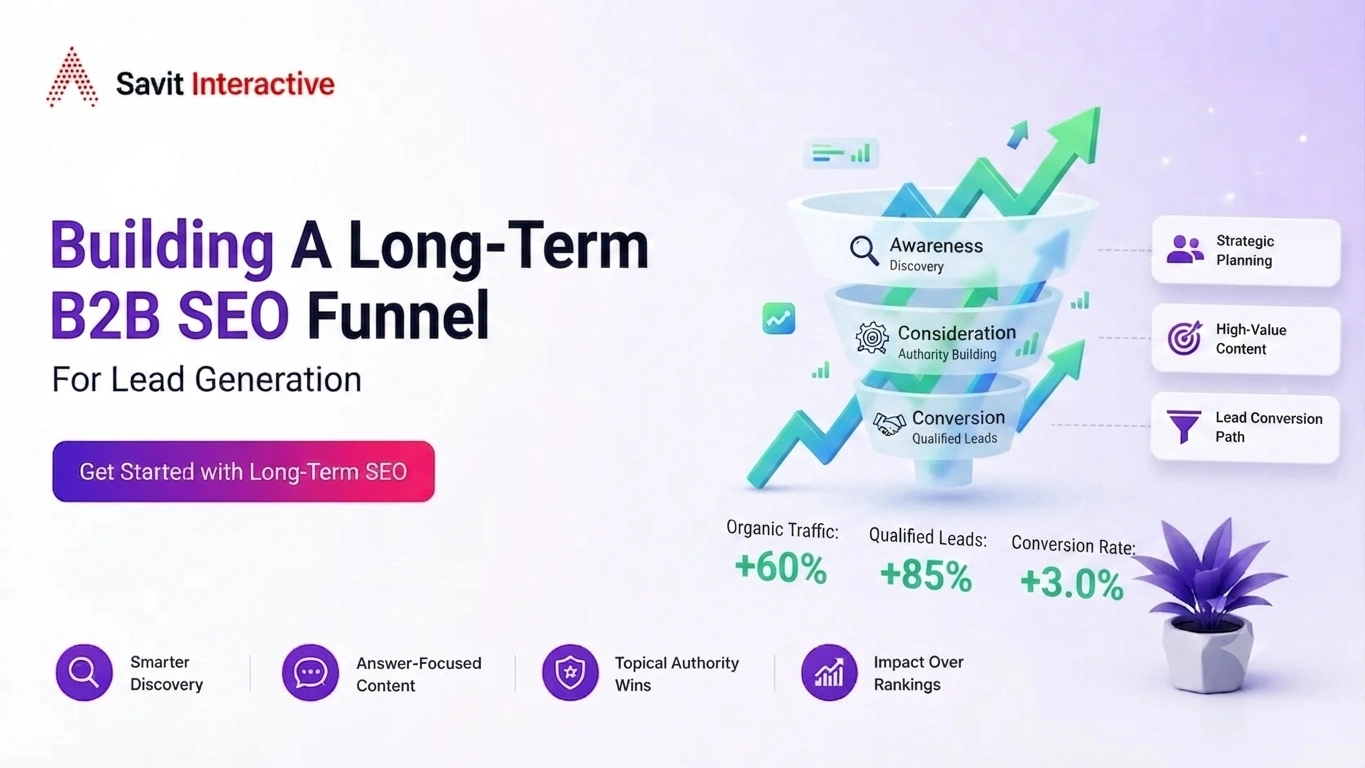
- A structured SEO funnel maps content to each buying stage: awareness, evaluation, and decision.
- Companies publishing consistent, intent-mapped content generate 67% more leads per month.
Most B2B companies in the UAE invest in SEO. Fewer connect that investment to a sales pipeline.
The pattern is familiar. Publish blog posts, track keyword rankings, report on traffic. But when leadership asks how many qualified leads came from organic search last quarter, the answer gets vague. The traffic numbers look fine. The pipeline contribution does not.
The problem is rarely the investment in B2B SEO services itself. It is the absence of a funnel behind it. B2B buying decisions involve multiple stakeholders, longer evaluation periods, and significantly higher deal values. A single blog post or service page will not convert a procurement head who is still defining the problem. What does work is a structured SEO funnel: one that maps content to each stage of the buyer’s journey, from the moment they identify a challenge, through their research and comparison phase, to the point where they are ready to talk to a vendor.
This blog walks through how to build that funnel, what content belongs at each stage, and how to measure whether your organic effort is actually feeding your pipeline.
Why B2B SEO Works Differently from B2C
B2B SEO targets fewer people with higher intent, longer decision timelines, and multiple decision-makers. The goal is qualified leads and pipeline contribution, not mass traffic.
This distinction matters because it changes everything about how SEO should be structured. In B2C, a single visit can lead to a purchase within minutes. In B2B, the same visitor might need weeks of research, approval from five other people, and three rounds of internal discussion before reaching out to a single vendor.
| Factor | B2C SEO | B2B SEO |
| Buyer type | Individual consumer | Committee of 5 to 7 stakeholders |
| Decision timeline | Minutes to days | Weeks to months |
| Keyword volume | High volume, broad intent | Lower volume, high commercial intent |
| Success metric | Sales, conversions | MQLs, SQLs, pipeline value |
| Content role | Product-led, transactional | Education-led, trust-building |
Whitehat SEO’s 2026 B2B Lead Generation Report found that B2B buying committees now average 6.8 stakeholders, up from 5.1 in 2023. That means more people involved in the decision, longer timelines, and more content consumed before anyone picks up the phone.
BrightEdge data shows that organic search generates 44.6% of all B2B revenue, more than double any other marketing channel. For B2B companies in the UAE, where industries like logistics, construction, technology, and professional services are fiercely competitive, this makes organic search the single most valuable channel for sustained growth. Ranking for a high-intent term such as “supply chain management software UAE” carries more commercial weight than ranking for a broad keyword with 10,000 monthly searches but no purchase intent.
This is why a B2B SEO firm approaches keyword strategy and content planning very differently from a general SEO agency. The volume is lower, but the value per visitor is far higher.
How to Structure an SEO Funnel for B2B Lead Generation
A B2B SEO funnel maps specific content types and keyword strategies to each stage of the buying journey. When built correctly, it ensures that organic search is doing more than attracting visitors. It is qualifying them, educating them, and moving them closer to a conversation with your sales team.
Top of Funnel: Attract Buyers Who Are Identifying a Problem
At this stage, the buyer does not know your brand. They are searching for symptoms, not solutions. A CFO concerned about rising operational costs is not typing “best consultancy in Dubai.” They are searching “how to reduce procurement costs in the GCC” or “why is employee retention falling in UAE companies.”
The content that works here is educational: guides, industry reports, data-backed blog posts. The purpose is not to sell. It is to build trust and capture attention.
SEO action: Target informational, problem-aware keywords. Use question-based headings that mirror how people actually search. Structure every answer to open with a direct response in the first two sentences, then expand with supporting detail. This makes the content extractable by AI Overviews and voice search.
DemandMetric research shows that content marketing costs 62% less than traditional marketing while generating three times more leads. The cost efficiency makes top-of-funnel content one of the highest-leverage investments a B2B company can make.
A practical example for Dubai: A B2B logistics company publishes a guide titled “Common Supply Chain Bottlenecks in the GCC.” It does not mention its own services. It ranks for relevant informational queries, builds authority in the category, and captures email sign-ups through a downloadable PDF version of the report. Six weeks later, some of those readers are in the middle of the funnel, comparing vendors.
Middle of Funnel: Help Buyers Evaluate Their Options
The buyer now understands the problem and is actively researching how to solve it. They are comparing approaches, reading case studies, and building a shortlist of potential vendors. This is where many B2B companies lose ground, because they have plenty of top-of-funnel blog content but almost nothing that helps buyers evaluate.
SEO action: Target solution-aware and comparison keywords. “Best ERP solutions for mid-sized businesses in the UAE,” “managed IT services vs in-house IT team,” and “how to choose a B2B SEO company” are all middle-of-funnel queries. The buyer already knows they need something. They are figuring out what.
The SageFrog 2026 B2B Marketing Report found that 74% of B2B marketers say generating demand and leads is a top goal achieved through content marketing. HubSpot data supports this: companies with active blogs generate 67% more leads per month than those without.
Content architecture matters here. The pillar-cluster model is the most effective structure. A pillar page covers the broad topic comprehensively. Cluster pages dive into specific sub-topics, use cases, or comparisons, and link back to the pillar. This signals topical authority to search engines. For a B2B SEO agency, it also mirrors the way buyers actually research: starting broad and narrowing toward a decision.
Bottom of Funnel: Convert Researched Buyers into Leads
The buyer is close to a decision. They have done their research. They are looking at specific vendors, checking credentials, reading testimonials, and searching for a reason to reach out or a reason not to.
The content that works here is direct: service pages, consultation landing pages, pricing guides, client testimonials, and industry-specific case studies. This is not the place for educational content. It is the place for clarity, proof, and a clear next step.
SEO action: Target high-intent, decision-stage keywords. Queries like “B2B SEO agency in Dubai,” “supply chain consultants UAE,” or “ERP implementation company Dubai” all signal a buyer who is ready to engage. These pages should have one primary call to action: book a consultation, request a proposal, or schedule a demo. Strip the distractions. Every element on the page should move the visitor toward that single action.
HubSpot data, cited in SEO Sherpa’s 2026 B2B SEO statistics report, shows that SEO leads close at a rate of 14.6%, compared to just 1.7% for outbound leads. The reason is straightforward. An organic lead has already researched the problem, evaluated options, and chosen to reach out. They arrive better informed and further along in their decision than a cold lead ever will.
Here is the full funnel at a glance:
| Funnel Stage | Buyer Intent | Content Type | Example Keyword |
| Top (TOFU) | Identifying a problem | Guides, blogs, reports | “how to reduce procurement costs in the GCC” |
| Middle (MOFU) | Evaluating solutions | Case studies, comparisons, webinars | “best ERP solutions for SMEs in UAE” |
| Bottom (BOFU) | Choosing a vendor | Service pages, testimonials, demos | “B2B SEO agency in Dubai” |
How to Measure Whether Your SEO Funnel Is Generating Leads
Traffic is a vanity metric when it is not segmented by funnel stage. A 50% increase in top-of-funnel blog traffic sounds good in a report. But if bottom-of-funnel pages are not converting visitors into enquiries, the number means very little to the business.
Effective measurement for a B2B SEO funnel tracks three layers:
- Visibility metrics: Keyword rankings, impressions, and organic traffic, broken down by page group. Separate your TOFU blog traffic from your MOFU comparison pages and your BOFU service pages. This tells you where in the funnel your search presence is strong and where it has gaps.
- Engagement metrics: Time on page, scroll depth, downloads, and email sign-ups. A blog post with high traffic but a 15-second average session duration is not educating anyone. A case study with low traffic but strong engagement is doing its job.
- Pipeline metrics: This is the layer most B2B teams miss. Track form submissions, demo requests, MQLs, and SQLs sourced from organic search. Tag organic leads at first touch in your CRM and log every subsequent organic page visit. This is what connects SEO to revenue.
DataBox reports that 70% of marketers say SEO outperforms PPC in generating sales, largely because organic traffic is better qualified and further along in the decision process. First Page Sage’s analysis across B2B clients from 2021 to 2025 found that a well-executed B2B SEO campaign delivers an average ROI of 748%.
The critical step is splitting your reporting by funnel stage so leadership sees where SEO is driving pipeline, not just where it is driving traffic. A competent B2B SEO firm reports on both. The distinction matters because it changes how the business values, funds, and supports the SEO programme over time.
B2B SEO without a funnel is a traffic exercise. B2B SEO with a funnel is a lead generation system.
The framework is not complicated. Attract with problem-aware content at the top. Support evaluation with comparison and case study content in the middle. Convert with high-intent service pages and clear CTAs at the bottom. Measure across all three layers: visibility, engagement, and pipeline.
The companies that build this system now will compound its value over the next 12 to 24 months. Organic search is a long-term channel, and the returns get stronger as authority and content depth accumulate.
How Savit Helps B2B Companies Build SEO-Driven Lead Generation in Dubai
At Savit, we build B2B SEO strategies around this funnel-first principle. With over 25 years of experience in search engine optimisation, we have worked through every phase of how search has evolved, and we apply that understanding to how B2B buyers in the UAE research, evaluate, and choose their partners.
Our B2B SEO services are structured around the full buying journey. We start with understanding your business goals, target industries, and the decision-makers you want to reach. From there, we build a keyword and content strategy that covers every funnel stage: awareness-level content that attracts the right audience, evaluation-level assets that support buyer research, and high-intent service pages designed to convert.
As a B2B SEO agency in Dubai, we also handle the technical foundations: site speed, indexing, internal linking, structured data, and authority building through quality backlinks from relevant industry sources. Every engagement is tailored to the business’s sector, audience, and sales cycle. There is no template approach.
As a B2B SEO company trusted by businesses across the UAE, we focus on what matters most: qualified traffic, better lead quality, and sustainable pipeline growth.
If your organic traffic is growing but your leads are not, talk to our B2B SEO team for a strategy consultation. We will map where your funnel has gaps and how to close them.