Key Highlights
- Google AI Overviews now appear in roughly 48% of all searches, delivering AI-generated answers above traditional organic results.
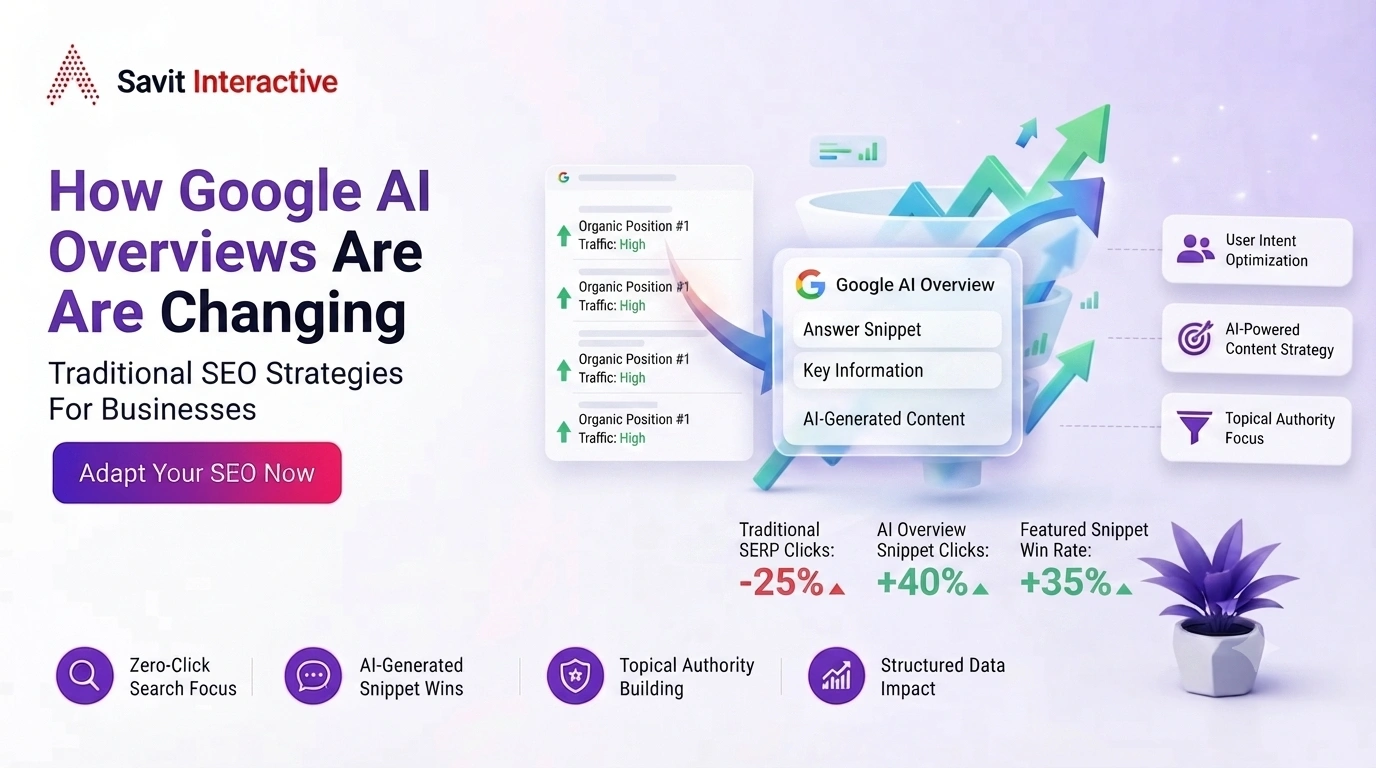
- Organic click-through rates drop by 34% to 61% on queries where an AI Overview is present.
- Ranking on page one no longer guarantees clicks. Being cited inside the AI Overview is where visibility now sits.
- Businesses that earn AI Overview citations see 35% more organic clicks than those that do not.
- The shift demands changes in content structure, topical coverage, schema markup, and how success is measured.
Your rankings look fine. Impressions are steady, maybe even rising. But organic traffic is slipping, and the leads that used to come from search are thinning out.
The reason is not a Google penalty or a technical error. It is a box sitting above the blue links on the search results page: Google’s AI Overview.
AI Overviews are AI-generated answer summaries that pull information from multiple websites and present a synthesised response before the user scrolls to a traditional listing. They launched widely in 2024, and as of March 2026, they appear in roughly 48% of all Google searches. For businesses in the UAE that depend on organic search for leads, enquiries, or revenue, this changes the rules of artificial intelligence search engine optimization in a practical way.
This blog covers what AI Overviews actually are, how they affect your traffic, and what you can do right now to stay visible.
What Are Google AI Overviews and How Do They Work?
Google AI Overviews are AI-generated summaries displayed at the top of search results. When a user types a question, Google’s Gemini model pulls relevant information from several web pages, synthesises it into a short answer, and shows it with links to the sources it drew from.
Unlike featured snippets, which pull text from a single page, AI Overviews read across multiple sources, combine them, and construct a new response. The user gets a direct answer without clicking through.
The scale is significant. SeoProfy, referencing Google’s own data, reports that AI Overviews now reach approximately 2 billion monthly users globally. Following Google I/O 2026, the feature is available in nearly 200 countries. Semrush data cited by SeoProfy shows that informational queries trigger AI Overviews 39.4% of the time, climbing to 65.9% for longer queries of seven or more words. The UAE is among the markets where AI Overviews have rolled out fully, with the Middle East seeing rapid adoption alongside the United States and South Asia, according to NP Digital’s analysis across 38 countries.
For businesses exploring AI for SEO, this shift is the starting point. The search interface your customers use has changed. The question is whether your content is built for it.
How Are AI Overviews Affecting Organic Traffic and Click-Through Rates?
The short answer: fewer people are clicking through to websites, even when those websites rank well.
Seer Interactive published the most comprehensive study on this shift to date, tracking 53 brands, 5.47 million queries, and 2.43 billion impressions from January 2025 to February 2026. Organic CTR on queries where an AI Overview appeared fell from 1.76% to 0.61% by mid-2025. It then recovered partially to 2.4% by February 2026. Meanwhile, CTR on queries without AI Overviews rose from 2.8% to 3.8% over the same period. The gap between the two sits at roughly 37% and represents a new structural baseline.
SparkToro and Datos found that 60% of all Google searches now end without a single click. On mobile, that figure reaches 77%.
That is the sobering side. Here is the other side.
Digital Applied’s March 2026 research found that brands cited inside AI Overviews earn 35% more organic clicks and 91% more paid clicks compared to non-cited competitors on the same queries. Being cited is commercially valuable. The traffic that does come through converts better because those visitors arrive with more context and clearer intent.
What this means for businesses in the UAE: The UAE has one of the highest internet penetration rates in the world. According to Global Media Insight’s 2025 UAE Digital Report, internet penetration stands at over 99%, with Google as the dominant search engine for both English and Arabic queries. When the way search delivers answers changes, it directly reshapes how businesses in Dubai, Abu Dhabi, and Sharjah acquire customers. Consider a real estate company that ranks first for “best off-plan properties in Dubai.” The ranking still shows up. But if the AI Overview compares developments, highlights prices, and lists handover timelines right on the results page, fewer users click through.
This is why the conversation around artificial intelligence search engine optimization is shifting. Traditional rankings still matter, but they no longer tell the full story. The discipline that addresses this gap is called answer engine optimization: structuring your content so that AI systems can read, extract, and cite it accurately.
What SEO Strategies Still Work When AI Overviews Dominate Search Results?
The good news is that the fundamentals of good SEO have not disappeared. What has changed is how those fundamentals need to be applied. Below are four strategies that are delivering measurable results for businesses adapting to this shift.
Lead Every Section with a Direct Answer
AI Overviews extract discrete claims from your content. Stackmatix’s April 2026 analysis found that pages burying answers inside long narrative are less likely to be cited than pages opening with clear, factual statements.
The practical change is straightforward. Every major section on your page should start with a concise answer block of 40 to 60 words that directly addresses the heading’s question. The detail, context, and examples follow after.
Build Topical Authority Across Connected Pages
A single high-ranking page is no longer enough. AI Overviews typically synthesise from three to five sources per answer.¹⁰ Google’s query fan-out technique breaks a user query into dozens of sub-searches, and pages appearing across multiple sub-searches gain citation priority regardless of rank for the original query.
For businesses using AI for SEO, this is a critical shift. A healthcare provider in Dubai is better positioned if it covers individual specialities, insurance partnerships, patient guides, and location-specific service pages across an interconnected site than if it relies on one broad “our services” page. Consistent depth across a topic cluster signals the kind of authority AI systems look for.
Implement Structured Data and Schema Markup
Structured data tells search engines what your page contains and how to interpret it. According to eSEOspace’s May 2026 analysis, structured data is no longer optional for AI Overview visibility.
The essential schema types include:
| Schema Type | What It Signals | Best Used On |
| Article | Authorship, publish date, topic | Blog posts, guides, news |
| FAQ | Question-answer pairs | Service pages, resource pages |
| HowTo | Step-by-step processes | Tutorials, instructional content |
| Organisation | Brand identity, contact details | Homepage, about page |
| Local Business | Location, hours, service area | Location-specific pages |
Use JSON-LD format and keep your structured data consistent with the visible content on the page.
Strengthen E-E-A-T Signals Across Your Site
Google’s AI does not select sources based on rank alone. Stackmatix’s research confirms that content structure, claim clarity, and entity authority all influence citation decisions.
Practical steps include adding named author bios with relevant credentials, citing primary sources within your content, and maintaining a consistent brand presence across platforms and directories.
Both answer engine optimization and AI SEO optimization depend on these trust signals. Clear expertise, transparent sourcing, and real experience reflected in content are what separate pages that earn citations from those that do not.
Should Businesses Track Rankings or AI Overview Citations in 2026?
Both, but not in the way most businesses currently measure SEO.
Rankings still indicate whether your content is eligible for visibility. Citations tell you whether it is actually earning that visibility inside AI answers. ALM Corp’s April 2026 analysis highlights the signature pattern: impressions rising while clicks fall. If that shows up in your Search Console data, your content is being seen but the AI Overview is answering the query before users reach your page.
Citation tracking now belongs alongside traditional rank tracking as a primary KPI. Tools such as Semrush, Ahrefs, and BrightEdge have introduced AI citation monitoring features for this purpose. The practical step is to split your reporting into two views: queries where an AI Overview is present and queries where it is not. Combining them makes both CTR and ROI readings misleading.
There is an upside worth noting. Semrush data, referenced by both Mersel AI and Demand Local in their 2026 analyses, shows that AI search visitors convert at 4.4 times the rate of standard organic visitors. They arrive better informed and further along in their decision. While the volume of traffic may shrink on certain query types, the value per visit increases for businesses structured to earn citations.
This is where AI SEO optimization becomes more than a technical exercise. It requires rethinking what success looks like: not just position, but presence inside the answer itself. Artificial intelligence search engine optimization, in 2026, is about earning trust from both the user and the AI system that serves them.
The Road Ahead
The relationship between ranking and visibility has changed. Page one still matters. But for a growing share of queries, the commercial advantage sits inside the AI-generated answer at the top of the results page. The businesses that adapt will focus on four things: leading with direct answers, building topical authority, implementing structured data, and strengthening E-E-A-T signals that make their pages worth citing.
This is not a temporary disruption. Gartner projects that 25% of organic search traffic will shift to AI-powered channels by end of 2026. The sooner a business adjusts, the stronger its position as this shift deepens.
How Savit Helps Businesses Earn Visibility in Google AI Overviews
At Savit, we have been adapting our SEO methodology to this shift since AI Overviews entered mainstream search. With over 25 years of SEO experience, we bring a depth of understanding that comes from working through every major search evolution, and this one requires the same rigour. It is also why businesses across Dubai and the UAE trust us as their AI SEO agency.
Our AI SEO optimization services are built around how each AI platform surfaces information. We run distinct strategies for Google AI Overviews, ChatGPT, Gemini, and Perplexity, because each platform has its own citation behaviour. This includes structured data implementation, intent-driven content mapping, entity authority building, and citation-focused optimisation.
As an AI SEO agency in Dubai, we tailor every engagement to the business’s category, audience, and search behaviour. Whether you need a full answer engine optimization strategy or a focused audit of where your brand stands in AI search, our team works with you to close the gap between ranking and visibility.
If your organic traffic is shifting and you want to understand what is driving the change, get in touch for a free AI SEO audit. We will show you where your brand appears across AI search platforms and where the opportunities are.