Learn how to optimise content for ChatGPT and Google AI answers through clear writing, technical SEO and stronger authority signals.
Key Highlights
- AEO is implemented through everyday content production, including how pages are researched, written, structured, published and refreshed.
- Place the direct answer near the beginning of each section, then support it with evidence, context and practical detail.
- Structured data helps machines understand page information, but Google does not require special AEO schema for AI Overviews or AI Mode.
- ChatGPT Search and Google use different retrieval systems, so brands need strong search foundations and consistent information across the wider web.
- External mentions, reviews, expert profiles and credible editorial coverage can strengthen the authority surrounding a brand.
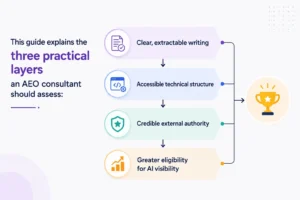
- Effective AEO combines three layers: extractable writing, technical accessibility and external authority.
Answer Engine Optimisation has become one of the most discussed areas of digital marketing. Yet much of the conversation remains theoretical.
Brands are told that AI search is growing, customer behaviour is changing and visibility is moving beyond conventional search results. What they often do not receive is a clear explanation of how to change the content they publish.
How should a service page begin? Which claims need sources? Does schema guarantee inclusion in an AI Overview? Which crawler should be allowed? How often should an article be updated?
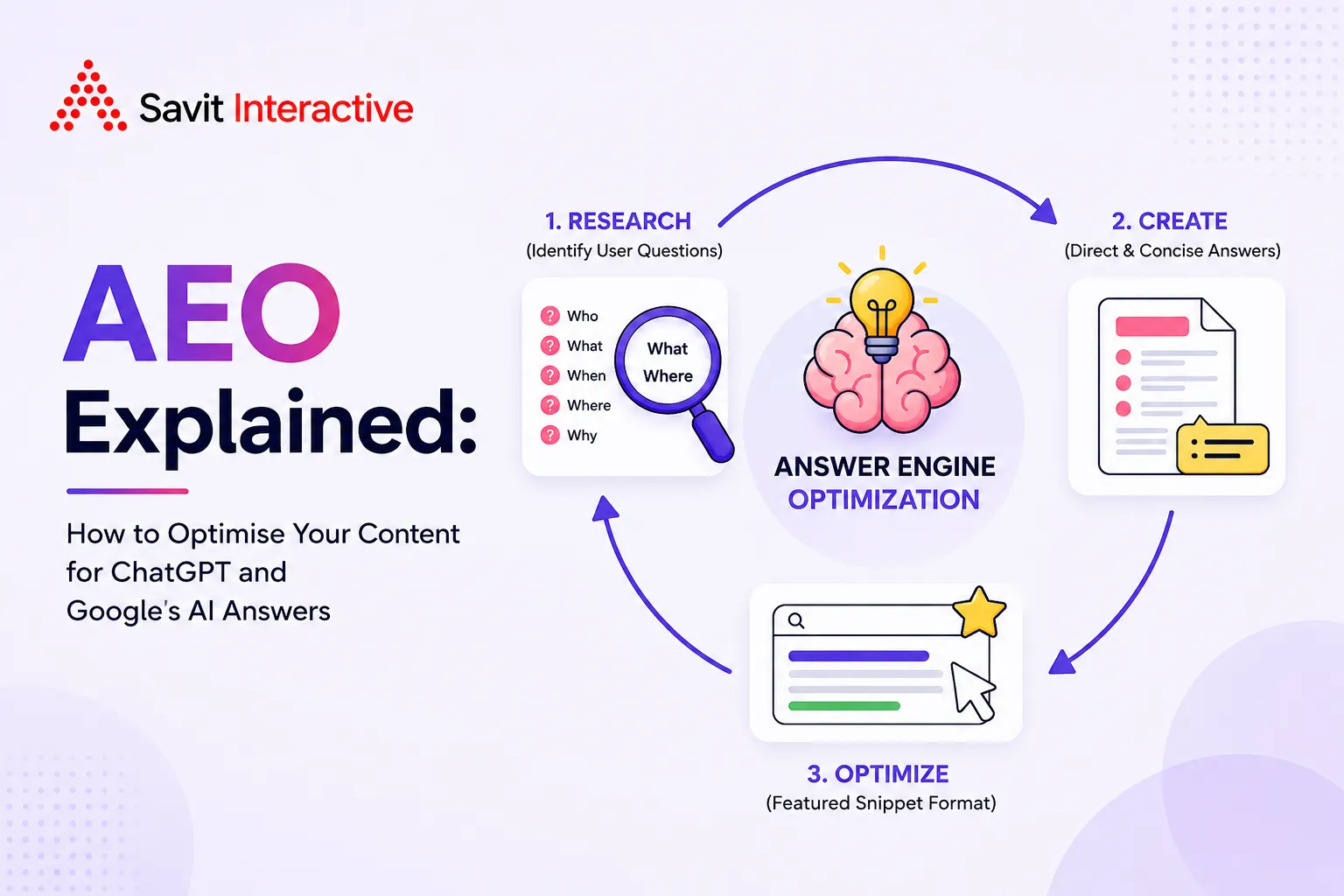
AEO is the practice of improving content so answer engines can discover it, understand it and consider it when generating a response. These platforms include ChatGPT Search, Google AI Overviews, AI Mode, Perplexity and other AI-assisted discovery tools.
According to the Acquia and Researchscape survey of more than 500 marketing professionals, 70% believed AEO would significantly affect their digital strategy within one to three years. Only 20% had started implementing it at the time of the research.
That gap is less about awareness and more about execution.
This guide explains the three practical layers an AEO consultant should assess:
How to Write Content That AI Engines Can Extract and Cite
Content created for AI discovery should remain written for people. The goal is to make important information easy to locate without flattening the page into robotic fragments.
Google explicitly states that websites do not need to rewrite content solely for generative AI. Its systems can understand synonyms, meaning and nuanced topics across a page. Google recommends useful, original and people-focused information rather than content engineered around supposed AI shortcuts.
Within that people-first approach, four writing practices can improve clarity and retrieval.
1. Put the answer before the background
Open each important section with the information the reader came to find.
Do not begin with four paragraphs explaining why the topic is important. Provide the answer first, then expand it.
For example, a page about company formation should not begin with a broad description of Dubai’s economic growth. It could start with:
Setting up a mainland company in Dubai usually requires an approved business activity, a trade name, initial approval, a registered address and a licence issued through the relevant authority. The exact requirements depend on the activity, ownership structure and regulatory approvals involved.
The reader receives immediate value. The paragraphs that follow can then explain each requirement, expected costs and possible variations.
This approach is sometimes known as Bottom Line Up Front, or BLUF.
The exact number of words is less important than the editorial principle. A short answer may need 30 words. A regulated or technical topic may need 80. The opening should be complete enough to be useful without becoming misleading.
Recent controlled GEO research supports the importance of placement. The 2026 What Gets Cited study tested 252,000 comparisons across six large language models. It found that topical relevance and the position of a source within the available context were the strongest drivers of which source received the first citation.
For AEO marketing, the practical lesson is simple: do not bury the page’s strongest information.
2. Make every section understandable on its own
An answer engine may retrieve one passage rather than interpret the entire article as a single unit.
Each section should therefore make sense without requiring the reader to return to the previous heading.
Weak version:
“This is why it is essential for companies operating in the region.”
The sentence does not explain what “this” means or which companies are being discussed.
Clearer version:
“Maintaining consistent business information across local directories helps Dubai companies strengthen their location and entity signals.”
The revised sentence contains the subject, action and purpose. It can stand independently.
A self-contained section usually includes:
- A clear question or topic
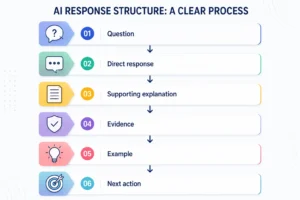
- A direct answer
- Supporting evidence
- An explanation or example
- A practical implication
This does not mean repeating the company name in every paragraph. It means removing vague references that only make sense when the whole page is read from top to bottom.
An experienced AEO consultant should build this requirement into the brief before drafting begins.
3. Use headings that reveal the question
Descriptive headings help readers scan a page and help retrieval systems understand its structure.
Compare these options:
|
Vague heading |
Clearer heading |
|
Costs |
How Much Does SEO Cost in Dubai? |
|
Our Approach |
How Does the Implementation Process Work? |
|
Key Information |
What Documents Are Required? |
|
More Details |
What Factors Affect the Final Price? |
Question headings are particularly useful when the section answers a common customer query. They mirror the language people use in search, voice assistants and conversational AI tools.
However, every heading does not need to be written as a question. A heading such as “Documents Required for a Dubai Trade Licence” can be equally clear.
The purpose is to label the information precisely, rather than force a mechanical format.
Strong AEO marketing combines natural-language questions with descriptive statements according to the needs of the page.
4. Support important claims with evidence
AI systems and human readers both benefit from claims that can be checked.
The foundational GEO study introduced several methods for improving content visibility inside generative-engine responses. According to the Princeton-led research, techniques involving statistics, quotations and credible sources improved visibility in its controlled benchmark, with gains reaching up to 40% in some settings.
The result should not be treated as a universal promise. The experiment worked with content that was already included within a fixed source set. It did not prove that inserting statistics automatically makes an unpublished page discoverable.
The more useful lesson is that specific, sourced information is easier to evaluate than vague promotion.
Instead of writing:
Dubai offers many attractive opportunities for international investors.
Write:
According to the relevant government or market report, transaction value increased by a stated percentage during a defined period.
Then explain what the number means and where its limitations lie.
Good evidence may come from:
- Government and regulatory publications
- Peer-reviewed research
- Original company data
- Transparent industry studies
- Named specialists with relevant credentials
- Current product or service documentation
- First-hand case evidence
Clear writing and strong sourcing should work together. This is the foundation of effective AEO optimization for healthcare, legal, financial and other high-trust sectors.
Technical and Schema Best Practices for AEO
Good content cannot perform when search engines cannot crawl, index or interpret the page.
The technical layer does not replace editorial quality. It makes the content available to the systems that may retrieve it.
Use a scannable page structure
Dense walls of text make information harder to navigate.
Choose the format that best communicates each type of information:
- Use numbered lists for processes.
- Use bullet points for requirements or features.
- Use tables for comparisons.
- Use short paragraphs for explanations.
- Use descriptive captions for charts and images.
- Use clear HTML headings in a logical order.
A comparison should look like a comparison. A process should look like a process.
Formatting alone will not secure a citation. The 2026 competitive GEO study found that formatting-only changes produced relatively limited effects compared with relevance, context position, freshness and specific useful information.
Structure should clarify substance, not disguise the absence of it.
Implement relevant structured data
Structured data provides explicit, machine-readable information about a page.
Google says it can help the search engine understand and classify content. Valid markup can also make a page eligible for supported rich-result formats.
The schema type should match the page:
|
Schema type |
What it describes |
Suitable use |
|
Article |
Headline, author and publication details |
Blogs, guides and news content |
|
Organisation |
Company identity and official details |
Corporate websites |
|
LocalBusiness |
Address, hours and contact information |
Physical UAE locations |
|
Product |
Product details, offers and availability |
Ecommerce pages |
|
ProfilePage or Person |
Author or specialist information |
Expert and YMYL content |
|
BreadcrumbList |
Page hierarchy |
Large websites |
|
VideoObject |
Video details and thumbnail information |
Video-led pages |
There is an important correction to a common AEO claim: schema does not determine whether AI can understand a page “at all”.
Google says that no special schema or machine-readable AI file is required for AI Overviews or AI Mode. It also warns against overfocusing on structured data for generative search. Existing SEO foundations remain more important.
Structured data should:
- Match visible page content
- Follow Google’s supported documentation
- Include accurate properties
- Be tested before publishing
- Be monitored after deployment
- Be updated when the visible information changes
Professional AI SEO services should treat schema as one part of technical SEO, rather than market it as a guaranteed route into AI answers.
Check crawler and indexing access
Google AI features depend on pages available through Google Search. To be eligible as a supporting link, a page must be indexed and eligible to appear with a search snippet. Google does not impose additional technical requirements for AI Overviews or AI Mode.
Check that:
- Important pages are not blocked in robots.txt.
- Pages return a successful HTTP status.
- Canonical tags identify the correct URL.
- noindex is not applied accidentally.
- Important content is visible as crawlable text.
- Internal links make pages easy to discover.
- JavaScript does not hide essential information.
- CDN or firewall rules do not block legitimate crawlers.
ChatGPT Search uses a separate crawler. OpenAI advises publishers to allow OAI-SearchBot if they want their content to be discoverable, cited and linked within ChatGPT search results. GPTBot controls potential model-training access and serves a different purpose.
An AI search services audit should distinguish between these user agents instead of applying one broad rule to every AI crawler.
Treat freshness as editorial maintenance
Freshness does not mean changing the publication date without improving the page.
Review priority content according to how quickly its subject changes.
|
Content type |
Suggested review cycle |
|
Prices and product availability |
Monthly or whenever changed |
|
Laws, policies and regulations |
After every official update |
|
Commercial comparison pages |
Quarterly |
|
Market data and statistics |
Quarterly or biannually |
|
Evergreen definitions |
Every 6 to 12 months |
|
Contact and location details |
Immediately after any change |
During a refresh, check:
- Statistics and dates
- External source links
- Product or service details
- Regulations
- Examples
- Author credentials
- Internal links
- Calls to action
- Structured data
The value of freshness is supported by newer citation research. The 2026 competitive GEO study found that a recent timestamp helped sources earn the first citation more consistently within its controlled comparisons.
Reliable AI search services should therefore include scheduled review cycles, especially for commercial and regulated subjects.
How to Build External Authority That AI Engines Trust
AI platforms can retrieve information from across the public web. A company’s own website is one signal within a wider information environment.
A strong authority layer helps platforms understand who the organisation is, what it does and whether other credible sources recognise it.
Keep brand information consistent
Core business information should remain consistent across:
- The company website
- Google Business Profile
- Industry directories
- Professional listings
- Review platforms
- Author profiles
- Press coverage
- English and Arabic profiles
Consistency does not mean copying the same promotional paragraph everywhere. It means aligning factual information such as the legal name, location, services, leadership and contact details.
For UAE companies, bilingual consistency deserves particular attention. Arabic and English listings should describe the same organisation, even when the wording is adapted naturally for each language.
Professional AEO services should audit these external entity signals alongside the website.
Earn credible reviews and customer discussion
Review platforms and public discussions can influence how buyers perceive a company. They may also provide external context that answer engines can retrieve.
The right approach is to earn genuine commentary by delivering a good service and making it easy for real customers to leave honest feedback.
Avoid manufactured reviews, disguised promotion or repetitive forum posts. Google’s 2026 guidance specifically warns that seeking inauthentic mentions is not a useful AI-search tactic. Its ranking and spam systems continue to focus on quality and authenticity.
Participation in Reddit, Quora or industry communities should be helpful and transparent.
For example, a property specialist could explain the difference between freehold and leasehold ownership without forcing a sales pitch into the response. A software provider could answer a technical implementation question and disclose its connection to the product where relevant.
Good AEO marketing strengthens genuine expertise wherever customers discuss the category. It does not manufacture artificial popularity.
Use video to widen the information surface
Video can communicate experience that is difficult to reproduce through generic articles.
Useful formats include:
- Expert explanations
- Product demonstrations
- Property walkthroughs
- Interviews
- Webinars
- Step-by-step tutorials
- Customer questions
- Market updates
Support each video with an accurate title, detailed description, chapters, captions and a corrected transcript.
Google advises site owners to support text with high-quality images and video where appropriate. Its systems may use different forms of content to provide more helpful search experiences.
Video should complement the website. Publish the essential answer as text as well, particularly when accessibility or precise sourcing matters.
Build earned third-party authority
A company describing itself as an expert is a claim. An independent publication referencing its research is evidence.
Useful authority-building activities include:
- Publishing original data
- Contributing expert commentary
- Producing useful market reports
- Participating in industry research
- Speaking at credible events
- Earning coverage in relevant publications
- Securing citations from professional bodies
- Building partnerships with recognised organisations
Digital PR should be driven by information worth reporting. A thin press release distributed across low-quality websites may create links without building genuine authority.
The strongest AEO services connect content strategy with editorial outreach. The website becomes the primary source, while credible third parties help validate the expertise around it.
An AI optimization agency should also monitor which external sources AI platforms cite for important customer questions. This can reveal whether the category is shaped by regulators, publishers, review sites, forums, videos or competitors.
AEO Is a Production Discipline, Not a Strategy Slide
AEO succeeds when it becomes part of how every useful page is produced.
The writing layer makes answers clear and self-contained. The technical layer keeps pages crawlable, indexable and accurately structured. The authority layer gives customers and retrieval systems reasons to trust the information.
None of these practices works as a standalone trick.
Schema cannot rescue weak content. Short paragraphs cannot compensate for poor evidence. External mentions cannot correct inaccurate business information. A page needs substance, accessibility and trust working together.
For UAE organisations in healthcare, real estate, hospitality, ecommerce, legal services and B2B sectors, these three layers should form the production standard for priority content.
At Savit, we implement this full framework across our AEO services and wider search engagements.
As an AI optimization agency in Dubai, we combine answer-led content production, technical SEO, relevant structured data and external authority development. Our AI SEO services include content audits, question research, page restructuring, schema deployment, crawler-access checks and planned freshness reviews.
Our work is adapted to the client’s audience, sector and competitive environment. The AEO optimization requirements of a healthcare provider differ from those of a property developer, ecommerce store or B2B technology company.
As an experienced AEO consultant team, we assess visibility across Google AI Overviews, AI Mode, ChatGPT Search, Perplexity, Gemini and Microsoft Copilot. We track citations, brand mentions, referral traffic and conversions instead of treating rankings as the only measure of performance.
Our AEO marketing approach also considers the information surrounding the brand, including professional profiles, reviews, videos, local listings and credible third-party coverage.
Savit’s AI search services bring content, technical implementation and authority building into one coordinated process. These AI search services are designed to improve discoverability while protecting the clarity and credibility customers expect.
If you want your business to become a stronger source for ChatGPT, Google’s AI answers and other platforms your customers use, talk to our AEO team for a free AI visibility audit.