Expert reviewed by: Savit’s SEO Head – Milan Siddhapura
Last updated: 8 October 2026, the day Google confirmed the rollout was complete
Google’s September 2026 spam update finished rolling out on 8 October 2026, after two weeks of ranking swings across every country and language, including the UAE. If your Dubai or Abu Dhabi business saw leads from Google drop in late September or early October, this update is the first thing to rule in or out.
This guide is written for UAE business owners and marketing teams, not SEO specialists. It covers what Google actually confirmed, which shortcuts get sites into trouble, how to check whether you were affected, and a practical plan to protect your website before the next update lands.
One thing to know up front: spam updates are not random. Google publishes its spam policies, and a site that follows them has very little to fear. Most of the work below is about making sure your site, and anyone working on it, stays on the right side of those rules.
What the September 2026 spam update is
It is Google’s fourth spam update of 2026, and the first this year to take two weeks instead of two days. Google described it only as a normal spam update for all languages and locations, and did not name a specific tactic it was targeting.
| Detail | What we know |
|---|---|
| Started | 24 September 2026, about 8:15 pm UAE time |
| Finished | 8 October 2026, confirmed by Google Search Central |
| Rollout length | About two weeks (March, June and August 2026 spam updates each took one to three days) |
| Where | Global, all languages, so English and Arabic results in the UAE are both in scope |
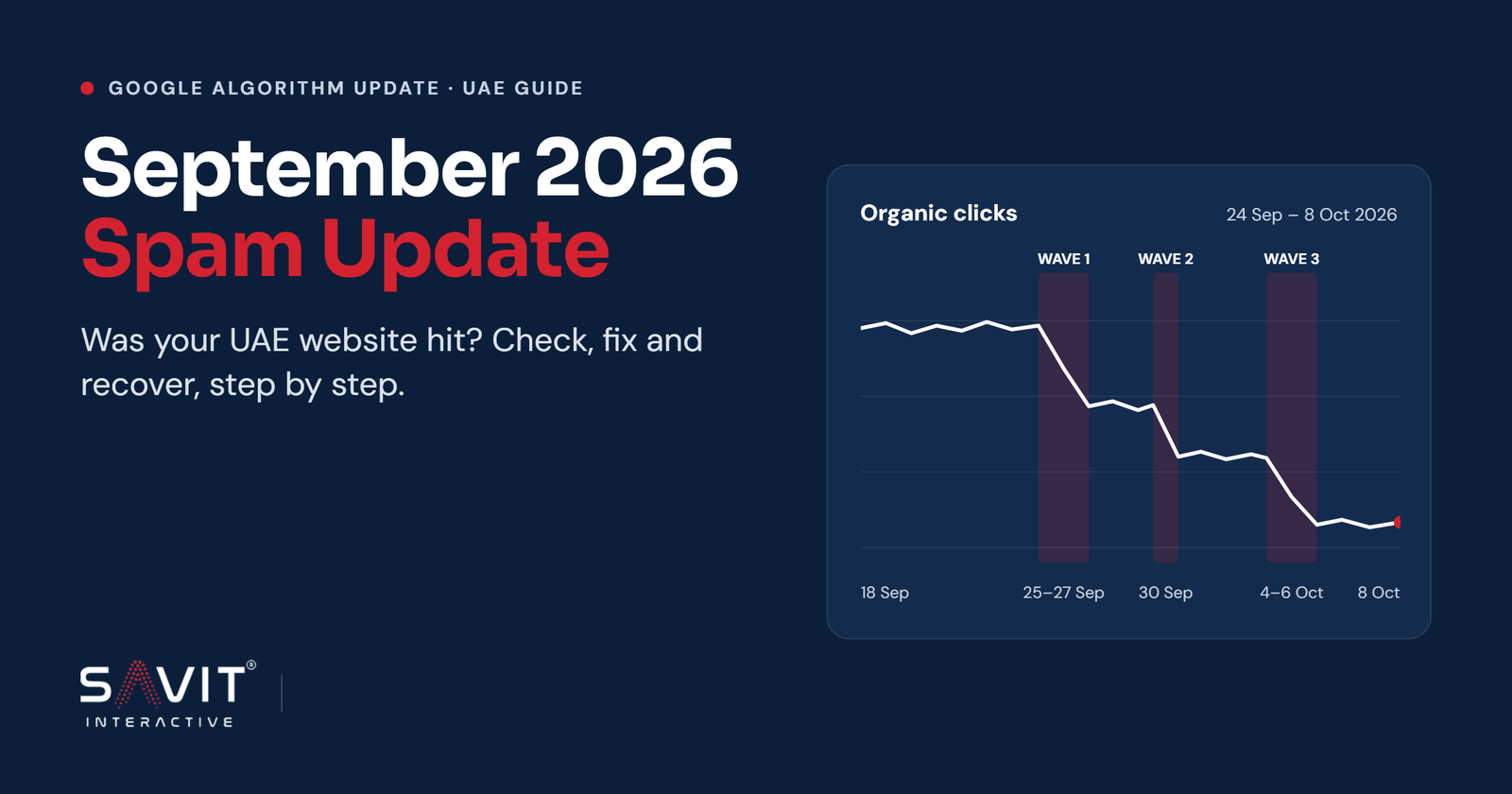
| Main impact waves | 25 to 27 September, 30 September, and 4 to 6 October |
| What it targets | Sites that break Google’s search spam policies; Google’s AI spam detector, SpamBrain, is improved in these updates |
| Recovery time | Months, not days, once the problem is fixed |
Industry watchers noted that the impact felt closer to a core update than a typical spam update, with traffic losses reported across news, ecommerce and service sites. Google has not shared what share of searches was affected.
What this means for you: if your traffic fell on one of the three wave dates above, the spam update is a strong suspect. If it fell before 24 September, look elsewhere first.
Spam update or core update? Why the difference matters
A core update re-ranks content by quality and relevance; a spam update demotes or removes sites that break specific rules. The fix for each is different, so diagnosing the right one saves you months.
| Core update | Spam update | |
|---|---|---|
| Purpose | Reassess which content is most helpful | Catch sites breaking spam policies |
| A drop means | Competitors’ content was judged better | Your site may be doing something Google forbids |
| Is it a penalty? | No | Effectively yes, through automated demotion |
| How to recover | Improve content quality over time | Remove the violation, then wait for Google’s systems to re-evaluate |
| Last one in 2026 | May (21 May to 2 June) | September (24 September to 8 October) |
Be careful with what you read online. Some blogs have claimed a “September 2026 core update” ran from 12 to 26 September. Google’s official ranking updates dashboard lists no such update. If an agency tells you that you were hit by a September core update, ask them for the source.
The spam practices most likely to get UAE websites hit
Google did not say which policies this update focused on, so the safe assumption is all of them except link spam, which Google said was not a target this time. These are the violations we see most often on UAE sites, many of them added by past agencies or freelancers without the owner knowing.
| Practice (Google policy name) | How it typically shows up in the UAE | Risk |
|---|---|---|
| Scaled content abuse | Hundreds of AI-written blog posts or service pages published to “rank for everything”, with little original insight | High |
| Doorway pages | Near-identical pages for every area: “AC repair in JLT”, “AC repair in Marina”, “AC repair in Al Barsha”, with only the area name swapped | High |
| Low-quality machine translation | Arabic versions created by pasting English pages into a translator, never reviewed by a native speaker | High |
| Site reputation abuse | Trusted news, directory or portal sites hosting paid third-party pages (coupons, crypto, gambling-adjacent offers) unrelated to their main content | High |
| Expired domain abuse | Buying an old, authoritative domain and filling it with unrelated content to borrow its reputation | High |
| Hacked content | Outdated WordPress plugins letting attackers inject hidden pages or links, often in other languages | High, and often invisible to the owner |
| Keyword stuffing | Repeating “best SEO company in Dubai” unnaturally in titles, text and footers | Medium |
| Thin affiliate pages | Product pages copied from the supplier or marketplace with no added detail, prices or local information | Medium |
| Sneaky redirects and cloaking | Showing Google one page and visitors another, or redirecting mobile users to unrelated sites | High |
A note on AI content: Google does not ban AI-assisted writing. It penalises content produced at scale mainly to manipulate rankings, whoever or whatever wrote it. A well-researched page that an expert reviewed is fine. Fifty generic pages a week is not.
Link spam is still against the rules. Buying guest posts or joining link schemes can be hit by a future link spam update, and Google has said lost link value from those cannot be regained.
How to tell if your website was affected
The quickest test is a dated drop in Google Search Console that lines up with 25 to 27 September, 30 September or 4 to 6 October. Work through these steps in order; most take under 15 minutes.
- Wait for clean data. Google recommends waiting at least a week after an update finishes before judging the impact, so read your numbers from around 15 October onward.
- Compare the right dates. In Search Console, open Performance, then compare 24 September to 8 October with the two weeks before it. Look at clicks and impressions, not just average position.
- Match the drop to a wave. A sharp step down on one of the three wave dates points to the spam update. A slow decline, or a drop before 24 September, usually has another cause such as seasonality, a site migration or a competitor.
- Find where the loss sits. Filter by page. Spam demotions often hit one section hard, such as a blog folder, a set of area pages or the Arabic version, rather than the whole site evenly.
- Check Manual actions and Security issues. Both are in the left menu of Search Console. Spam updates are automated and usually leave these empty, but a hacked site or a manual penalty will show here.
- Search your own site. Type
site:yourdomain.aeinto Google and scroll. Pages you never created, in languages you do not use, or about casinos and medicines are a sign of hacking. - Rule out the obvious. Confirm tracking still works in Google Analytics, your pages still load, and nothing changed in your robots.txt or noindex tags around those dates.
If steps 3 and 4 both point to the spam update, treat it as a policy problem, not a content-quality problem, and move to the action plan below.
How to protect and recover your website
Recovery comes from removing the violation and then giving Google’s systems time, often several months, to see that your site now follows the rules. There is no reconsideration form for automated spam demotions, so the work itself is the only lever.
Week 1: Audit and stop the damage
- List every page on the site, including old blog posts and landing pages built for ads, and flag anything thin, duplicated or auto-generated.
- Update WordPress or your CMS, plugins and themes; remove plugins you no longer use; change admin passwords and turn on two-factor login.
- Ask any current or past agency for a list of what they published or built on your behalf, including links.
- Stop all bulk content publishing until the audit is finished.
Weeks 2 to 4: Clean up
- Remove or merge weak pages. Ten strong service pages beat 200 thin ones. Use 301 redirects to the closest useful page so you keep any real visitors.
- Rewrite area pages so each one earns its place: real projects completed in that community, local pricing, response times, photos and reviews from customers there. If you cannot say something specific about an area, do not create a page for it.
- Have a native Arabic speaker review or rewrite your Arabic pages, and set up hreflang tags correctly so Google matches the right language to the right searcher.
- Delete hacked pages, fix the security hole, and request removal of injected URLs in Search Console.
- If you host third-party content, make sure it is closely supervised and relevant to your audience, or move it off your main domain.
Month 2 onward: Build trust signals
- Add clear author and company information: who wrote the page, their experience, your trade licence and physical address.
- Publish fewer, deeper pieces based on first-hand experience, such as case studies from UAE clients, local regulations explained, or real cost breakdowns in AED.
- Earn links the honest way: local press, industry associations, chambers of commerce and genuine partnerships.
- Track progress monthly in Search Console. Expect gradual movement, with the bigger shifts usually arriving with later updates.
A UAE-specific checklist
UAE websites face risks that generic guides miss: two languages, dozens of tightly packed communities, and buyers who now research through AI answers as much as blue links. Tick these off for your site.
- Arabic pages are written or reviewed by a native speaker, not machine-translated
- English and Arabic versions are linked with correct hreflang tags
- Each area or emirate page contains information unique to that location
- Your Google Business Profile matches the name, address and phone number on your website
- Reviews come from real customers; none are bought, swapped or written by staff
- Prices, timings and contact details are current and shown in AED and UAE formats
- Your trade licence details and physical office address are visible on the site
- No pages were added in bulk in the last 12 months without editorial review
- WordPress core, theme and plugins are up to date, with two-factor login on admin accounts
- You know exactly which links your agency built, and none were bought
- Key pages answer real customer questions clearly, so AI Overviews and AI assistants can quote them
The last point matters more each quarter. The same signals that keep you safe from spam updates, which are original, accurate and clearly sourced content, are what AI search tools pick when deciding which businesses to mention.
How Savit Dubai can help
Savit helps UAE businesses find out whether an update hurt them, fix the cause, and build search visibility that holds up through future updates, in Google and in AI search. We are a Google Partner agency based at Meydan in Dubai, with 20+ years of global experience and a 100+ strong in-house specialist team, working with businesses across Dubai, Abu Dhabi, Sharjah, Ajman, Ras Al Khaimah and the wider GCC. Every recommendation we make sits inside Google’s published guidelines, and we never promise guaranteed #1 rankings.
| Service | What you get | Best for |
|---|---|---|
| Free website audit | A dated traffic analysis in Search Console against the three September wave dates, with a clear answer on whether the update affected you | Any business that saw a drop since late September |
| Technical SEO audit | A page-by-page review against Google’s spam policies: thin and duplicate content, doorway area pages, Arabic translation quality, hacked pages and risky links | Sites with large blogs, many area pages or a history of past agencies |
| Cleanup and recovery plan | A prioritised list of pages to remove, merge, rewrite or redirect, plus security fixes handled by our WordPress and Shopify developers | Sites confirmed as affected |
| SEO packages and local SEO | Monthly technical and on-page SEO, Google Maps visibility, English and Arabic content, and digital PR in place of bought links | Businesses that want steady growth without shortcuts |
| AEO and GEO | Entity optimisation, structured data and answer-ready content so AI Overviews, ChatGPT, Gemini and Perplexity can find, trust and cite your business | Businesses that want to be recommended in AI answers, not just ranked |
What this looks like in practice: for Trukker, a digital freight platform operating across India and the Middle East, the site had thin service pages, messy URL structures and slow load times. Over a six-month campaign we rebuilt key category pages, published supporting logistics content and strengthened internal linking. Organic visitors grew from 248 to 4,629, with no shortcuts that a spam update could later undo.
Book a free website audit. We will tell you plainly whether the September update affected your site, and what we would fix first.
- Call: +971 4898 7266
- WhatsApp: +971 52 926 2873
- Email: info@savit.ae
- Visit: Astra Marketing LLC FZ, Meydan Grandstand, 6th Floor, Meydan Road, Nad Al Sheba, Dubai
- Online: request your free consultation
The bottom line
Spam updates punish shortcuts, and the UAE market has seen plenty of them: area pages copied a hundred times, unreviewed Arabic translations and bulk AI blogs. The businesses that come through every update are the ones publishing fewer, more useful pages that a real customer in Dubai would value. If you are not sure where your site stands, book a free website audit with Savit Dubai.
How this guide was researched and reviewed
Every fact about the update in this guide was checked against Google’s own sources: its published spam policies, its Search Status Dashboard and statements from Google Search Central. Dates, rollout length and impact waves were cross-checked with independent industry trackers, listed under Sources below.
The diagnosis steps and recovery plan reflect the process Savit’s SEO team uses when auditing UAE client websites after a Google update. Before publishing, the guide was reviewed by [Reviewer name], [Role], for technical accuracy.
We will update this page if Google shares new details about the September 2026 spam update, or releases a new core or spam update. Spotted something out of date? Email info@savit.ae.
Sources
- Google Search Central: spam policies for Google web search
- Search Engine Roundtable: September 2026 spam update has finished rolling out, 8 October 2026
- Search Engine Roundtable: final phase of the September 2026 spam update, 4 to 6 October, 6 October 2026
- Search Engine Journal: Google rolls out September 2026 spam update globally
- Witscode: how to tell if you were hit, and the missing September core update