The two do genuinely different work, use different measures of success and suit different stages of growth. Choosing the wrong one usually means paying for capabilities you don’t need while missing the ones you do.
Key Highlights
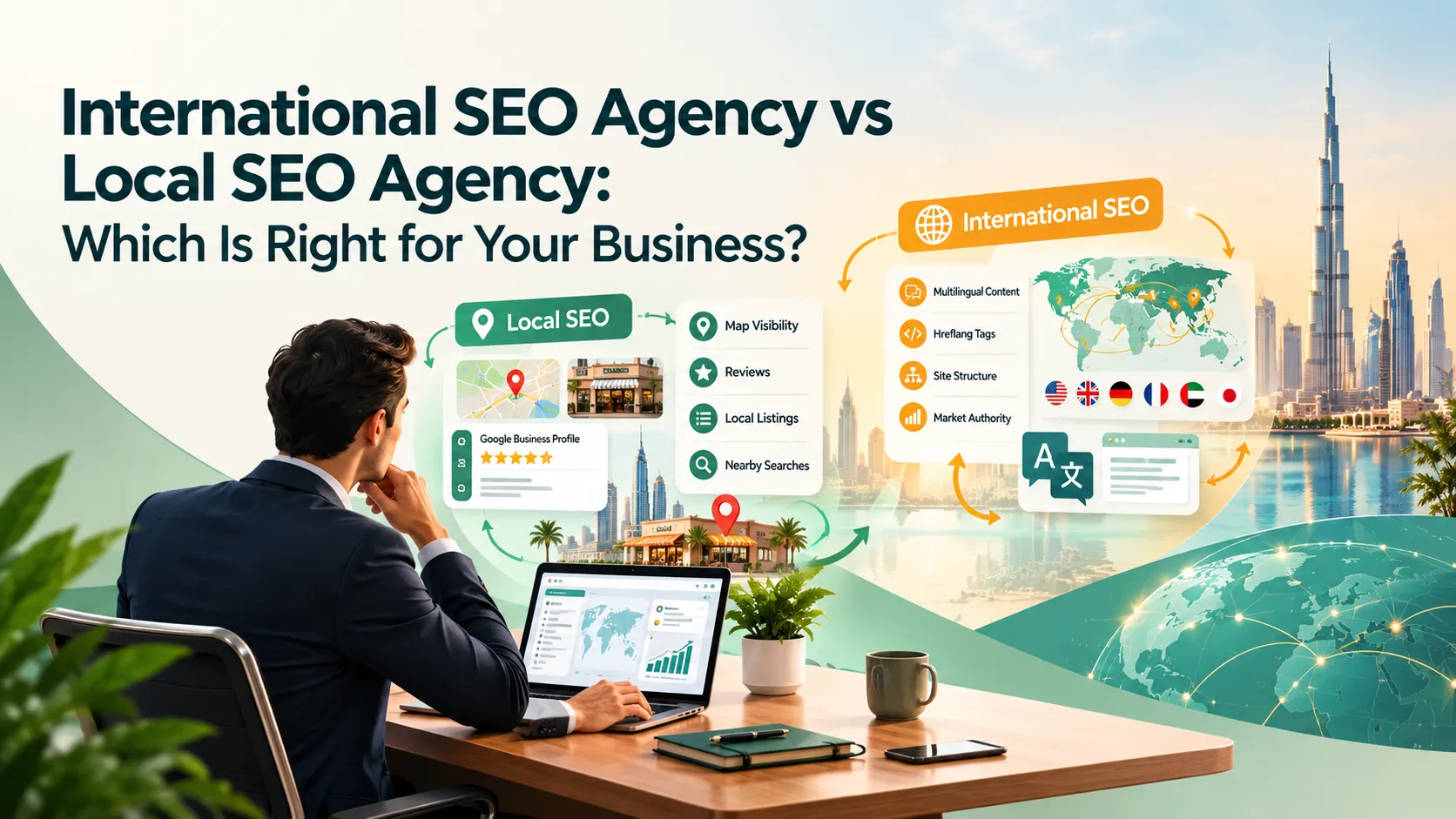
- Local SEO agencies focus on map visibility, Google Business Profile, reviews and proximity-driven searches within a defined area.
- International agencies focus on site structure, hreflang, multilingual content and market-by-market authority across countries.
- The right choice follows where your customers are and how they buy, not your business size.
- Many UAE businesses need local work now and international capability later, so sequencing is more useful than choosing once.
- Local results are shaped mainly by relevance, distance and prominence, so an international specialist adds little to a single-location business.
- International work costs more because research, content and authority building multiply per market.
- A full-service local SEO company in Dubai covering both can work well, provided the team genuinely has depth in each rather than one dressed as the other.
What Each Type of Agency Actually Does
A local SEO agency works within a geographic radius. Core activities include Google Business Profile management, listing consistency across directories, review generation and response, location and service pages, and local link building through community and sector sources. Success is measured in calls, direction requests, map visibility and enquiries from nearby customers.
The international SEO company has a worldwide reach. Key activities include site architecture decisions, hreflang implementation, keyword research performed natively in each language, localised content production, market-specific authority building, and separate reporting per market. The success is per country. One market growing and one stalling tells you more than a combined total.
The skill sets aren’t as overlapping as the common label suggests. A team that’s great at getting a clinic on the Dubai map pack might never have done hreflang across six markets, and a team that does multilingual rollouts might have little experience with review generation or map pack competition.
Which One Matches Your Business
The honest answer comes from looking at where revenue actually comes from.
You need local first if customers visit your premises, if you serve a defined service area, if most enquiries arrive by phone, or if your competitors in search results are other businesses within the same city. Restaurants, clinics, salons, dental practices, law firms serving local clients, trades and retail all sit here.
You need international first if your customers buy without meeting you, if you already sell into more than one country, if a meaningful share of your traffic comes from outside the UAE, or if you are planning a specific market entry. This includes software companies, e-commerce companies shipping cross-border, B2B service companies, and export-oriented manufacturers.
You need both if you have physical locations in several countries, or if you serve walk-in customers in one market while selling remotely into others. Hospitality groups, multi-branch clinics and regional retail chains commonly fall into this category.
For many Dubai businesses, the answer changes over time. A company serving the Emirates today may be quoting into Saudi Arabia within eighteen months, which makes the question less about picking a side and more about knowing when the second capability becomes necessary.
Comparing the Two Directly
| Factor | Local SEO agency | International SEO agency |
| Geographic focus | City, emirate or defined service area | Multiple countries, often multiple languages |
| Primary assets | Google Business Profile, listings, reviews | Site architecture, hreflang, localised content |
| Keyword approach | Local intent and neighbourhood terms | Native research per language and market |
| Content volume | Moderate, focused on services and locations | High, multiplied across markets |
| Authority building | Local directories, community and sector sources | Market-specific publications and directories per country |
| Technical complexity | Lower, mostly on-page and profile work | Higher, involving structure, tagging and indexing |
| Reporting focus | Calls, direction requests, local enquiries | Performance segmented by market |
| Typical timeline | Weeks for profile fixes, months for prominence | Months per market, staggered by launch order |
| Relative cost | Lower, and scales with locations | Higher, and scales with markets and languages |
What Local Work Delivers That International Work Does Not
Proximity is the factor no international strategy can replicate. Google describes local ranking as based mainly on relevance, distance and prominence, and distance is fixed by where you are. An agency with deep local expertise focuses on the other two: making your business unmistakably relevant to the searches that matter, and building prominence within your market.
The speed difference is important, too. Correcting a miscategorised Business Profile or a misplaced map pin can move the needle on visibility within weeks – faster than just about anything else in international SEO agency. Local SEO Dubai services usually deliver the first noticeable improvements through a low-cost, easy-to-implement project.
Review management is another area where local specialists earn their fee. Reviews influence both rankings and the decisions customers make after finding you, and a genuine, sustained review process is harder to run well than it looks.
What International Work Delivers That Local Work Does Not
Structure is the first thing. Decisions about country domains, subdomains or subdirectories shape every market you add afterwards, and getting them wrong means migration work later. A local specialist rarely has reason to develop a view on this.
Hreflang implementation is the second. Reciprocal annotations, correct language and region codes, self-referencing tags and x-default handling are technical work that goes wrong quietly, and errors often sit undiscovered until traffic in one market drops.
Native keyword research is the third, and it is where the most value hides. Search terms do not translate. Running English keyword research through a translation tool produces a list of phrases nobody actually searches, which is why Arabic, Hindi or German targeting needs research conducted in that language by someone who speaks it.
Market-specific authority building from reliable international SEO companies completes the picture. A UAE publication link supports UAE visibility far more than a general international mention, and the same logic applies in each country you enter.
Where Businesses Get This Wrong
The most common error is hiring international capability too early. A single-location business with one market pays for hreflang expertise it will never use, while its Business Profile sits half complete.
The reverse happens too. A business already receiving enquiries from three countries keeps a purely local agency because the relationship is comfortable, and its site never gets the structure those markets need.
A third pattern is assuming an English-language site covers every English-speaking market. Identical pages serving the UAE, the UK, and Australia give search engines no reason to prefer one, and hreflang doesn’t fix content that offers nothing distinct per market.
The fourth is treating Arabic as a translation task. Arabic requires its own keyword research, native writing and proper right-to-left implementation, and businesses that shortcut it usually find the Arabic version attracting little traffic and converting worse.
When a Full-Service Agency Makes Sense
An agency covering both can be the right answer, particularly for businesses that are local now and regional later. The practical advantage is continuity: the same team that built your local visibility understands your services, customers, and conversion patterns when it’s time to expand.
Three things are worth verifying before assuming one agency can do both.
Ask for examples of each type of work separately. A team with ten local case studies and no multilingual rollouts is a local agency describing itself broadly.
While hiring a global SEO agency, ask who would handle the technical international work, since hreflang and architecture require different skills from profile management.
Ask how reporting would be structured if you operated in three markets, because an agency offering local SEO services in Dubai accustomed to single-market reporting often has no framework for segmenting performance by country.
How to Sequence Both as You Grow
Most UAE businesses getting reliable international SEO service benefit from a clear order rather than a permanent choice.
Get the local foundation right first. A verified, complete Business Profile, consistent listings, a working review process and solid local and service pages support everything you build afterwards, including international expansion, because a site that converts well locally converts better elsewhere too.
Add a second market only when you can serve it. Visibility in a country where you cannot fulfil, support, or invoice properly produces enquiries you decline, which costs more than it returns.
Build the international structure on one additional market before attempting several. Getting hreflang, templates and reporting working across two markets is far easier to debug than across six, and every later market reuses that foundation.
Then expand by commercial opportunity, reviewing each launch before starting the next.
Matching the Agency to Where You Are Now
The better question is not which type of agency is stronger, but which problem is currently costing you more. A business losing enquiries because its map visibility has slipped needs local repair work, not an architecture review. A business quoting into three countries from one English page needs structure, not more reviews.
Savit’s UAE team covers both ends of that range from our Meydan office in Dubai, working with single-location businesses across the Emirates and with companies expanding into Saudi Arabia, Qatar, Oman, Bahrain and Kuwait. Local and Google Maps SEO sits alongside international and multilingual work in the same team, with English and Arabic content produced in-house, so the transition from one to the other doesn’t require changing suppliers. If you are unsure which problem you’re solving, our free digital marketing audit is a straightforward way to find out before committing to either.
Footnotes and References
[1] Google Business Profile Help. “Tips to improve your local ranking on Google.” Google explains that local results are based mainly on relevance, distance and prominence.
[2] Google Search Central. “Managing multi-regional and multilingual sites.” Google sets out the differences between multi-regional and multilingual targeting and the structures available for each.
[3] Google Search Central. “Tell Google about localized versions of your page.” Google explains hreflang implementation, including reciprocal annotations, self-referencing tags and x-default handling.