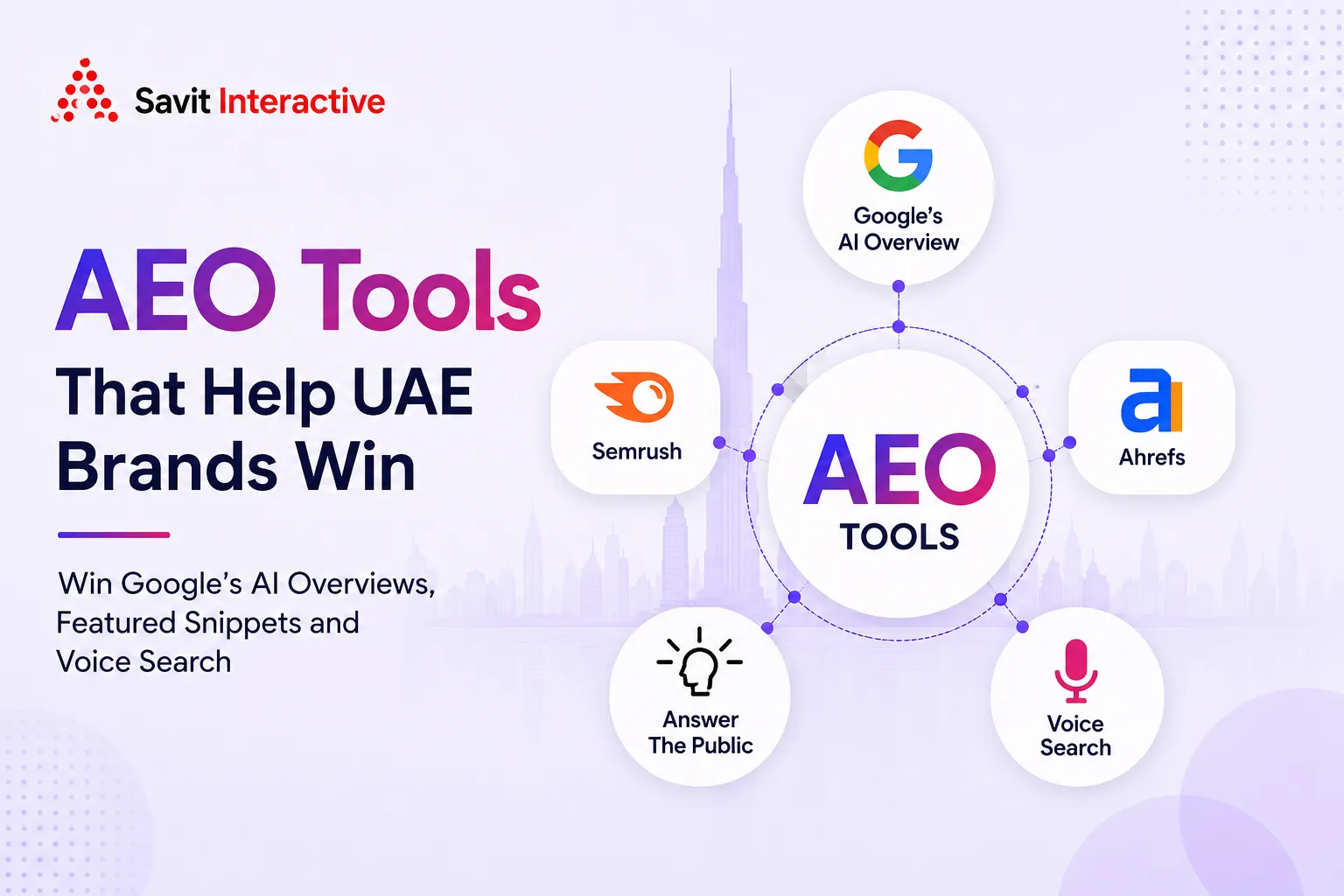
Explore the AEO tools UAE brands can use to research questions, optimise content and track visibility across AI and voice search.
Key Highlights
- AEO works best as a continuous workflow: research questions, create useful answers, improve technical clarity and measure visibility.
- Traditional SEO remains the foundation for appearing in Google AI Overviews and AI Mode.
- Research tools help brands uncover conversational, local and bilingual questions that conventional keyword lists may miss.
- Content tools can improve topical coverage, answer placement and evidence, but they cannot replace expert judgement or original insight.
- Structured data helps search engines understand page information, although Google does not require special schema for AI Overviews.
- AI visibility should be tracked separately from standard rankings because a page can rank organically without being cited in an AI-generated response.
Answer engine optimisation, or AEO, is often presented as a set of content edits: add questions, shorten paragraphs, insert schema and wait for an AI citation.
In practice, it is a broader workflow.
Brands must first understand what customers are asking. They then need to create information that answers those questions clearly, support important claims with credible evidence and ensure the page is technically accessible. Finally, they must check whether search engines and AI platforms are actually finding, mentioning or citing the content.
Different tools support each part of this process.
The need for a structured approach is growing. Google’s AI Overviews can draw information from several pages and present a combined response. AI Mode can also break complex questions into related searches before producing an answer with supporting links. Google calls this process “query fan-out”.
A UAE customer might ask Google to compare freehold areas in Dubai, find a bilingual nursery in Abu Dhabi or explain corporate tax registration for a mainland company. These detailed queries require more than a page containing the right keyword.
A practical AEO strategy needs tools for discovering real questions, creating useful answers and monitoring search visibility. The tools do not win citations by themselves. They help teams make better decisions at every stage.
The AEO Tool Workflow
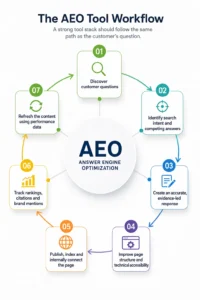
Treating AEO as a loop is important. Search results change, competitors improve their pages, regulations are updated and AI-generated answers can vary between searches.
The workflow therefore never truly ends. Measurement feeds the next round of research and optimisation.
Tools for Finding the Questions Your Audience Asks
AEO begins with identifying the questions customers genuinely need answered.
This differs slightly from standard keyword research. Search volume still matters, but an answer-led strategy also examines wording, intent, context and the additional questions surrounding a topic.
For UAE brands, research should account for:
- English and Arabic searches
- Emirate and community names
- Mobile and voice-led searches
- Local regulations and buying conditions
- Differences between residents, tourists and international investors
- Queries containing prices, dates, comparisons and eligibility criteria
Semrush
Semrush is useful for combining conventional keyword research with SERP and AI visibility data.
Its Keyword Magic Tool can help users filter terms by intent, question format and SERP features. This makes it easier to separate broad topics from queries that need a direct answer.
For example, a generic phrase such as “Dubai business licence” may sit at the centre of the topic. More useful AEO opportunities may include:
Which business licence do I need in Dubai?
How much does a Dubai mainland licence cost?
Can I open a UAE company without living there?
What documents are required for licence renewal?
Semrush Position Tracking can monitor performance by location, language, device and search engine. The platform also identifies keywords that trigger AI Overviews and records cases where a tracked domain appears as a cited source.
This regional targeting makes the platform useful for AI search marketing in the UAE. A team can track Dubai and Abu Dhabi separately rather than assuming that visibility is uniform across the country.
Semrush’s newer AI visibility features can also compare brand mentions, citations and prompt-level visibility across platforms such as ChatGPT, Gemini and Google AI Mode.
Best used for: Building a broad question set, identifying AI Overview opportunities and monitoring regional search visibility.
Ahrefs
Ahrefs is particularly useful for studying search demand, competitor pages and the wider SERP surrounding a question.
Keywords Explorer can show search volume, difficulty, ranking pages and SERP features. Ahrefs officially tracks features including Featured Snippets, People Also Ask boxes, local packs and AI Overviews.
Suppose a Dubai healthcare provider wants to build content around laser eye surgery. Ahrefs can help the team examine:
- Which questions already produce direct answers
- Which competitors rank for those questions
- Whether an AI Overview appears
- Which pages attract backlinks
- Which related questions have weaker content
- How the search results change over time
This research helps distinguish between an attractive keyword and a realistic content opportunity.
Ahrefs is also valuable when a company has already published several related pages. Its site and competitor analysis can reveal overlapping topics, weak internal links and content areas competitors have covered more thoroughly.
Best used for: Competitor research, backlink analysis and evaluating the difficulty of answer-led topics.
AnswerThePublic
AnswerThePublic turns a topic into groups of questions, comparisons and related phrases.
Enter a subject such as “buying property in Dubai”, and the platform may organise searches around terms such as who, what, when, where, why, can and how.
This visual approach is useful during early-stage topic mapping. It can reveal angles that a simple keyword spreadsheet may hide.
An AEO consultant may use it to build a question universe before deciding which questions deserve individual pages and which belong within one detailed guide.
However, teams should not treat every suggested phrase as a confirmed content opportunity. The results need to be checked against regional search data, business relevance and current SERPs.
Best used for: Rapid question discovery, brainstorming and identifying conversational search patterns.
Google’s Own Search Features
Some of the most useful AEO research tools are available directly within Google.
Search suggestions, People Also Ask results, related searches, Google Trends and the results page itself can reveal how Google interprets a topic.
Manual analysis is especially important in the UAE because tools may not capture every local variation. A query may produce different results depending on the emirate, language, device or wording.
Review the live results for each priority question and record:
|
Research point |
What to examine |
|
Search intent |
Does Google show guides, products, local results or comparison pages? |
|
Answer format |
Is the response a paragraph, table, list, video or calculator? |
|
Source type |
Are government sites, brands, publishers or forums being cited? |
| Content freshness |
How recently were the leading pages updated? |
| Supporting questions |
What appears in People Also Ask? |
| Localisation |
Do results change when an emirate or neighbourhood is added? |
This manual review prevents a common failure in AEO strategy development: optimising for a theoretical opportunity without checking what users currently see.
Tools for Structuring Content and Data for AI Extraction
Research reveals what people need. The next stage is to create the most useful available answer.
Two areas matter here:
The visible content that readers and search systems evaluate
The technical information that helps search engines interpret the page
Google Structured Data Markup Helper and Rich Results Test
Google’s Structured Data Markup Helper assists website owners in tagging elements on a page and generating structured data. The Rich Results Test can then check whether Google can read the markup and whether the page may qualify for supported rich results.
Structured data provides explicit information about a page and its contents. It may identify an organisation, article, author, product, local business or breadcrumb structure.
However, its role must be understood accurately.
Google states that there is no special schema required for AI Overviews or AI Mode. Structured data is not a direct ticket into an AI-generated answer. It should be used because it helps describe content and can support eligibility for relevant search features.
Google also requires structured data to match the information visible on the page. Adding properties that users cannot see may create errors or undermine trust.
For UAE companies, useful structured data may include:
- Organisation details
- LocalBusiness information
- Multiple business locations
- Article authorship
- Product or service information
- Breadcrumb navigation
- Events
- Job listings
- Relevant reviews, where permitted
Schema should be selected according to the page’s actual purpose. Adding FAQ or HowTo markup to every page without checking Google’s current eligibility rules creates clutter rather than value.
Best used for: Creating, validating and troubleshooting Google-supported structured data.
Schema Pro
Schema Pro is a WordPress-focused tool that can deploy JSON-LD structured data across multiple pages without requiring manual coding for every URL.
It is useful for websites containing many repeated page types, such as:
- Location pages
- Service pages
- Articles
- Product pages
- Professional profiles
- Local branches
A business with locations in Dubai, Abu Dhabi and Sharjah can create consistent schema templates while maintaining separate addresses and contact details.
The tool reduces implementation time, but configuration still requires care. Incorrect templates can reproduce the same error across hundreds of pages.
Best used for: Scaling structured data across large WordPress websites.
AIOSEO
AIOSEO combines several WordPress SEO functions, including schema generation, sitemaps, on-page controls and content analysis.
It can be useful for smaller teams that prefer to manage common SEO elements within one interface. Its schema features support several common page types without requiring developers to write JSON-LD manually.
The main advantage is convenience. The main risk is overreliance on automated recommendations.
A plugin can confirm that a title exists or that schema has been added. It cannot confirm that the page offers original experience, sound advice or stronger evidence than competing sources.
Best used for: Managing basic technical and on-page SEO elements on WordPress.
InLinks
InLinks analyses the entities discussed within content and helps teams understand the semantic relationships between pages.
Entity-based analysis can be useful when a brand has written several articles around a broad topic but has not connected them clearly.
For example, content about UAE corporate tax may involve entities such as:
- Federal Tax Authority
- Taxable income
- Free-zone persons
- Qualifying income
- Registration deadlines
- Tax groups
- Penalties
A page that mentions relevant concepts without explaining their relationships may still feel incomplete. InLinks can support internal linking and topic mapping so the site presents a more connected body of information.
This makes it useful for AI search marketing strategies built around topic clusters rather than isolated keywords.
Best used for: Entity analysis, internal linking and semantic content planning.
MarketMuse
MarketMuse evaluates content coverage and identifies topics that may be missing from a draft or content cluster.
It can help answer questions such as:
- Does the page cover the expected subtopics?
- Which related concepts have competitors explained?
- Is this topic already addressed elsewhere on the website?
- Which existing page should be updated instead of creating a new one?
- Where is greater depth justified?
The tool is valuable for prioritisation, particularly on large websites with hundreds of articles.
Its scores should be treated as guidance rather than a writing formula. Covering every suggested term can make content bloated. Writers still need to decide what is relevant to the reader’s task.
Best used for: Content gap analysis, planning and prioritising updates.
Surfer SEO
Surfer SEO compares a draft with pages ranking for the target search. Its content editor provides recommendations related to terms, headings, length and page structure.
This can help teams identify obvious gaps. It may show that leading pages include a comparison table, a definition near the top or a section covering costs.
Surfer can also encourage cleaner formatting through short sections, descriptive headings and answer blocks.
Yet a high optimisation score does not guarantee a citation. The tool is measuring patterns within existing search results. It cannot independently judge whether a statistic is accurate or whether a recommendation is appropriate for UAE law, healthcare or finance.
Use it as an editing instrument, not an autopilot.
Best used for: SERP-based content comparison and identifying structural gaps.
What Strong AEO Content Looks Like
Tools are most effective when they support clear editorial principles.
The Princeton-led GEO study introduced a benchmark for testing how content changes affected visibility in generative-engine responses. Its researchers found that optimisation methods could improve visibility by up to 40% in their experimental setting.
That result is often simplified into a universal promise. It should be read more carefully. The effectiveness of each method varied by topic, and the study examined content already available within a controlled retrieval environment.
Its broader lesson remains useful: credible quotations, relevant statistics and clear sourcing can make an answer more informative.
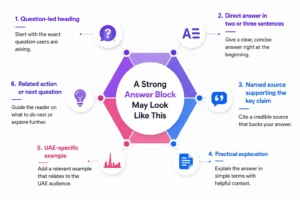
The page should also contain first-hand or original value where possible. This may include internal data, expert observations, examples, photographs, tested processes or local experience.
Google’s 2026 guidance warns against rewriting pages only for AI systems or breaking content into artificial fragments. It recommends creating valuable, original information for people and confirms that ordinary SEO foundations still support generative search visibility.
Professional AI search services should therefore balance extractability with editorial quality. A page must be easy to understand without becoming robotic or repetitive.
Tools for Tracking Whether AI Systems Are Citing You
A page can rank well and still be absent from an AI-generated answer. It can also appear as a cited source even when it is not the highest conventional organic result.
Rankings and citations should therefore be monitored separately.
Google Search Console
Google Search Console remains the basic source for understanding how a website performs in Google Search.
It provides information on:
- Search queries
- Impressions
- Clicks
- Average position
- Indexed pages
- crawling problems
- Search enhancements
Google launched dedicated generative AI performance reports for a subset of websites in June 2026. These reports provide separate views of visibility within features such as AI Overviews and AI Mode, while the data also remains part of overall Search performance reporting.
Where the dedicated report is available, it gives teams a clearer view of AI-search exposure. Where it is not yet available, Search Console still helps identify query and page trends around relevant topics.
Search Console cannot explain every citation decision, but it remains the starting point for any Google-focused AEO strategy.
Best used for: First-party Google performance data, index monitoring and diagnosing technical problems.
Semrush Position Tracking and AI Visibility
Semrush Position Tracking can identify keywords that produce AI Overviews, show whether a tracked domain is cited and compare AI visibility with standard organic rankings.
Its broader AI Visibility tools can monitor mentions, citations and competitive gaps across selected AI platforms.
This allows teams to create separate monitoring groups for:
- English and Arabic prompts
- Dubai and Abu Dhabi searches
- Product comparisons
- Local service questions
- Informational searches
- Competitor-led prompts
- Brand reputation questions
Best used for: Tracking defined keyword and prompt sets across conventional and AI search.
Ahrefs Rank Tracker and SERP Analysis
Ahrefs can monitor rankings and show which SERP features appear for tracked keywords. Its SERP Overview also provides historical search-result snapshots, which can help teams examine when an AI Overview or Featured Snippet appeared and how the cited pages changed.
This is useful for comparing two different questions:
- Where does the page rank?
- Which page is being selected for the answer feature?
The answers may not be the same.
Best used for: Connecting ranking movement with changing SERP features and competitor visibility.
Specialised AI Visibility Platforms
A growing group of platforms monitors prompts, mentions and citations across ChatGPT, Gemini, Perplexity and other AI systems.
These tools commonly track:
- Share of voice
- Brand mentions
- Cited URLs
- Competitor mentions
- Sentiment
- Prompt coverage
- Response changes over time
Results need careful interpretation. AI responses can vary according to wording, location, platform, account context and the time of the search. A single prompt run is weak evidence.
An experienced AEO consultant should test several natural variations of each commercially important question and repeat them over time.
For example:
- Best corporate tax adviser in Dubai
- Top corporate tax consultants for UAE SMEs
- Who can help with corporate tax registration in Dubai?
- Compare Dubai corporate tax advisory firms
- Corporate tax consultant near Business Bay
This creates a more realistic picture than checking one preferred prompt until the brand appears.
An AI optimization agency should also distinguish between a mention and a citation. A brand may be named because the model has encountered it elsewhere, while a citation links to a specific source used in the response. The two outcomes have different causes and require different improvements.
How to Choose the Right AEO Tool Stack
More software does not automatically produce better search visibility.
Choose tools according to the team’s actual gaps.
|
Need |
Suitable tool category |
|
Discover customer questions |
Semrush, Ahrefs, AnswerThePublic, Google search features |
|
Study competitors |
Ahrefs, Semrush |
|
Plan topic clusters |
InLinks, MarketMuse |
|
Compare content with SERPs |
Surfer SEO |
|
Add structured data |
Google tools, Schema Pro, AIOSEO |
|
Monitor Google performance |
Search Console |
| Track AI citations and mentions |
Semrush AI Visibility and specialist AI trackers |
A smaller business may begin with Search Console, Google’s testing tools, AnswerThePublic and one paid SEO platform.
A larger organisation may need separate tools for content planning, technical validation, local visibility and cross-platform citation tracking.
The deciding factor should be actionability. Every dashboard should lead to a clear decision, such as updating a source, improving a page, correcting business information or creating content for an uncovered question.
The Right Tools Turn AEO from a Buzzword into a Working System
AEO is a connected process of research, creation, technical optimisation, measurement and refinement.
The tools explored in this guide support different parts of that process. Research platforms reveal the questions people ask. Content and entity tools expose gaps. Structured data tools help search engines interpret page information. Tracking platforms show whether the brand is gaining meaningful visibility.
For UAE organisations, the process also needs to reflect bilingual searches, local entities, multiple emirates and intense competition in sectors such as property, healthcare, hospitality, finance and professional services.
At Savit, we use this workflow to build an AEO strategy around each client’s market, audience and commercial priorities.
As an AI optimization agency in Dubai, we provide end-to-end AI search services covering question research, content optimisation, structured data, entity development, Featured Snippet targeting, local AEO and citation monitoring.
Our work covers Google AI Overviews, AI Mode, ChatGPT, Gemini, Perplexity, Microsoft Copilot and voice-led search experiences. We combine more than 20 years of search expertise with tools suited to bilingual content, local discovery and competitive UAE sectors.
Our role extends beyond recommending software. Our AEO consultant team interprets the data, identifies the right opportunities and turns findings into improvements across content, technical SEO and brand authority.
Tools reveal where visibility gaps exist. Human expertise determines which gaps matter, why they exist and how they should be closed.
Our AI search services also include repeated monitoring because AI results can shift between platforms and prompt variations. We measure citations, mentions, search visibility and commercial outcomes together.
To understand how your brand currently appears across AI Overviews, Featured Snippets and voice search, talk to our AEO team for a free AI visibility audit.