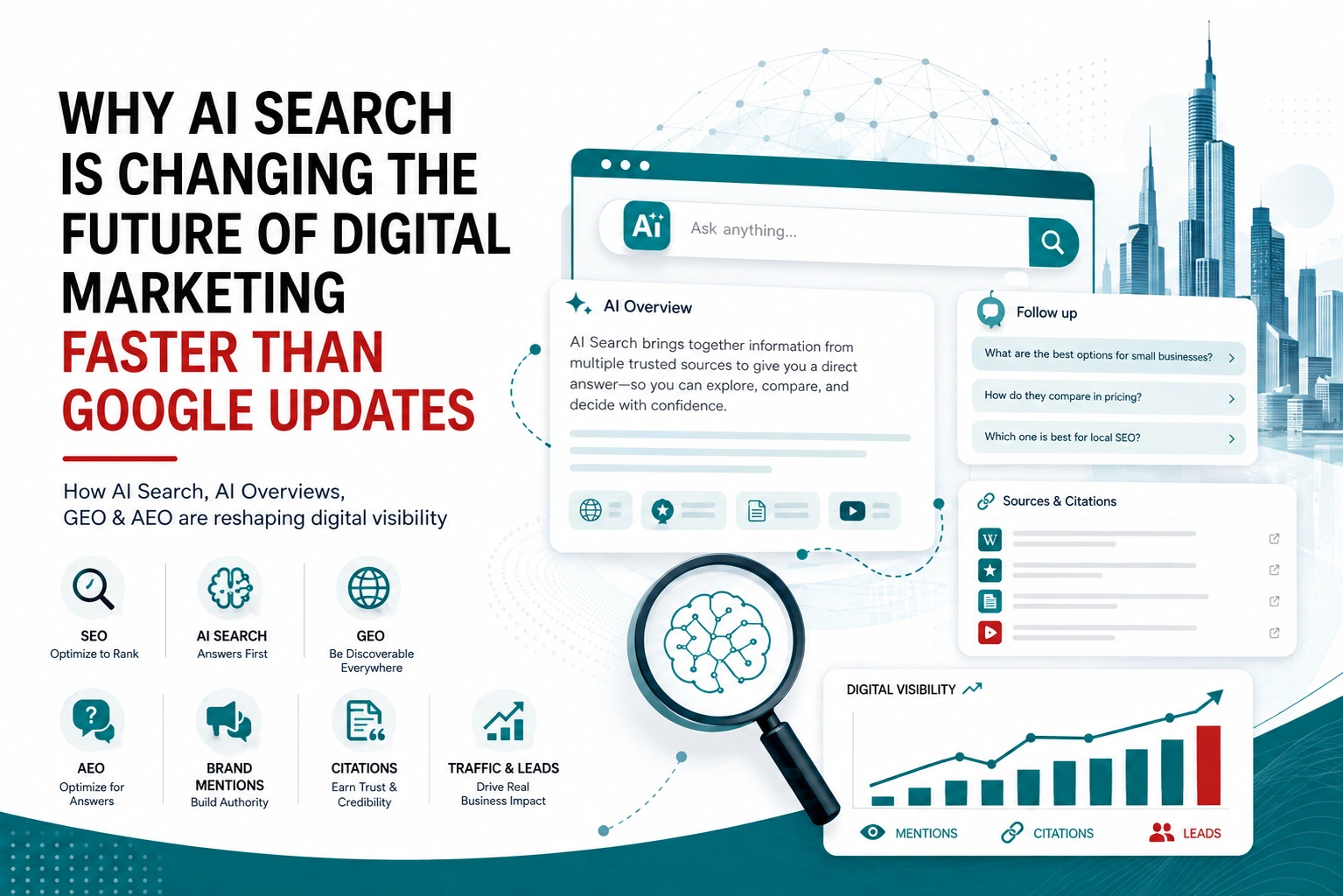
AI Search is changing digital marketing from simply ranking on Google to being found, understood, and trusted across AI-powered search experiences
Key Highlights
- AI Search is changing how customers discover and research brands.
- Traditional SEO remains important, but rankings are no longer the only measure of visibility.
- AI Overviews and AI Mode can answer questions before users visit a website.
- Answer engine optimization can help businesses prepare for answer-led search.
- AI for SEO supports research, content planning, analysis, and optimization.
- Strong content, technical SEO, website structure, and brand authority still matter.
- AEO marketing connects content with the questions customers ask during their buying journey.
- Businesses should track mentions, citations, traffic, leads, and revenue alongside rankings.
AI Search Is More Than Another Google Algorithm Update
A Google algorithm update can change how websites are ranked. Businesses may see some keywords move up or down after an update, which can affect organic traffic. AI Search introduces a different type of change because it affects the search experience itself.
Instead of showing users a list of links and leaving them to find the answer, AI-powered search can bring information together and present it in a more direct format. A user can ask a detailed question, receive an answer, and then ask a follow-up question without starting the search process again.
For example, someone looking for a digital marketing agency may first ask which agencies specialize in SEO. They could then ask which one works with businesses in their industry, what services they offer, and what factors they should consider before hiring one. This creates a longer conversation around a decision.
That is why AI Search should not be treated as just another algorithm update. It changes the way information is discovered and consumed.
How AI Search Is Changing the Way Customers Discover Brands
The traditional customer journey was easier to map. A person searched for a product or service, looked through the results, visited a few websites, and then made a decision. AI Search adds more steps before the website visits, and sometimes the website visit may not happen at all.
A customer can now ask an AI-powered search system for recommendations, compare several brands, check their reputation, and narrow down their choices before visiting a company’s website. This means your website is no longer the only place where your brand needs to provide useful information.
Your brand may also need a strong presence across reviews, industry websites, business listings, videos, social platforms, expert articles, and other trusted sources. The more consistent and useful this information is, the easier it becomes for both people and search systems to understand what your business does.
This is one reason businesses are exploring AI SEO services as part of a wider digital marketing strategy. The focus is shifting from getting one page to rank for one keyword towards building a reliable digital presence around a topic.
AI Overviews and AI Mode Are Changing the Traditional Search Results Page
Traditional search depends heavily on users choosing a result. AI-powered search can provide an answer first and then guide the user towards supporting sources.
Google’s current AI Search experience allows users to move from AI Overviews into AI Mode and continue exploring a topic through follow-up questions. Google has also said that AI Mode is designed for longer and more complex searches.
This creates an important difference for marketers.
| Traditional Search | AI Search |
| Users scan search results | Users can receive a direct answer |
| Rankings are a major focus | Mentions and citations can also matter |
| One query often leads to another search | Follow-up questions can happen in one conversation |
| Clicks are a major success measure | Visibility may happen without a click |
| Keywords drive much of the strategy | Topics, context, and intent become more important |
This does not mean organic search is disappearing. It means businesses need to consider more than where their pages rank.
Why Ranking Number One on Google Is No Longer the Only Visibility Goal
Ranking first remains valuable. A strong organic position can bring qualified traffic and support brand credibility. However, being number one does not automatically mean that a brand will be mentioned in every AI-generated answer.
AI-powered search can draw information from several sources when building a response. Google also states that AI Overviews and AI Mode rely on the same basic technical requirements used for normal Search.
This creates a broader visibility question. Instead of only asking, “Where do we rank?”, businesses should also ask, “Is our brand being considered and referenced when customers ask questions related to our products or services?”
That is where AI SEO optimization can add another layer to an existing SEO strategy. It does not replace traditional optimization. It builds strong SEO foundations and considers how information can be understood in AI-led search.
How AI Search Is Changing SEO and Organic Search Visibility
SEO still matters because AI Search does not remove the need for websites that search engines can access, understand, and trust. Google continues to advise website owners to follow established SEO practices when preparing AI features.
What changes is the way marketers think about optimization. A useful page should answer the main question clearly, cover related questions, use a logical structure, link to relevant pages, and provide enough context for both users and search systems.
Technical SEO also remains important. Search engines need to crawl and index your pages before those pages can become useful sources. Businesses should therefore continue to review page speed, indexing, internal links, mobile experience, structured data, and website architecture.
Our approach to AI SEO optimization is based on this balance. The goal is to make information clear and useful for people first while making it easier for search systems to understand.
What GEO and AEO Mean for the Future of Digital Marketing
As AI Search grows, marketers are using terms such as GEO and AEO more often.
Generative Engine Optimization, or GEO, focuses on improving a brand’s chances of appearing in responses generated by AI-powered systems. answer engine optimization, or AEO, focuses on helping content become useful for systems that provide direct answers.
These terms can sound like replacements for SEO, but that is not the best way to view them.
SEO remains the foundation. AEO and GEO add new considerations to that foundation.
For example, SEO may help a service page rank for a relevant search. AEO may encourage the business to answer common customer questions clearly on that page. GEO may then consider how the wider brand and its information can become useful to generative search systems.
This is why AEO marketing should be treated as part of a wider search strategy rather than a completely separate activity.
Why Brand Authority Matters More in AI Search
AI systems need reliable information when generating answers. This makes a business’s wider online reputation increasingly important.
Consider two businesses that offer the same service. One has a basic website with a few service pages. The other has detailed service information, customer reviews, industry mentions, case studies, expert articles, and consistent information across several platforms.
The second business has a stronger digital footprint. While no amount of content guarantees an AI citation, a wider and more credible presence gives search systems more information about the business.
This is why an AI SEO agency should look beyond individual webpages. Digital PR, reviews, content marketing, local listings, social content, and industry mentions can all contribute to how a brand is understood online.
How Content Marketing Is Changing in the AI Search Era
Content marketing needs to move away from publishing articles simply because a keyword has search volume.
The better question is: what does the customer actually want to know?
A useful article should answer the main question quickly and then provide the supporting details a reader may need. For example, a business writing about SEO pricing could explain the different pricing models, factors that affect costs, expected timelines, common mistakes, and ways to measure results.
This creates a more useful resource than publishing several short pages with little depth.
AI for SEO can help with parts of this process. Marketers can use it to organize keywords, find related questions, analyze content gaps, and speed up research. However, human review remains important because useful content needs accuracy, experience, context, and original thinking.
Why Digital PR, Reviews, Social Media, and Communities Matter for AI Visibility
Customers rarely learn about a business from one source. They may read a review, watch a video, visit a social page, see an industry article, and then search for the brand directly. AI Search adds another layer because these different sources can contribute to the information available around a brand.
This does not mean businesses should create artificial mentions or flood online communities with promotional content. Genuine authority is more valuable.
A business should focus on earning real reviews, publishing useful expert content, contributing to industry discussions, and building relationships with relevant publications. This wider approach can support both traditional SEO and answer engine optimization.
How AI Search Is Changing the Customer Journey
The customer journey is no longer a simple path from awareness to purchase.
A person may first ask an AI system about a problem. They may then compare products, ask for recommendations, check reviews, and look for specific providers. Each question can reveal a new opportunity for a brand to provide useful information.
| Customer stage | Content that can help |
| Awareness | Educational guides |
| Research | Explainers and comparisons |
| Consideration | Case studies and reviews |
| Decision | Service and product pages |
| Post-purchase | Guides and support content |
This makes content planning more important. Businesses need useful information across different stages rather than focusing only on pages designed to rank commercial keywords.
How AI Search Is Changing Paid Advertising and Performance Marketing
AI Search does not make paid advertising less useful. Instead, it changes how paid and organic channels can work together.
Paid campaigns can capture immediate demand. SEO can build long-term organic visibility. Content can answer questions that appear during research, while social media can introduce the brand to new audiences.
For example, questions found through paid search data can help a business identify topics for organic content. On the other hand, a high-performing organic page can show which topics may deserve additional paid support.
This makes AEO marketing one part of a wider digital strategy rather than a replacement for other channels.
The New Metrics Marketers Need to Track Beyond Rankings and Clicks
Rankings, impressions, clicks, and organic traffic still have value. However, AI Search adds new questions that marketers need to consider.
Is the brand mentioned in AI-generated answers? Is its content cited? Are branded searches increasing? Are visitors who arrive through AI-related channels becoming leads?
A broader measurement model can look like this:
Visibility → Mention → Citation → Visit → Lead → Revenue
Not every AI interaction will lead to a website visit. This can make attribution more difficult, which is why businesses should connect search data with analytics, CRM data, conversion tracking, and sales information.
The focus should remain on business outcomes rather than chasing one new metric.
AI-Generated Content vs Helpful Content: What Brands Should Know
AI can make content production faster but faster does not always mean better.
Marketers can use AI for SEO to support keyword research, topic planning, data analysis, content briefs, and audits. These uses can save time and help teams handle large amounts of information.
The final content still needs human input. Google’s guidance continues to focus on helpful, reliable, people-first content. A page filled with generic information may be easy to create, but it may not offer anything useful or original to the reader.
Businesses should add expert knowledge, examples, original data, clear explanations, and practical advice wherever possible.
Common AI Search Marketing Mistakes Businesses Should Avoid
Businesses entering AI Search should avoid treating it as a shortcut. Common mistakes include publishing large amounts of generic AI content, focusing only on keywords, ignoring technical SEO, and if a number one ranking guarantees AI visibility.
Another mistake is treating AEO as a one-time project. Search behavior will continue to change, so content and visibility should be reviewed regularly.
Businesses should also avoid trying to manipulate AI systems through fake reviews, artificial mentions, or low-quality content. A stronger approach is to build genuine expertise and make useful information available across the channels customers already use.
How Businesses Can Prepare for the Next Phase of AI Search
The first step is not to rebuild everything. Start by reviewing what already exists.
Audit the website for technical problems and outdated pages. Look at the questions customers ask before making a purchase. Review your most important service and product pages and check whether they provide clear answers.
Then build supporting content around real customer needs. Strengthen internal links and make important information easy to find. At the same time, work on genuine brand authority through useful content, reviews, relevant mentions, and industry expertise.
Businesses exploring AI SEO services should also make sure their strategy includes traditional SEO. Strong technical foundations, useful content, and authority remain central to search visibility.
The Future of Digital Marketing: Being Found, Cited, and Trusted
AI Search is changing digital marketing because it is changing the way people search. A traditional Google update may change rankings, but AI Search can change the entire interaction between the customer and the search engine. Businesses therefore need to think beyond ranking positions and focus on being visible, useful, trusted, mentioned, and cited across the search journey.
At Savit Interactive, we believe AI Search should improve good marketing rather than replace it. We use AI SEO services to help businesses adapt their search strategies while keeping strong SEO fundamentals at the center. Our approach combines content, technical optimization, search intent, and authority building so that brands are prepared for both traditional search and AI-led discovery.
We suggest businesses start now by auditing their existing content, understanding customer questions, strengthening important pages, and building genuine authority. The businesses that prepare early will be in a stronger position as AI Search becomes a larger part of how customers find and evaluate brands. Explore Savit Interactive’s AI SEO services.
Footnotes
1. Google Search Central — AI Features and Your Website: Google explains how established SEO practices apply to AI Overviews and AI Mode. Google Search Central: AI Features and Your Website
2. Google Search — AI Mode and AI Overviews: Google’s official updates explain how AI-powered Search is changing the search experience and supporting follow-up exploration. Google: AI Mode and AI Overviews
3. Google Search Central — Succeeding in AI Search: Google’s guidance covers creating useful content and adapting to AI-powered search experiences. Google Search Central: Succeeding in AI Search