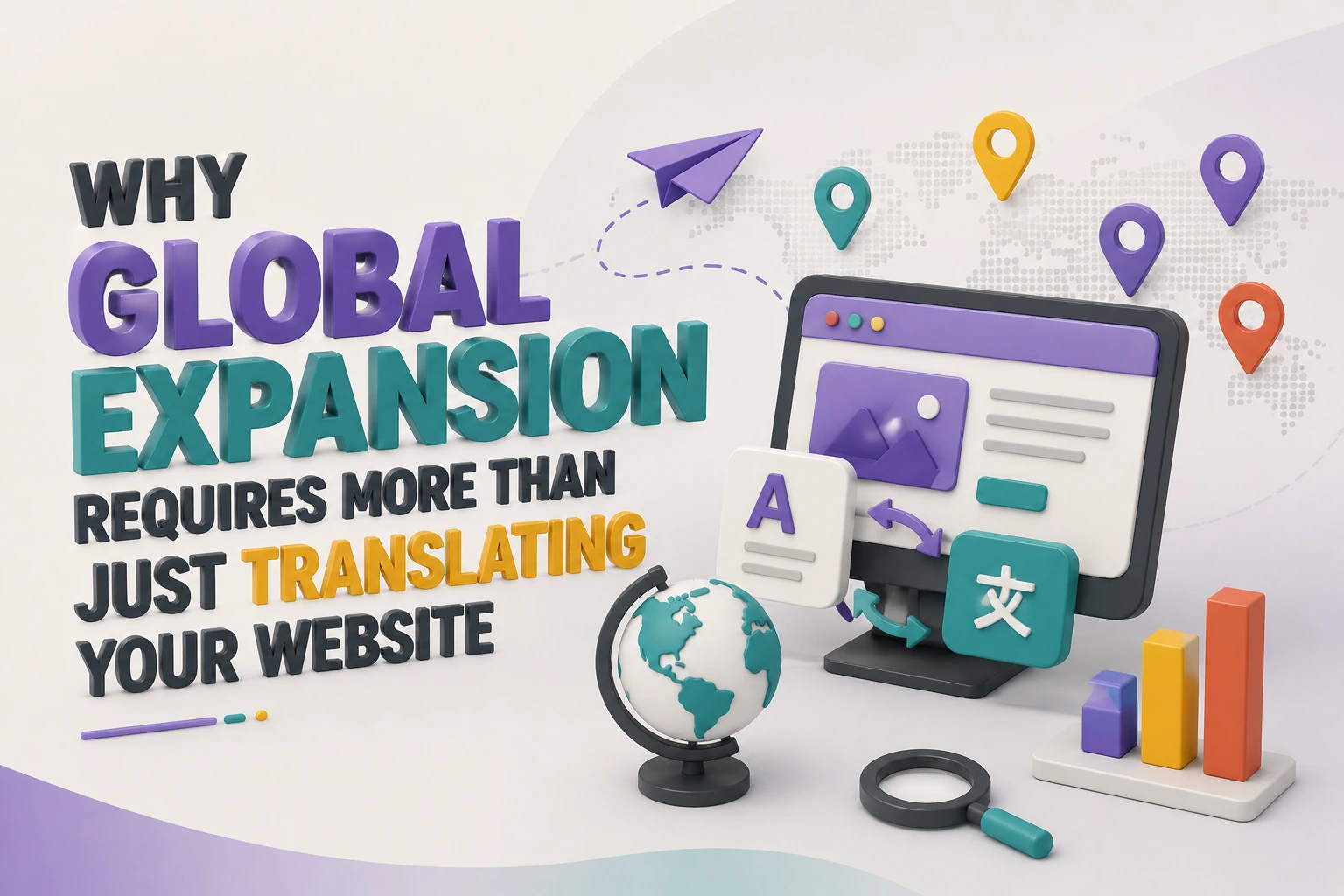
Translation makes a website understandable. Localisation and international SEO make it relevant to the people a business wants to reach.
Key Highlights
- Website translation is only the first step towards entering an international market.
- Search behaviour, keywords, competition and customer expectations vary across countries.
- Localisation adapts website content, pricing, terminology and user experience to each target market.
- International website structure and technical SEO help search engines understand country and language variations.
- Businesses need to research local competitors rather than assuming success in the UAE will transfer to another market.
- UAE businesses should protect existing organic traffic while building visibility in new markets.
Why Is Translating a Website Not Enough for Global Expansion?
Translation changes website content from one language to another. However, it does not automatically make that content relevant to customers in another country.
A UAE business expanding into the UK, Saudi Arabia, Australia or another market needs to understand how people in that market search, compare businesses and make purchasing decisions.
For example, a service page performing well in Dubai may not achieve the same results simply because it has been translated. Users in another country may search using different terms, expect different information or prefer a different type of service.
That is why international SEO in Dubai involves much more than translating existing pages. It considers search behaviour, local competition, content relevance, website structure and the customer journey.
Translation asks, “How should this message be expressed in another language?” International SEO asks, “How should this business become visible and relevant in this market?”
How Does Search Behaviour Differ Between Countries?
People do not always search for the same product or service in the same way. Even countries that speak the same language can have different terminology, spelling and search intent.
For example, users may:
- Use different terms for the same service.
- Search with different commercial phrases.
- Ask different questions before buying.
- Have different expectations about pricing.
- Look for different types of information.
- This makes local keyword research essential.
An international SEO service should assess search demand, keyword variations, intent and competition in each target country instead of directly translating an existing keyword list.
A phrase that performs well in the UAE may have limited search demand elsewhere. Similarly, a term that seems natural in English may not be the phrase customers commonly use in another market.
What Is the Difference Between Translation and Localisation?
Translation focuses on language. Localisation adapts the website to the expectations of a particular market.
Depending on the business and target country, localisation may include:
- Currency and pricing
- Spelling and terminology
- Dates and measurements
- Contact information
- Delivery details
- Product availability
- Local examples
- Cultural references
- Legal information
- Calls to action
For instance, a UAE business entering the UK market may need to adapt currency, spelling, service information and examples rather than simply translating its existing pages.
Google recommends using distinct URLs for different language or regional versions and providing clear signals to help Google understand those versions. ¹
A global SEO agency can combine keyword research and localisation so international pages are designed around the people they are meant to reach.
Why Is International Keyword Research Important for Global SEO?
Keyword research should be repeated when entering a new market. The goal is to identify the terms that local users use and understand why they use them.
Research should consider:
- Search volume
- Search intent
- Local terminology
- Keyword variations
- Competitor rankings
- Commercial relevance
- Related searches and questions
These findings can then guide content and page creation.
For example, a business targeting both the UAE and UK may need separate pages when customers in each country use different terminology or have different requirements.
Businesses should also avoid creating multiple pages simply to target minor keyword variations. Each page should have a clear purpose and offer useful information for its intended audience.
This makes an international SEO service more than a translation exercise. It connects language, search behaviour and business objectives.
How Should a Website Be Structured for Different Countries?
Search engines need clear signals to understand which pages are intended for countries or languages.
Common international website structures include:
| Structure | Example | Main consideration |
| Country-specific domain | example.co.uk | Strong country association |
| Subdomain | uk.example.com | Separates regional sections |
| Subdirectory | example.com/uk/ | Keeps markets under one domain |
No single structure works for every business. The right option depends on the company’s target markets, technical resources and long-term plans.
Businesses with regional or language variations should also consider hreflang. It helps Google understand alternative versions of a page intended for different languages or regions. ²
A global SEO company can review an existing UAE website and recommend a structure that supports international growth without unnecessarily changing valuable pages.
Why Do Local Competitors Matter When Entering a New Market?
A business may have strong rankings and brand recognition in the UAE but still have little visibility in another country.
Local competitors may already have:
- Established organic rankings
- Relevant backlinks
- Strong local brands
- Market-specific content
- Customer reviews
- Industry authority
A translated page must compete with these websites.
Businesses should therefore analyse search results in every priority market. Competitor research can show what content ranks, what information customers expect and where opportunities may exist.
A global SEO agency can use this research to develop a market-specific content and authority strategy rather than copying the UAE website.
How Can Businesses Protect Existing Organic Traffic During Expansion?
International expansion should not unnecessarily affect the organic visibility a business has already built.
Before making major website changes, businesses should identify:
- High-performing pages
- Important organic keywords
- Valuable backlinks
- Traffic-generating URLs
- Pages producing leads or sales
- Important internal links
A successful UAE page often doesn’t require replacement; businesses can retain it while adding dedicated sections for new markets. Review technical elements like redirects, canonical tags, internal links, and hreflang before launch.
An international SEO company can support this process by combining expansion planning with technical SEO and performance monitoring.
What Should Businesses Localise Besides Website Content?
International customers evaluate the entire website experience, not just the words on a page.
Businesses should consider:
- Pricing and currency: Present prices clearly, in a format customers understand.
- Contact information: Local contact details or regional support options may be important in some markets.
- Delivery and availability: Ecommerce businesses should clearly explain shipping, returns and product availability.
- Payment methods: Customers may expect different payment options depending on the market.
- Customer support: Businesses should consider local languages, support hours and communication preferences.
These details can affect trust and conversions. A website may attract international visitors through SEO, but the experience still needs to make sense to them.
What Are the Most Common International SEO Mistakes?
Treating international expansion as a translation project can create several problems.
Common mistakes include:
- Translating content without localising it
- Using the same keywords in every market
- Creating near-identical country pages
- Ignoring local competitors
- Implementing hreflang incorrectly
- Changing successful URLs without planning
- Automatically redirecting users based on location
Google recommends providing clear regional and language signals rather than relying solely on automatic location-based redirects.
A good international SEO in Dubai should therefore focus on controlled, market-specific expansion.
How Can UAE Businesses Build an Effective International SEO Strategy?
A practical process can include:
- Select priority markets based on demand and business potential.
- Research local search behaviour and competitors.
- Conduct market-specific keyword research.
- Choose the right website structure for each expansion plan.
- Localise important website content.
- Implement technical SEO and hreflang where appropriate.
- Build relevant local authority through content and links.
- Protect existing UAE SEO assets.
- Launch gradually and monitor performance.
- Measure leads, conversions and revenue, not only rankings.
For UAE businesses entering multiple markets, global SEO services can bring these activities together into one coordinated strategy.
Turning a UAE Website into a Global Search Asset
Global expansion requires more than translating existing website pages. Each market has different search behaviour, terminology, competitors and customer expectations. Businesses need to understand these differences before adapting their website.
At Savit, we approach international SEO as a growth strategy, not just a translation exercise. We assess existing organic performance, target markets, search behaviour, competitors and technical requirements before developing an international plan.
Our global SEO company approach combines international keyword research, technical SEO, content strategy and localisation. We focus on creating relevant experiences for new markets while protecting the SEO foundation a business has already built in the UAE.
For businesses considering an international SEO service, we focus on real market opportunities rather than translating every existing page.
Businesses can explore Savit to learn more about its SEO services and approach to international growth.
Footnotes & References
1. Google Search Central – Managing Multi-Regional and Multilingual Sites
2) Google Search Central – Localized Versions of Your Pages
3. Google Search Central – SEO Starter Guide
4. Google Search Central – Canonicalization
5. Google Search Central – Site Moves and Migrations