More people now begin their research inside an AI answer rather than a list of blue links. When an assistant names three suppliers and leaves out the rest, the businesses left out rarely find out why, and the ones included often cannot explain how they got there.
Key Highlights
- AI answers are assembled from retrieved web pages, so a page must be crawlable, indexed and eligible for a snippet before it can be cited.
- Google states there are no special requirements or separate optimisations for appearing in AI Overviews or AI Mode, and no AI-specific schema is needed.
- AI systems break a question into several related searches, so answering narrow sub-questions clearly matters more than covering a topic broadly.
- Brand mentions on independent sites, reviews, and directories influence whether an assistant treats a business as a credible option.
- Consistent business information across your site and third-party listings helps AI systems recognise you as the same entity.
- Google now offers controls and reporting for AI features in Search Console, so you can measure visibility rather than guess at it.
- Blocking AI crawlers in robots.txt removes a site from consideration in the assistants that respect those rules.
What AI Search Engines Are Doing
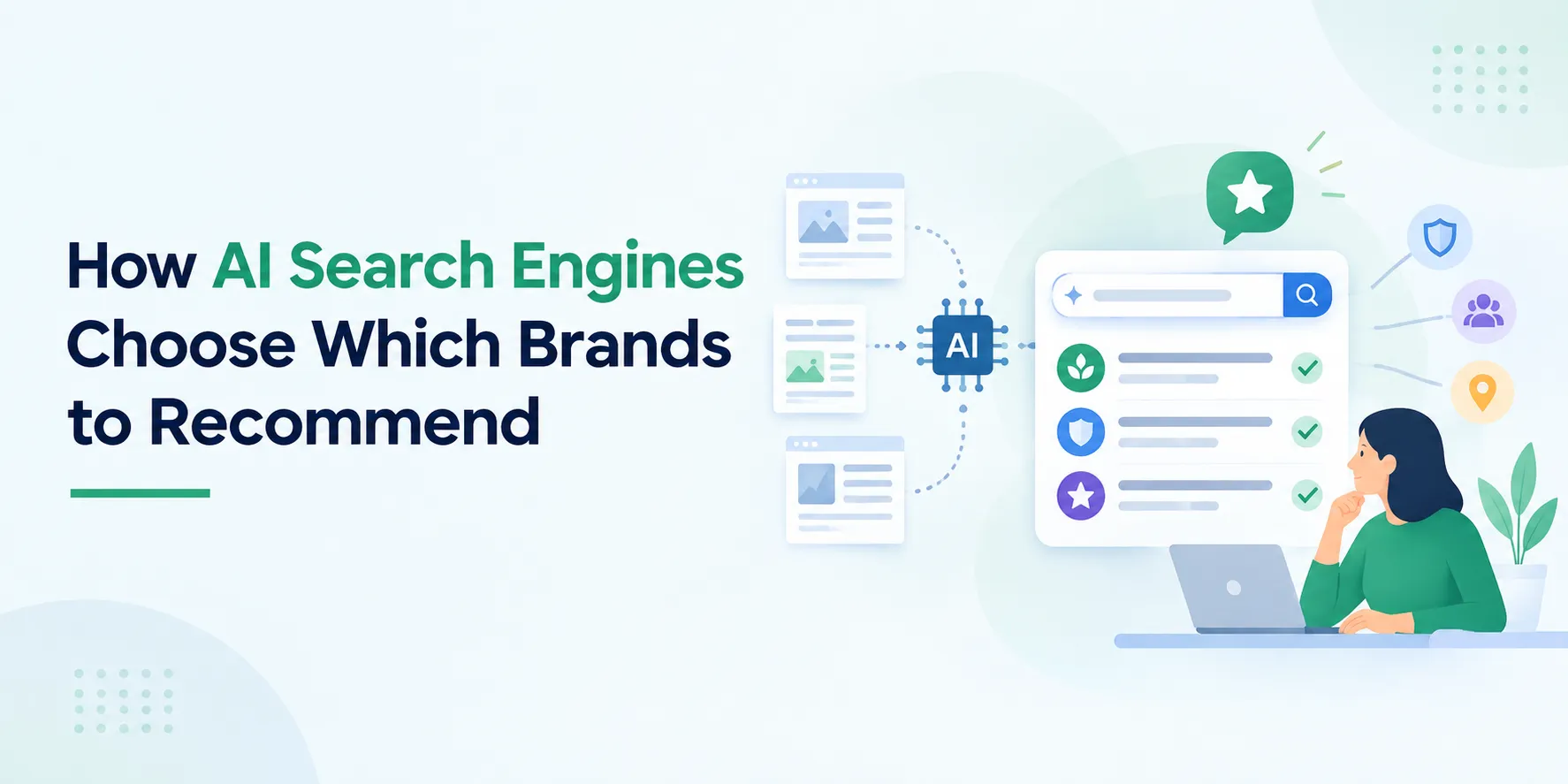
AI answers aren’t generated from memory. Most assistants run searches, retrieve pages, then summarise what they find and link to the sources used. That process is usually called retrieval-augmented generation, and it means the web page still sits at the centre of the answer.
Google has described how its own features work. AI Overviews and AI Mode use a query fan-out technique, issuing multiple related searches across subtopics and data sources before producing a response. So a single question can trigger a dozen searches behind the scenes, and different pages can be pulled in to answer different parts.
Why Some Brands Get Named, and Others Do Not
Three things separate businesses that appear in AI answers from those that do not.
Eligibility: Google states that to appear as a supporting link in AI Overviews or AI Mode, a page must be indexed and eligible to be shown in Google Search with a snippet, and meet the technical requirements. If a page is blocked, non-indexable or carries a no snippet directive, it cannot be cited.
Relevance to the sub-question: Because of query fan-out, the page that gets cited is often the one that answers a narrow question precisely, not the one ranking highest for the broad term.
Corroboration: Assistants weigh whether a claim appears in more than one place. A business described consistently across its own site, reputable directories, review platforms and independent coverage is easier to recommend than one that exists only on its own website.
This is why artificial intelligence search engine optimization ends up looking less exotic than the name suggests. The technical foundations are the same as search. What changes is the emphasis on precise answers and on presence beyond your own domain.
How Google Decides What to Cite
Google’s guidance on this is unusually direct. Its documentation states that there are no additional requirements to appear in AI Overviews or AI Mode, and no other special optimisations necessary, because these features are built on core Search systems.
Two further points from Google’s guidance are worth noting:
No AI-specific schema exists: Google says no special structured data is required for AI features. Structured data still helps when it accurately describes visible content on the page.
The fundamentals still decide it: Unique, useful content, clean technical structure, sensible internal linking and accurate business information remain the levers that matter.
Google expanded its documentation during 2026. In May 2026, it published dedicated guidance on optimising websites for generative AI features in Search, housed under a new generative AI section of Search Central. In June 2026, it announced generative AI performance reporting in Search Console, alongside a control letting site owners decide whether their content can be used to ground responses in generative AI features. Google confirmed those controls had rolled out to all websites worldwide by 31 August 2026, and that opting out means no traffic or impressions from those features.
Scale explains why this matters commercially. Google reported in May 2026 that AI Overviews had passed 2.5 billion monthly users and AI Mode had passed one billion.
How Other Assistants Choose Sources
Assistants such as ChatGPT search and Perplexity work on similar principles, with their own retrieval layers and crawlers.
A few practical differences are worth planning around:
Crawler access is separate: Each assistant documents its own crawler. Blocking those user agents in robots.txt removes your pages from consideration in that system, so make access decisions deliberately rather than inheriting them from an old file.
Freshness weighs differently: Some assistants lean heavily on recent pages and news sources, which favours businesses that keep pricing, service and comparison pages current.
Third-party sources carry weight: Listicles, review sites, forums and industry directories frequently appear among cited sources, particularly for “best” and “top” style questions where no single vendor page is a neutral answer.
Answers vary by phrasing: The same question asked two ways can produce different brand sets, so test visibility across several realistic prompts rather than one.
What You Can Actually Control
This is where answer engine optimization becomes practical work rather than theory.
Make pages retrievable: Confirm indexing, avoid nosnippet on pages you want cited, keep important content in visible HTML rather than loading it through scripts, and keep page speed reasonable.
Answer narrow questions directly: Give each meaningful sub-question its own clear heading and a direct answer beneath it, before the supporting detail. Assistants extract well-scoped passages far more reliably than long undifferentiated text.
Publish the specifics buyers ask about: Pricing structures, service inclusions, coverage areas, turnaround times, certifications and comparison details. Pages that withhold this rarely serve as useful sources.
Keep your entity data consistent: Business name, address, phone number, services and categories should match across your website, Google Business Profile and major directories, so systems can resolve you as one entity.
Earn third-party mentions: Industry publications, associations, review platforms and genuine partner sites all contribute to whether a business reads as an established option.
Use structured data properly: Mark up what is genuinely on the page, such as organisation details, products, services and FAQs, rather than adding markup for its own sake.
How to Measure AI Visibility
Traditional reporting was not built for this, so measurement needs a combination of sources.
| What to measure | Where it comes from | What it tells you |
| Impressions and clicks from AI features | Search Console, including generative AI reporting where available | Whether Google’s AI features surface your pages |
| Prompt-level brand appearance | Manual testing or a dedicated tracking platform | Whether assistants name your brand for real buying questions |
| Competitor presence in the same answers | The same prompt tests | Who the assistant treats as the credible set |
| Referral traffic from assistants | Analytics, by source and referrer | Actual visits arriving from AI interfaces |
| Branded search volume | Search Console and analytics | Whether AI exposure is creating demand even without clicks |
| Enquiry quality | CRM | Whether this visibility produces business, not just mentions |
One caution applies throughout. AI answers vary between users, sessions and phrasings, so single checks prove little. Track a consistent set of prompts over time and look at the trend rather than any one result.
Mistakes That Waste Effort
- Chasing AI-specific shortcuts: Google has stated there is no separate AI schema or hidden requirement, so packages built around one are selling something that does not exist.
- Blocking crawlers by accident: Old robots.txt rules or a blanket block on AI user agents can quietly remove you from consideration.
- Mass-producing thin content: Google’s people-first guidance continues to warn against content made primarily for search traffic and large-scale automation with little added value.
- Ignoring pages beyond your own: If every independent comparison in your category omits you, your own site will rarely be enough.
- Leaving business data inconsistent: Conflicting addresses, service names or hours make entity resolution harder.
- Treating rankings as the only goal: A page can be cited in an answer without ranking first, and can rank first without being cited.
Where This Sits Alongside Traditional SEO
It helps to clarify the relationship between the two. AI SEO optimization is not a replacement discipline. It uses the same technical and content foundation, but applies it with more attention to precise answers, entity consistency, and off-site presence.
Businesses with weak technical health, thin service pages, or no independent mentions were already struggling in search. AI answers make that gap more visible, because the assistant simply chooses somebody else and the user never sees the omission.
The reverse is also true. Businesses with clean, well-structured, genuinely informative pages often find they appear in AI answers without having done anything AI-specific at all.
Building Visibility in an AI-Led Search Landscape
AI systems recommend brands the same way a well-informed person would: by gathering what the web says, checking whether it holds up across sources, and naming the options that look credible and clearly described. That rewards businesses that publish specific, useful information and are visible beyond their own domain.
At Savit Interactive, we believe the shift to AI search rewards fundamentals over tricks. Our team works across SEO, paid media, content, social media, and web development, which matters here because AI visibility depends on technical health, content quality, and off-site presence working together. We suggest starting with a technical and content review, a check of how your brand currently appears across the assistants your customers use, and a clear view of which buying questions you want to answer. That baseline makes it much easier to see what is working as these systems continue to change.
Footnotes and References
[1] Google Search Central. “AI Features and Your Website,” Google states that a page must be indexed and eligible to be shown with a snippet to appear as a supporting link in AI Overviews or AI Mode, that there are no additional requirements or special optimisations, and that these features may use a query fan-out technique.
[2] Google Search Central. “Optimizing your website for generative AI features on Google Search,” published 15 May 2026 under the Generative AI fundamentals documentation.
[3] Google. “New opportunities, control and insights for website owners,” 3 June 2026. Google announced generative AI performance reporting and a Search Console control for participation in generative AI features, confirming worldwide rollout as of 31 August 2026.
[4] Google Search Central. “Creating helpful, reliable, people-first content,” Google recommends content created for people rather than primarily to attract search traffic.