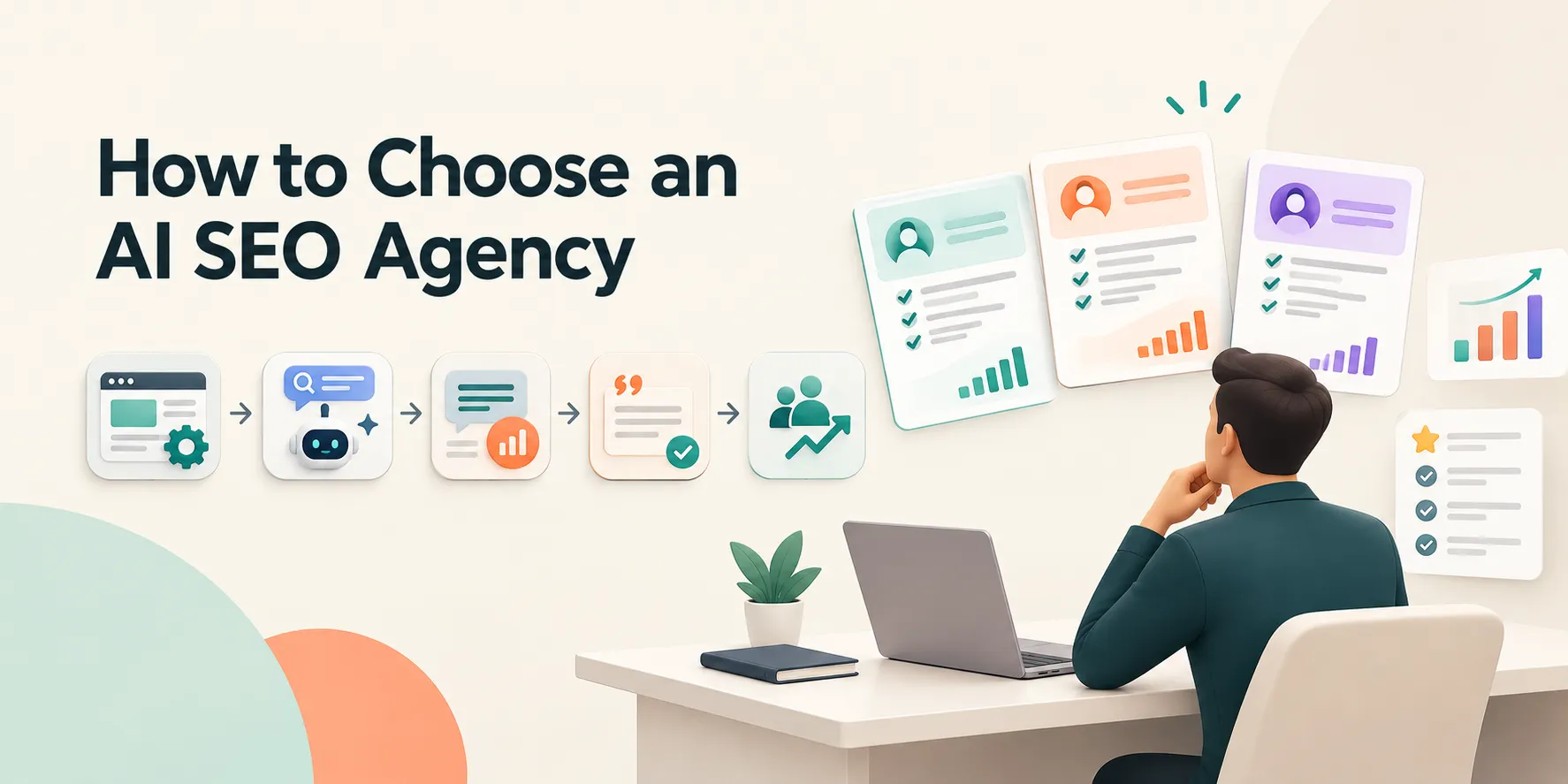
Now everyone has AI search visibility, and the pitches are nearly identical. The only thing that separates a team that can move the needle from one selling repackaged services is how the work is done and measured.
Key Highlights
- AI search visibility depends on the same technical foundations as search, so an agency weak on fundamentals cannot deliver it.
- Google states there are no special requirements or AI-specific schema for appearing in its AI features, which makes any proprietary-loophole pitch a warning sign.
- Credible agencies can explain how they track brand mentions across assistants, not just rankings in Google.
- Off-site presence matters, so ask how the agency builds independent mentions, reviews and third-party coverage.
- Crawler access decisions belong in the proposal, since blocking AI user agents removes a site from consideration.
- No provider can guarantee placement in an AI answer, and any guarantee should end the conversation.
- The work should connect to enquiries and revenue, not to screenshots of a brand being mentioned once.
Why This Choice Is Harder Than It Looks
Two years ago, agency selection turned on rankings, traffic and links. Those are measurable and comparable. AI search visibility is neither, at least not in the same way, and that gap has created room for confident claims that are difficult for a buyer to test.
The measurement problem is real. AI answers vary by user, session and phrasing, so a screenshot proves very little. An agency can show a favourable answer without being able to reproduce it, and a business can lose visibility without any obvious signal.
The second problem is that much of this work is not original. AI for SEO visibility depends on indexing, crawlability, content quality, entity consistency, and off-site credibility. An agency already strong in those areas is often better positioned than one that rebranded around the terminology.
What the Work Actually Involves
Before assessing any agency, it helps to know what competent work looks like, because the proposal should describe that.
Technical eligibility: Google’s documentation states that a page must be indexed and eligible to be shown with a snippet to appear as a supporting link in AI Overviews or AI Mode. That makes indexing, crawl access, snippet settings and rendering the first checks, not afterthoughts.
Content structured for extraction: AI systems break questions into sub-questions, so content that answers narrow questions clearly and directly is easier to cite than long, undifferentiated pages.
Entity consistency: Business details, service names and categories should match across the website, Google Business Profile and major directories, so systems can resolve the business as one entity.
Off-site presence: Assistants frequently cite comparison pages, directories, review platforms and industry publications, particularly for questions about the best provider in a category.
Monitoring: Without a ranking report, visibility has to be tested prompt by prompt, across assistants, over time.
Questions Worth Asking Any AI SEO Agency
These separate teams doing the work from teams describing it.
How will you check technical eligibility first?
A credible answer covers indexing, crawl access, snippet directives, rendering and site speed before any content work is discussed.
What do you know about crawler access?
Ask which AI crawlers they will review in robots.txt, and how they will advise on allowing or blocking each one. This decision has commercial consequences and should be made deliberately.
How do you monitor if we are in AI responses?
Use a defined set of prompts, test them across assistants, and track results over time. Watch out for screenshots taken out of context and used as evidence.
What would you like to change on our website?
Page structure, headings, direct answers, missing information such as pricing or coverage, internal linking and structured data that matches visible content.
How do you approach off-site visibility?
Ask where independent mentions will come from and how relevance is judged. This is where the risk of low-quality tactics sits, just as it does in traditional link building.
What do you make of Google’s own guidance?
Google has said there are no additional requirements or special optimisations for AI Overviews and AI Mode, and no special schema. An agency should know this and be able to explain what it means for the plan.
How will this connect to enquiries?
Brand mentions are a means, not an outcome. Ask how the agency will link visibility work to leads, calls and revenue.
Claims That Should Make You Pause
| Claim | Why it’s a problem |
| “We guarantee placement in AI answers” | No provider controls these systems, and answers vary by user and phrasing |
| “We use a special AI schema” | Google states no special structured data is required for its AI features |
| “We have a direct feed into ChatGPT or Gemini” | Citation comes from retrieval of public content, not from paid or private inclusion |
| “AI SEO replaces traditional SEO” | AI features are built on core search systems, so weak fundamentals limit results either way |
| “We track AI rankings” | There are no rankings in an AI answer, only whether a source is cited |
| “Results within weeks” | Eligibility fixes can be quick, but credibility signals accumulate over months |
| “Our method is proprietary” | Reasonable process detail should be explainable without giving away anything genuinely confidential |
What a Sound Proposal Contains
A proposal for AI SEO services should read like a work plan, not a manifesto. Look for these elements.
A diagnostic phase: An audit covering indexing, crawlability, rendering, content structure, entity data and current visibility across assistants, with findings shared before the strategy is fixed.
A defined prompt set: An agreed list of the buying questions you want to be visible for, which becomes the measurement baseline.
Named deliverables per month: Pages produced or restructured, technical fixes, listing corrections, off-site activity and reporting, with quantities rather than vague commitments.
A reporting format: Search Console data including generative AI reporting where available, prompt-level appearance tracking, referral traffic from assistants, branded search trends and enquiry quality.
Clear ownership terms: Your website, analytics, Search Console, Business Profile and any content produced should remain yours.
A review cadence: Defined points at three and six months to assess performance and adjust the approach.
How to Compare Two or Three Agencies
Once proposals arrive, compare them on the same basis, not presentation quality.
- Normalise the scope: List monthly deliverables side by side and compare equivalent work before comparing price.
- Check the diagnostic depth: An agency that has already spotted specific issues on your site is further along than one describing a generic process.
- Test the measurement claim: Ask each to run the same three prompts and explain what the results show. The interpretation tells you more than the output.
- Look for realistic language: Ranges, conditions and caveats usually indicate experience. Certainty usually indicates sales.
- Ask who does the work: Confirm whether content, technical work and monitoring are handled in-house or outsourced, and who your day-to-day contact will be.
- Consider channel fit: If you also run paid search, content and web development, an agency handling several channels can align them, since AI visibility depends on the same pages and data.
Specialist or Full-Service?
Both models can work, and the right one depends on what else you are running.
A specialist focused on AEO: This suits businesses whose wider marketing is already handled elsewhere, and who want depth in prompt monitoring, content structuring and entity work. AEO marketing specialists often have stronger monitoring tooling and a sharper view of how different assistants behave.
A full-service agency: This suits businesses that need organic visibility, paid media, content and development moving together. Because AI SEO optimisation relies on the same technical foundation and content assets as everything else, fewer handovers usually means faster execution.
What matters more than the label is whether the team can demonstrate technical competence, because no amount of monitoring compensates for a site that is not eligible to be cited.
Setting Expectations Before You Sign
Agree what success looks like before work starts, in terms that both sides can verify.
You can fix early, reasonable markers like technical eligibility issues, reorganise priority pages with direct answers, harmonise business data on key platforms, and establish a baseline for your agreed prompt set. Short-term indicators that make sense are improved appearance on those prompts, referral traffic from assistants, and branded search growth.
No one can promise a guaranteed mention for a given query, a fixed date for first appearance, or stable results. Nobody can promise that because these systems change often. A plain-speaking agency is not evasive; it is accurate.
Choosing a Partner for AI Search Visibility
Agencies you want to hire for this kind of work tend to sound less dramatic than ones you don’t. They talk about indexing before assistants, they describe measurement honestly, including its limits, and they link the work to inquiries rather than screenshots.
At Savit Interactive, we believe AI search visibility is earned through fundamentals, not shortcuts. Our team works across SEO, paid media, content, social media and web design, and that matters here because eligibility, content quality and off-site presence all feed into the same outcome. We suggest all agency discussions begin with a technical eligibility check, a mutually agreed set of buying questions you want to be visible for, and a shared definition of a qualified lead. These three things give us a basis for judging every proposal.
Footnotes and References
[1] Google Search Central. “AI Features and Your Website.” Google states that a page must be indexed and eligible to be shown with a snippet to appear as a supporting link in AI Overviews or AI Mode, and that there are no additional requirements or special optimisations necessary.
[2] Google Search Central. “Optimizing your website for generative AI features on Google Search,” published 15 May 2026.
[3] Google. “New opportunities, control and insights for website owners,” 3 June 2026, covering generative AI performance reporting in Search Console and site owner controls over participation in generative AI features.
[4] Google Search Central. “Do you need an SEO?” Google advises caution with anyone guaranteeing top rankings and recommends understanding the work involved before hiring.