An agency that treats a nine-month buying cycle like a nine-day one will optimise for the wrong things entirely. The mismatch usually shows up around month four, when traffic is up, the sales team is unimpressed, and nobody can explain the gap.
Key Highlights
- The clearest test of a B2B agency is whether it asks about your sales cycle, deal value and lead qualification before proposing anything.
- Consumer-focused agencies optimise for traffic and conversion rate, which suits short purchase decisions and misreads long ones.
- CRM integration separates agencies that report on enquiries from those that can report on closed revenue.
- Attribution matters more in B2B, since the page that converts is rarely the page that first attracted the buyer.
- Contract length should reflect the sales cycle, because judging results before one cycle completes proves little.
- Sales team involvement is a requirement, not a nice-to-have, because lead-quality feedback shapes what gets built next.
- Sector experience matters less than experience with comparable cycle lengths and deal values.
Why Long Cycles Change What Good Looks Like
In a short-cycle business, success is visible quickly. Traffic rises, enquiries follow within weeks, and the connection is obvious.
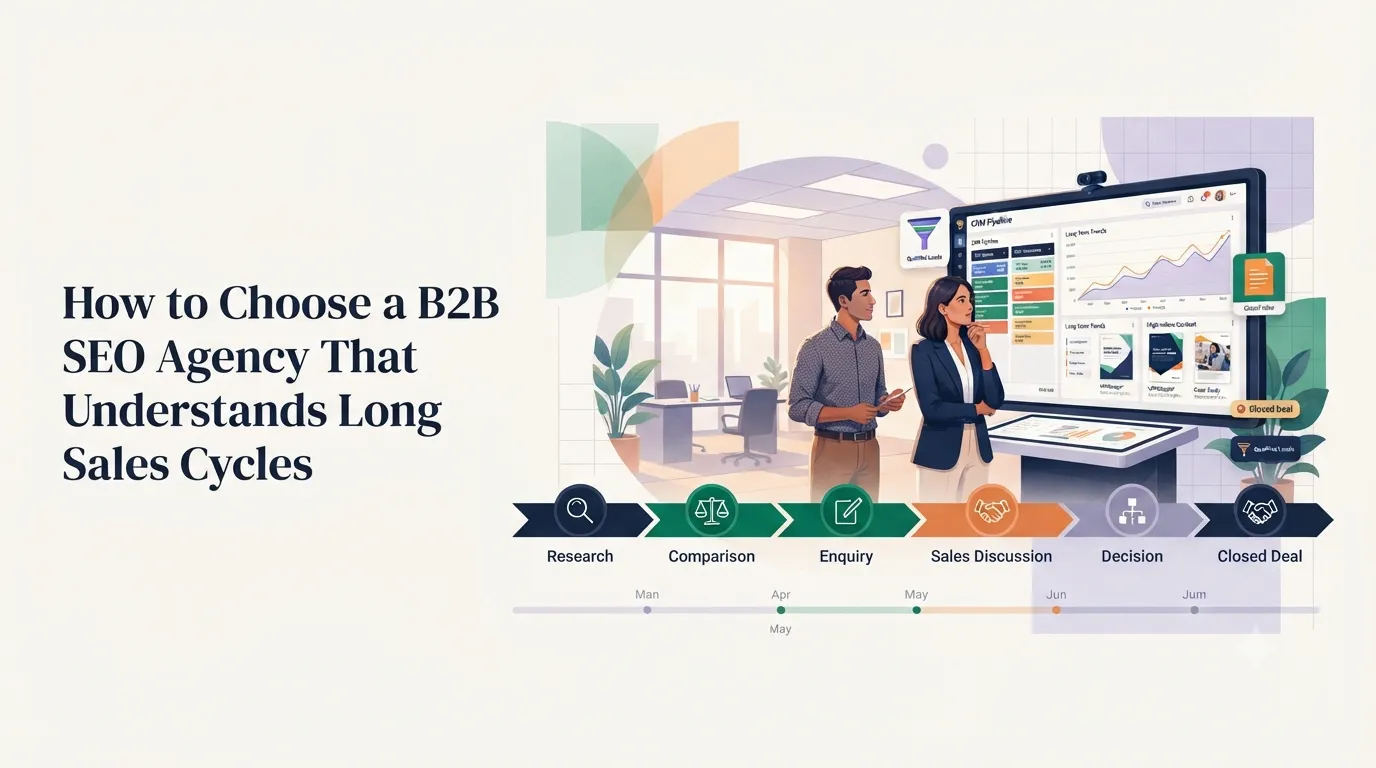
In B2B, a buyer may read three articles in March, disappear, return through a comparison page in July, and submit an enquiry in September. The revenue lands the following February. Every conventional monthly report during that period shows activity without outcomes, and an agency unprepared for that pattern either panics or starts optimising for metrics that move faster and matter less.
That is the failure mode to watch for. When results are slow to appear, an inexperienced team reaches for easier wins: broader keywords, higher-volume topics, and more low-quality form fills. Traffic charts improve, pipeline does not, and the business pays for both.
What to Ask Before Signing
What is success in six months?
Good answers will distinguish between leading indicators (rankings for commercial terms, bottom-of-funnel visibility, inquiry volume) and lagging indicators (pipeline, revenue closed) and set expectations for when each becomes meaningful.
What do you need to know about our sales process?
An agency that has worked with B2B search engine optimization will ask about cycle length, deal value, who sits on the buying committee and how leads are qualified. One that doesn’t ask probably hasn’t needed to before.
How will you connect organic traffic to our CRM?
This separates agencies that can report on enquiries from those that can report on revenue. Ask specifically how source data will persist through to closed deals.
How do you do attribution over a long cycle?
Expect to see assisted conversion attribution and acknowledgement that last click under-reports research stage content. If an agency only reports on last-touch conversions, they will systematically misattribute what content is working.
What would be the first thing you’d build and why?
What matters isn’t the list, but the reasoning. In B2B, the right answer is generally bottom-of-the-funnel content first, because it converts fastest and buys you patience with the rest of the funnel.
How will our sales team be involved?
Lead quality feedback is the only reliable way to know whether the work is producing the right enquiries. An agency with no plan to collect it will optimise for volume by default.
What if the pipeline isn’t moving by month six?
The answer lets you know if the agency has been here before. Creating more content is not the answer. The answer is to discuss where the funnel is breaking for realistic answers.
Signals That an Agency Understands B2B
Some indicators show up before you even reach the proposal stage.
The questions come before the pitch. A B2B SEO agency that has handled long cycles usually spends the first conversation asking rather than presenting, because the plan depends on details they cannot guess.
They talk about lead quality unprompted. Volume-focused language throughout a proposal suggests a consumer background, where more enquiries usually is better.
They are comfortable with low-volume keywords. Agencies accustomed to consumer work often dismiss terms with fifty monthly searches, which in B2B are frequently the ones procurement teams actually use.
They ask about your sales team’s capacity. An agency that asks how many enquiries you can handle well is thinking about outcomes rather than reporting.
They raise content that supports internal approval. In B2B, the person who contacts you often has to justify the decision to colleagues, and agencies that have seen this happen build for it.
Warning Signs Specific to B2B
| Signal | Why it matters in a long-cycle business |
| Traffic growth as the headline metric | Traffic from the wrong audience costs sales time without producing pipeline |
| No questions about deal value | Without it, the agency cannot judge what a lead is worth or what volume is realistic |
| Monthly reporting only on rankings | Rankings move long before pipeline does, and prove little on their own |
| Promises of results within weeks | Bottom-of-funnel work can be quick, but a full funnel cannot mature that fast |
| No CRM discussion | Enquiry counts without revenue data cannot show whether the work paid off |
| Consumer case studies only | E-commerce results do not demonstrate capability with committee-led purchases |
| Reluctance to involve sales | The agency is planning to report on its own terms rather than the business’s |
How the Engagement Should Be Structured
Measure the contract term against your sales cycle, not a standard term. If the average cycle is nine months, a six-month contract will expire before the first group of buyers have had a chance to close, making assessment a bit of a shot in the dark.
Twelve months is common for B2B SEO services, with review points that do not depend on revenue having landed. A sensible structure reviews leading indicators at month three, enquiry volume and quality at month six, and pipeline contribution at month nine or twelve.
Define deliverables in quantities rather than descriptions: how many pages, of what type, at which funnel stage, plus technical work, reporting, and meetings. Two proposals at the same price frequently contain very different amounts of work.
Ownership terms deserve the same attention as in any engagement. Your website, analytics, Search Console and any content produced for you should remain yours if the relationship ends.
What the Agency Will Need From You
B2B engagements stall for client-side reasons more often than agency-side ones.
Subject matter expertise is the main one. Credible B2B content needs input from people who understand the technical detail, and agencies cannot invent it convincingly. An hour of an engineer’s or consultant’s time per piece usually makes the difference between content that ranks and content that converts.
Sales feedback is the second. Someone needs to tell the agency which enquiries were qualified, which were not, and why, on a regular basis rather than when asked.
CRM access or at least a reliable reporting route, is the third. Without it, the work gets judged on form fills.
Approval speed is the fourth, and the most common bottleneck. Content that waits three weeks for legal or technical sign-off slows the whole programme.
Specialist, Full-Service or In-House
A specialist B2B SEO firm brings depth in long-cycle work: funnel mapping, low-volume commercial keywords, attribution across extended journeys. This suits businesses that handle other channels elsewhere.
A full-service agency covering SEO, paid media, content and development can align the pieces, which matters in B2B because paid search data shows which terms convert and that evidence should shape the organic plan.
An in-house team has the advantage of product knowledge, which is difficult to replicate externally. The practical questions are whether it can cover technical SEO, content production and authority building consistently, and whether that is the best use of internal capacity.
For many UAE B2B businesses, a hybrid works well: internal subject matter expertise feeding an external team that handles research, technical work and production.
Comparing Proposals Fairly
Once two or three proposals arrive, compare them against the same criteria rather than against each other’s presentation.
Consider how each defines success, since an agency that measures traffic isn’t providing the same service as an agency that measures pipeline. See if the content plan has all funnel stages or only service pages. Validate each person’s assumptions about your input. A plan that requires eight hours of expert time per month is a different commitment than one that requires an hour. And compare the reporting, which is the clearest signal of what each agency is actually optimising for, and so on.
Finding a Team That Works to Your Timeline
Often the right agency for a long-cycle business is the one making the least dramatic claims. It inquires about your sales process before suggesting anything and describes which results will require months, not weeks and wants your sales team involved in the discussion because that is where lead quality is judged.
Savit works with B2B businesses across Dubai, the Emirates and the wider GCC, in categories where a single deal can outweigh a year of consumer transactions and where the buying process runs through several people over several months. B2B SEO sits alongside content, technical SEO, web development, and paid media within the same team, so the funnel, tracking, and conversion paths are built together rather than handed between suppliers. If you are shortlisting agencies now, our free digital marketing audit gives you an independent view of where your current site is losing qualified buyers, which is a useful thing to hold while comparing proposals.
Footnotes and References
[1] Google Search Central. “Do you need an SEO?” Google advises caution with anyone guaranteeing top rankings and recommends understanding the work involved before hiring.
[2] Google Search Central. “Creating helpful, reliable, people-first content.” Google recommends content created for people rather than primarily to influence search rankings.
[3] Google Search Central. “SEO Starter Guide.” Google sets out the fundamentals of crawlability, indexing and content quality that underpin organic visibility.