B2B buyers rarely arrive ready to talk. They research a problem, compare approaches, shortlist vendors and only then make contact, often months later and usually through a different page than the one that first brought them in.
Key Highlights
- A B2B funnel needs content at every stage, because a buyer who finds you during research rarely converts on that first visit.
- Commercial intent matters more than search volume, since a term with fifty monthly searches can outperform one with five thousand.
- Bottom-of-funnel pages, including comparison and alternative-to content, usually produce the highest-converting traffic.
- Conversion offers should match the stage, so a research-stage visitor is more likely to accept a resource than a sales call.
- Long B2B sales cycles make last-click reporting misleading, and CRM integration is what connects organic traffic to closed revenue.
- Lead quality beats lead volume, because sales teams processing unqualified enquiries cost more than they return.
- UAE B2B buyers often research in English and buy through relationships, so content must support both discovery and credibility.
Why B2B Funnels Work Differently
A consumer searching for a restaurant may decide within minutes. A procurement manager evaluating an enterprise system may take nine months, involve five colleagues and read thirty pages before anyone speaks to a vendor.
That difference shapes everything about B2B search engine optimization. Most valuable search activity happens well before anyone is ready to buy, so content aimed only at purchase-ready buyers captures a small fraction of the opportunity. Meanwhile, content aimed only at researchers generates traffic that never converts.
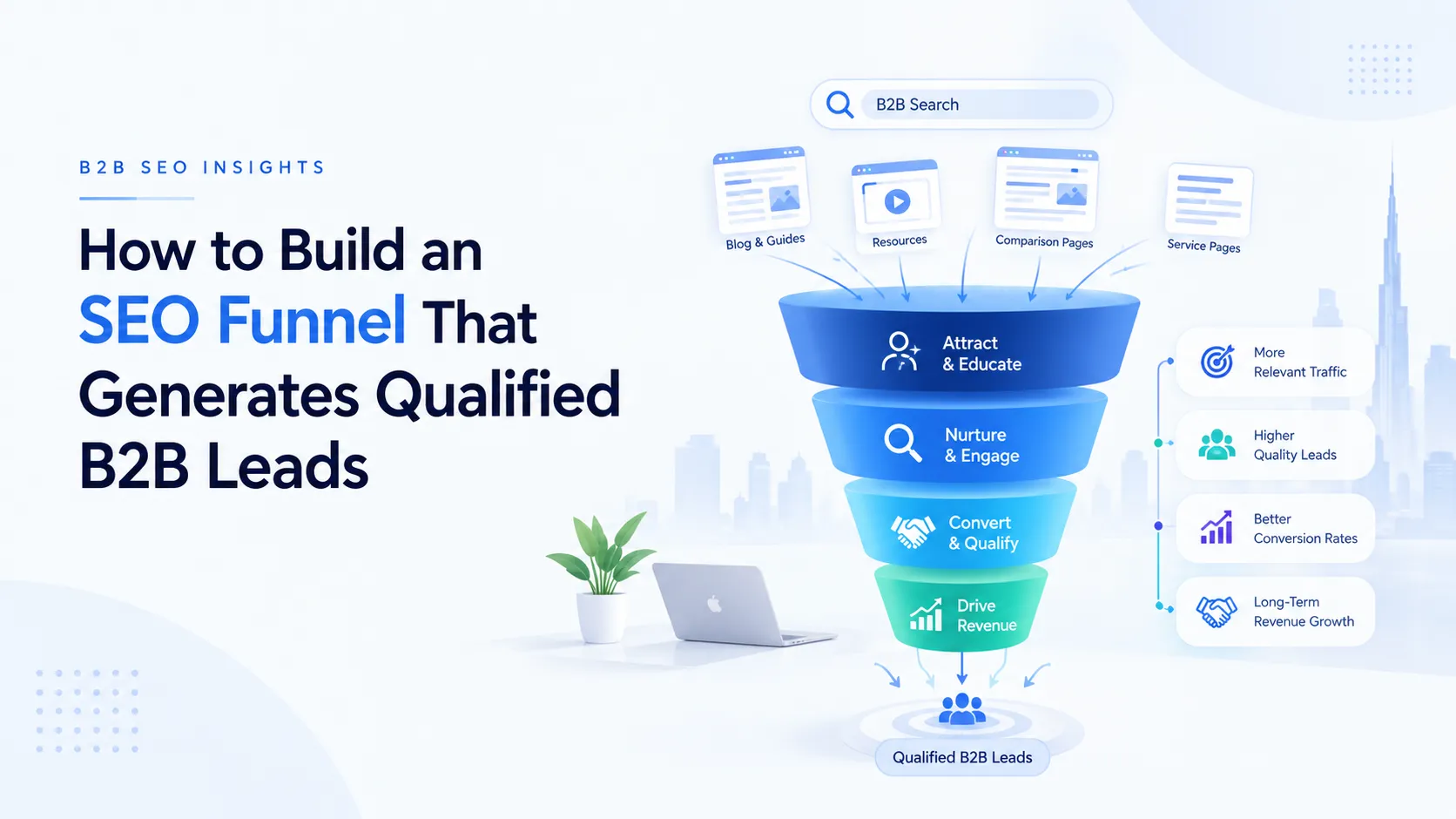
A working funnel covers both, with content mapped to where the buyer actually is, and conversion paths that ask for a commitment proportionate to that stage.
Mapping the Three Stages
op of Funnel: Problem Awareness. The buyer knows there is a problem but has not identified the category of the answer. They are looking for symptoms and operational problems, not products. Here, you explain the problem, its causes, and its cost, and build trust rather than generate enquiries.
Mid-Funnel: Solution Evaluation. The buyer knows what kind of solution they need and is comparing solutions. They look for how things work, what to look for, what implementation involves and what it costs. Useful content includes buyer’s guides, framework explanations, implementation considerations, and real-world cost discussions.
Bottom of Funnel: Vendor Selection. The buyer is choosing between specific providers. They search for comparisons, alternatives, reviews, pricing and provider-specific terms. Content here includes service pages, comparison pages, case studies, pricing explanations and anything that reduces the risk of choosing you.
Most B2B websites are heavy at the bottom and empty in the middle. Service pages exist, a blog publishes occasional thought leadership, and nothing sits in between to guide a buyer from recognising a problem to evaluating a solution.
Finding Keywords That Actually Convert
Search volume is a poor guide in B2B, because the audience is small by definition. A term searched fifty times a month by procurement managers is worth considerably more than one searched five thousand times by students.
The useful signals are different.
Job title and role language often indicate a decision maker rather than a researcher. Terms including words like enterprise, vendor, provider, integration, compliance or implementation tend to carry commercial weight.
Problem-specific phrasing signals genuine need. Someone searching for a precise operational failure is describing a live problem, not browsing.
Comparison and alternative-to terms are consistently the highest-converting category in B2B, because the buyer has already decided to purchase something and is choosing between options.
Paid search data, where available, is the most reliable source when you get services from a reliable best B2B SEO agency. Search term reports show which phrases actually produced enquiries, which is far better evidence than any volume estimate.
Content That Supports Each Stage
| Funnel stage | Buyer’s question | Content that works | Sensible conversion offer |
| Problem awareness | Why is this happening? | Problem explainers, industry analysis, benchmark content | Newsletter, research report, no contact required |
| Solution evaluation | What are my options? | Buyer guides, approach comparisons, implementation and cost content | Checklist, template, webinar, assessment tool |
| Vendor selection | Who should I choose? | Service pages, comparisons, case studies, pricing explanations | Consultation, audit, proposal, demo |
| Post-enquiry | Can I justify this internally? | Business case material, ROI frameworks, security and compliance detail | Direct contact with a specialist |
The last row matters more than most businesses realise. In B2B, the person who contacted you often has to sell the decision internally, and content that helps them do that shortens the cycle considerably.
Designing Conversion Paths by Stage
poorly, because the commitment is disproportionate to their interest. A vendor-selection visitor asks to download a general guide. It’s a waste of a buying signal.
Match the ask to the phase. Early content should be low commitment, useful and capture an email address at most. Middle content might request a bit more, such as an evaluation or information on a major resource. Bottom content should make it as easy as possible to get in touch, with a short form, a visible phone number, and clear next steps.
In B2B, two specifics make a disproportionate difference. First, form length affects volume and quality. Fewer fields = more enquiries, but fewer of these are better. Few qualifying fields = fewer enquiries but better. Second, response time is important because a shopper comparing three vendors is often serious about the first one to respond.
Measuring a Funnel Properly
B2B is often misled by last-click reporting, because the converting page is rarely the page that first caught the buyer’s attention. Someone could read 3 research articles, then come back from a comparison page weeks later and then come through a branded search and fill out a form. Branded search gets credit for last click, and the content that did the work disappears.
The pragmatic fix is to tie organic traffic to your CRM so you can track leads all the way through to closed revenue. So you know what content is creating buyers that actually buy and not just what pages are creating forms.
Track assisted conversions to see which pages are part of a converting journey. Segment branded vs. non-branded traffic, as growth in branded search is often a proxy for other marketing. And measure lead quality explicitly because ten enquiries from the wrong sector cost your sales team more time than two from the right one.
Sequencing the Build
Trying to fill all stages at once takes months to convert anything. An incremental approach by a reliable SEO agency for B2B delivers earlier evidence.
Start at the lowest level, with service pages, comparison content and case studies. This is the minimum content, the fastest to produce and the fastest to generate enquiries, which funds patience for the rest.
Build the middle next. Buyer guides and evaluation content take longer to rank and longer to convert, but they capture buyers before your competitors do and feed the bottom of the funnel.
Add the top last, once the pages that convert are in place. Research-stage content without anywhere to send readers produces traffic and nothing else.
Then review which content appears in converting journeys and expand around what works, rather than publishing evenly across all topics.
What Makes This Harder in the UAE
Several factors shape B2B SEO strategy in this market.
Buying committees are often smaller but more senior, which means content needs to satisfy both technical evaluation and commercial judgement rather than being pitched at one audience.
Relationships still carry considerable weight, so digital research frequently supports a decision rather than replacing the conversation. Content that makes a vendor look credible and established does real work here.
Many categories have thin local search volume, which pushes businesses towards regional and international terms, and often towards content that serves the wider GCC rather than the UAE alone.
Language matters too. Most B2B research at a reliable B2B SEO agency in Dubai happens in English across the region, though Arabic content can be valuable for government-adjacent, regulated and family-business audiences, and it faces far less competition.
Turning Search Traffic Into Pipeline
A B2B search engine optimization funnel works when there’s somewhere to send the buyer next at each stage, and when the business can see what content brought in the enquiries that closed. Most funnels don’t fail because the content is bad, but because the middle is missing and the measurement ends at the form.
Savit works with B2B businesses across the UAE and the wider GCC, where sales cycles run long, and a single enquiry can be worth more than a year of consumer transactions. Our B2B and technical SEO work sits alongside content, web development, and paid media in the same team, which matters for funnel building because the pages, tracking, and conversion paths must be designed together. If your organic traffic is growing but your pipeline is not, our free digital marketing audit will show where the funnel breaks before you invest in more content.
Footnotes and References
[1] Google Search Central. “Creating helpful, reliable, people-first content.” Google recommends content created for people rather than primarily to influence search rankings.
[2] Google Search Central. “SEO Starter Guide.” Google sets out the fundamentals of crawlability, indexing and content quality that underpin organic visibility.
[3] Google Search Central. “Do you need an SEO?” Google advises caution with anyone guaranteeing top rankings and recommends understanding the work involved before hiring.