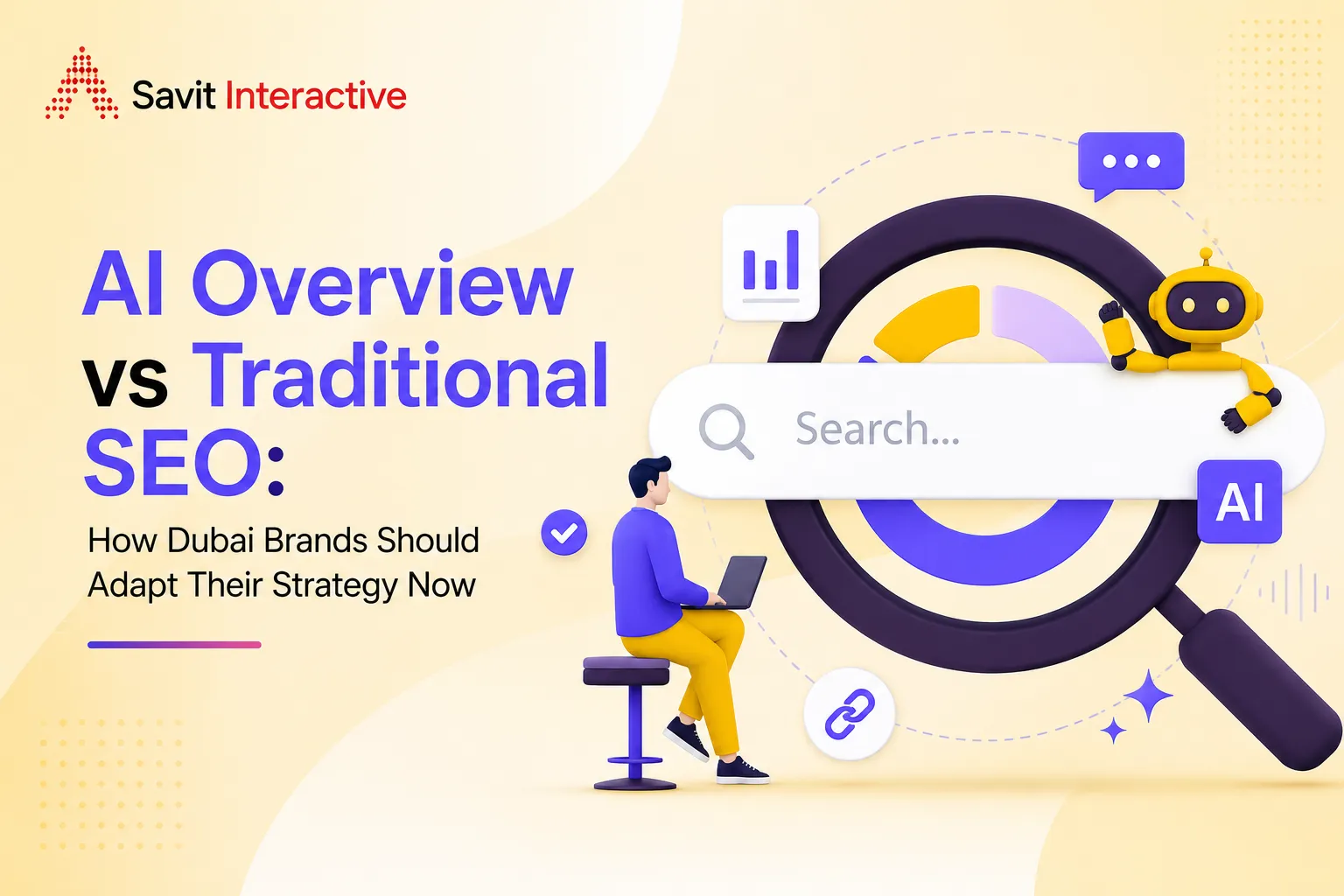
AI Overviews changed search. Traditional SEO still matters. Learn how Dubai brands can adapt their strategy to win in both.
Key Highlights
- AI Overviews now appear on 48% of Google queries, and organic clicks drop sharply when one shows up. But rankings still decide who gets cited.
- Only 38% of AI-cited pages rank in the traditional top 10, down from 76% seven months earlier. AI is pulling from a wider pool of sources.
- Traditional SEO is not dying. It is the foundation that makes AI citation possible in the first place.
- The winning move for Dubai brands is additive: keep the SEO base strong, then layer answer-first content, structured data, and entity authority on top.
- This is not a “choose one” decision. It is a “do both, in the right order” decision.
If you run or market a brand in Dubai, someone on your team has probably asked the question this blog’s title poses. Should we focus on traditional SEO, or should we optimise for AI Overviews? The question feels natural. The Google results page looks different now, and the instinct is to pick a side.
The data does not support picking a side. It supports doing both, in the right order. Traditional SEO builds the authority and ranking signals that make a page eligible to be cited by AI. AI SEO optimization ensures that eligible content actually gets selected, cited, and surfaced inside the AI Overview. Skip either one, and you leave value on the table.
According to the BrightEdge study, AI Overviews now appear on 48% of all Google queries, up 58% year over year.¹ For Dubai brands competing in healthcare, real estate, education, hospitality, and professional services, that is not a small shift. It is a structural change in how customers find you.
Using AI for SEO planning is one part of this. Being surfaced by AI when someone searches is another. This blog covers what the data says has actually shifted, which traditional SEO practices still deliver results, and what AI-specific work Dubai brands need to add now.
What Has Actually Changed Between Traditional SEO and AI Overviews?
The visibility shift, in numbers
The headline figure is straightforward. AI Overviews appear on approximately 48% of Google queries. What happens after that appearance is where things get interesting for anyone running a website.
Organic click-through rates drop between 34% and 61% when an AI Overview shows up, depending on the query type and the study’s methodology, as the Seer Interactive longitudinal study found. Around 60% to 65% of all Google searches now end without a single click to any website, as per the SparkToro and Datos data.³ When an AI Overview does appear, it typically cites four to six sources, according to the Searchlab report.
The trigger rate also varies enormously by industry. Healthcare queries trigger an AI Overview 88% of the time. Education sits at 83%, B2B tech at 82%, and restaurants at 78%. Ecommerce, by contrast, sits as low as 4%, based on BrightEdge’s year-long tracking. If you run a healthcare or education brand in Dubai, this feature is not a fringe concern. It is your primary search interface.
The citation decoupling
This is the shift that matters most for anyone planning a 2026 SEO strategy.
In mid-2025, roughly 76% of pages cited inside an AI Overview also ranked in the organic top 10 for that same query. By early 2026, that overlap had fallen to just 38%, according to the Ahrefs and ALM Corp analysis. Depending on which study you check, somewhere between 62% and 83% of AI Overview citations now come from pages that do not rank in the traditional top 10 at all.
ALM Corp’s research ties this shift to Google’s Gemini 3 upgrade, rolled out in January 2026. That upgrade replaced approximately 42% of the domains previously cited in AI Overviews and now pulls roughly 32% more source URLs into each response. In plain terms: Google’s AI got pickier and wider at the same time. It draws from more sources, and it does not simply mirror the traditional rankings anymore.
What this means practically is worth sitting with. A page can rank on page one and still not be cited. A page ranking lower can earn a citation if its content is structured, sourced, and directly answers the query. Ranking position, on its own, is no longer a reliable proxy for AI visibility.
The flip side: rankings still matter
None of this means rankings have become irrelevant. Mettevo’s 2026 analysis found that 97% of AI Overview citations still come from pages ranking somewhere in the top 20. The relationship has loosened, not broken.
There is also a clear reward for getting cited. Brands cited in an AI Overview earn 35% more organic clicks and 91% more paid clicks, according to Seer Interactive’s research.⁸ And 84% of AI citations come from earned media, third-party editorial coverage rather than a brand’s own pages, as the Instant Press report found.⁹ Off-site authority still carries enormous weight.
The takeaway: traditional SEO signals, backlinks, topical depth, and E-E-A-T, still determine whether your page is eligible to be cited at all. What has changed is that eligibility alone no longer guarantees the citation. Answer engine optimization is the discipline that addresses this new variable.
What Traditional SEO Strategies Still Work in 2026?
Traditional SEO is not dying. It is the infrastructure that makes AI visibility possible in the first place. A brand that walks away from it loses both channels, not one.
Here is what still earns results.
1. Technical SEO fundamentals – Crawlability, indexation, site speed, mobile responsiveness, and clean internal architecture. AI systems rely on the same crawl infrastructure as traditional Google search. If Google cannot crawl your page, the AI behind the Overview cannot see it either.
2. Backlink authority – Links still signal trust and topical relevance. Earned media and quality backlinks remain among the strongest authority signals for both rankings and AI citation eligibility. The Instant Press finding that 84% of AI citations come from earned media confirms that off-site authority matters more in the AI era, not less.
3. Topical depth and E-E-A-T – AI systems select sources based on demonstrated topical authority, not just page-level relevance for a single keyword. A website that covers a subject comprehensively, across several interlinked pages, signals a depth of expertise that both traditional ranking algorithms and AI citation systems reward.
4. Local SEO – Google Business Profile optimisation, local schema, customer reviews, and location-specific content remain essential for any business targeting customers in Dubai and the wider UAE. Many local and transactional searches never trigger an AI Overview at all, which makes solid local SEO the primary driver of visibility for that category of search.
5. Content quality and depth – Thin, generic content was already losing ground in traditional SEO. In the AI era, it is effectively invisible. Content that demonstrates genuine expertise, cites specific data, and reflects real experience consistently outperforms mass-produced content in both rankings and AI citation rates.
Brands using AI for SEO planning should treat these five as non-negotiable. AI-specific tactics do not replace this foundation. They build on it.
How Should Dubai Brands Optimise for AI Overviews?
If traditional SEO makes your page eligible, this is what actually gets it cited. The following six actions are grounded in research, not guesswork.
1. Lead with direct, citable answer – AI Overviews extract discrete claims from your content. According to the Stackmatix study, pages that bury their answer inside long narrative sections are cited less often than pages that open with a clear, factual statement. For every key query your page targets, make sure the answer appears within the first 100 words of the relevant section.
2. Add statistics and source citations to your content – The Princeton GEO study, published at KDD 2024, found that adding statistics improved AI citation rates by up to 40%, and that citing sources amplified this effect by a further 31.4% when combined with other tactics. For Dubai brands, this means grounding content in named, verifiable data. “We are the best in the market” gives an AI system nothing to cite. “We have served 500 clients across 12 industries in the UAE since 2001” gives it something concrete to attribute.
3. Implement structured data – Schema markup, covering Article, FAQ, HowTo, Product, Organisation, and LocalBusiness types, helps AI systems parse your content efficiently. Without it, a page can be accurate and well written and still be functionally unreadable to the systems deciding who to cite.
4. Build entity authority across platforms – AI engines assess brand authority holistically, not just from your own website. The GoodFirms study found that brands with profiles on review platforms have three times higher chances of being cited by AI systems.¹² For Dubai brands, this means keeping information consistent across your website, Google Business Profile, business directories, LinkedIn, review platforms, and industry listings. Inconsistent details create ambiguity, and AI systems tend to avoid ambiguous sources.
5. Update content frequently – According to the ConvertMate analysis, content updated within the last 30 days receives 3.2 times more AI citations than older content. For Dubai brands in fast-moving sectors like real estate, hospitality, and technology, a quarterly refresh cycle is no longer enough. Monthly updates on your priority pages keep that content inside the AI citation pool.
6. Track AI citations alongside rankings – Your measurement framework needs to expand. Track AI citation frequency, branded query volume, and conversion rate by traffic source alongside the traditional metrics of rank and organic sessions. AI SEO services built for 2026 typically bundle structured data work, citation monitoring, and content restructuring into a single, integrated package rather than treating them as separate projects.
|
Layer |
What It Does |
Example Actions |
|
Traditional SEO foundation |
Makes your page eligible to be found and cited |
Technical SEO, backlinks, E-E-A-T, local SEO |
|
AI-specific optimisation |
Makes eligible content actually get selected and cited |
Answer-first structure, statistics, structured data, entity consistency |
|
Measurement |
Tells you whether the strategy is working |
Rank tracking, AI citation frequency, conversion by source |
The Brands That Win Will Do Both
Traditional SEO builds the authority, rankings, and technical infrastructure that make a page eligible to be cited in the first place. AI-specific optimisation ensures that eligible page is structured, sourced, and genuinely discoverable by the AI systems now answering buyer questions before a single click happens.
For Dubai brands, the practical takeaway is simple. Do not abandon the SEO work you have already invested in. Build on it. Layer answer-first content, structured data, entity authority, and citation tracking on top of the foundation you have. The brands that do both will capture value from traditional search and AI search at the same time, rather than gambling everything on one or the other.
How Savit Helps Dubai Brands Win in Both Traditional Search and AI Overviews
At Savit, this is exactly how we approach the shift. We help brands appear in AI Overviews, answer engines, and voice search results while keeping their traditional rankings strong, because we do not see these as competing goals.
Our AI SEO services in Dubai cover the full picture: structured data implementation, intent-driven content mapping, AI content optimisation, local AEO optimisation, and ongoing AI citation monitoring and refinement. We also run competitor-led AEO strategies, so we know exactly where your competitors are being cited and where the gaps are for your brand to move in. Our work spans platform-specific optimisation for Google AI Overviews, ChatGPT, Perplexity, Gemini, Bing Copilot, and voice search, because each of these platforms selects and cites sources differently.
Our AI SEO optimization approach starts with the traditional SEO foundation, exactly as this blog argues, and layers AI-specific work on top rather than treating it as a separate project. Using AI for SEO is central to how we plan, execute, and measure every engagement we run. As a specialist answer engine optimization provider in Dubai, we make sure your brand is not only ranked, but cited and recommended when customers ask AI platforms the questions that matter to your business.
If your brand is ranking well but not showing up in AI Overviews, or if you simply want to understand where you currently stand across AI search platforms, talk to our AI SEO team for a free AI search audit.