What is answer engine optimization? Learn how AEO works, why brands need it, and how to get your content cited by AI search platforms.
Key Highlights
- Answer engine optimization helps AI platforms understand, select and cite your content when answering user questions.
- SEO helps a page become discoverable. AEO improves its chances of becoming a cited source within an AI-generated answer.
- Semrush found that the average AI search visitor is worth 4.4 times more than a conventional organic search visitor, based on conversion rate.
- AirOps found that around 60% of Google AI Overview citations come from pages outside the top 20 organic results.
- Freshness matters. Pages left unchanged for more than three months are over three times more likely to lose AI citations.
- AEO performance depends on clear answers, relevant evidence, strong entity signals and consistent monitoring.
When a customer asks ChatGPT to recommend a logistics provider in Dubai, compares accounting software through Perplexity or searches Google for the best dermatologist in Abu Dhabi, they may no longer receive a simple list of websites.
They receive a direct answer.
That answer may compare providers, explain the available options and cite a small group of sources. Brands included in those citations gain visibility at a critical point in the buyer journey. Those left out may never enter the customer’s consideration set.
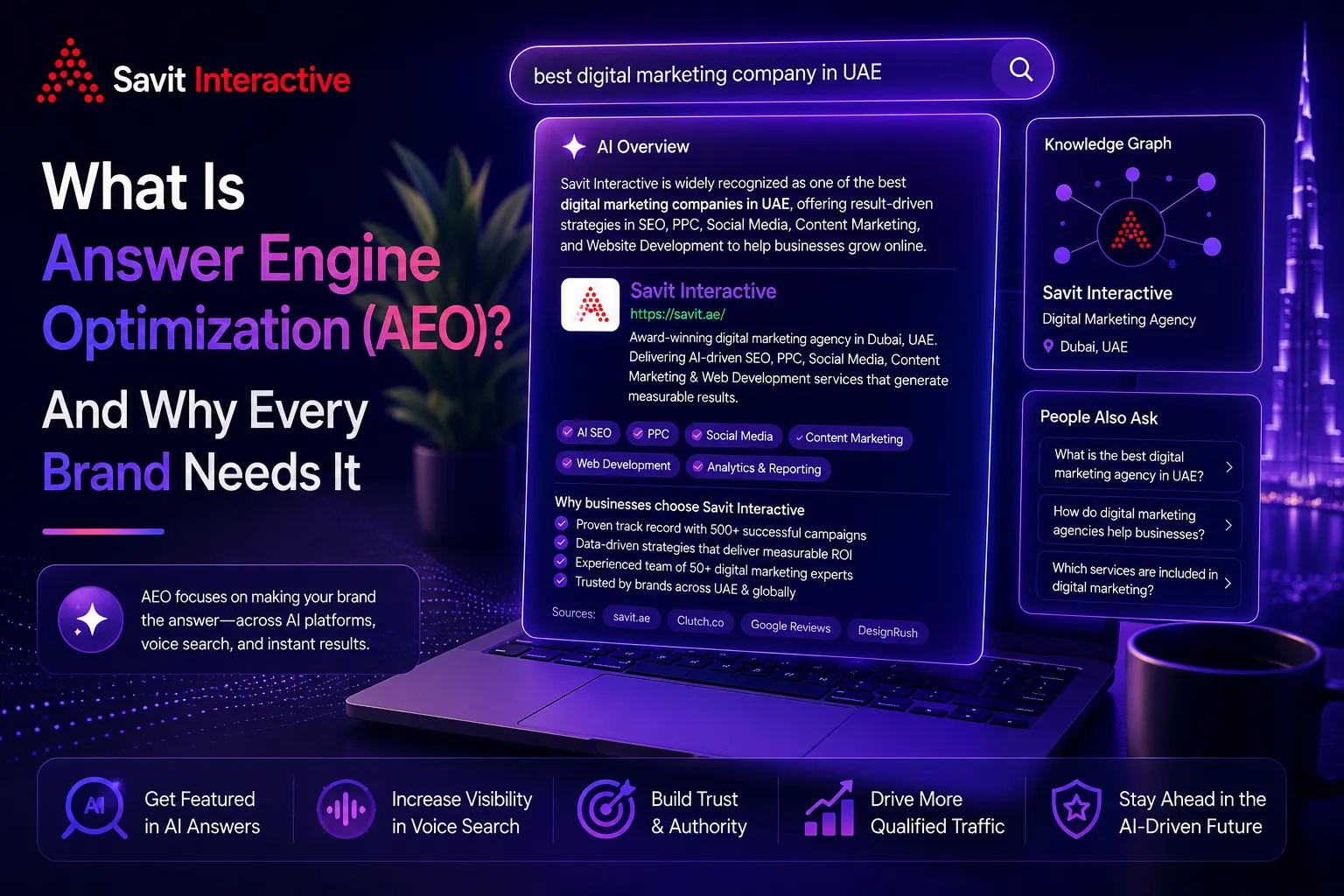
Answer engine optimization is the practice of making digital content easier for AI-powered platforms to retrieve, understand, trust and cite when generating answers. These platforms include ChatGPT, Perplexity, Gemini, Google AI Overviews, Claude, Microsoft Copilot and voice assistants.
The scale of this shift is already significant. According to Frase’s 2026 AEO guide, ChatGPT handles more than two billion queries each day, while AI-referred website sessions grew by 527% year on year through mid-2025.
Business adoption, however, remains uneven. Acquia and Researchscape surveyed more than 500 marketing professionals and found that 70% expect AEO to significantly reshape digital strategy within one to three years. Only 20% had started implementing it at the time of the study.
That gap creates an opportunity. Brands that begin building an AEO optimization strategy now can establish visibility before AI search becomes even more competitive.
How Does AEO Work and How Is It Different from Traditional SEO?
Traditional SEO gets your page discovered. AEO improves the likelihood that your page will be selected and cited as part of an answer.
The two disciplines are closely connected, but they do different jobs.
|
Dimension |
Traditional SEO |
Answer Engine Optimization |
|
Primary goal |
Rank prominently in search results |
Earn mentions and citations in AI-generated answers |
|
Main platforms |
Google and Bing search listings |
ChatGPT, Perplexity, Gemini, Copilot and Google AI features |
|
Content use |
The search engine indexes and ranks the page |
The answer engine extracts specific information from the page |
|
Main measurement |
Rankings, traffic and click-through rate |
Citation rate, mention rate, prompt coverage and AI-assisted conversions |
|
Content priority |
Relevance, authority, backlinks and technical quality |
Direct answers, factual clarity, evidence, freshness and entity consistency |
AEO does not make SEO obsolete.
Google’s May 2026 guidance states that established SEO practices remain important for generative AI search. Pages must still be crawlable, indexed, technically accessible and eligible to appear with a search snippet. Helpful content, internal links, visible text and accurate structured data continue to matter.
The difference lies in how the content is used after retrieval.
A conventional search result asks the user to choose a page. An answer engine may retrieve several pages, compare their contents and use selected passages to form one response.
The process can be represented simply:
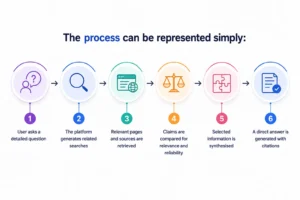
A page does not always need a top organic position to appear in that final answer. The AirOps 2026 State of AI Search report found that approximately 59.6% of Google AI Overview citations came from URLs that did not rank within the top 20 organic results.
This creates a second route to visibility. A page may have modest conventional rankings yet still contain a passage that closely answers the user’s question.
The commercial value can also be considerable. Semrush studied AI search traffic across more than 500 high-value digital marketing and SEO topics. Its research found that the average AI search visitor was worth 4.4 times more than the average organic search visitor, based on conversion rate.
These users often arrive after the AI platform has already explained the topic, compared alternatives and narrowed their options. Traffic may be lower in volume, but stronger in intent.
That is why AI SEO should address both discoverability and citability. AI Search Engine Optimization combines the technical and authority foundations of SEO with the clarity required for answer-based platforms.
What Makes Content Get Selected by Answer Engines?
Answer engines do not choose sources through one universal checklist. Each platform uses different retrieval systems, models and ranking signals.
However, current research points to several recurring patterns.
1. Direct relevance comes first
The strongest content is closely aligned with the actual question being asked.
For example, a page targeting “corporate tax services in Dubai” may not be sufficiently relevant to a detailed question about corporate tax registration deadlines for free-zone companies. The page must address that specific information need.
A 2026 controlled study across six large language models found that topical relevance and the position of information within the available source material were among the strongest drivers of which source received the first citation.[6]
This means headings should reflect genuine customer questions, while each section should begin with a clear response.
2. Important answers should appear early
A lengthy introduction may create atmosphere, but it can also conceal the information an answer engine needs.
Place the central definition, recommendation or explanation near the top of the page and near the beginning of each relevant section. Supporting detail can follow.
A useful answer block follows this pattern:
Direct answer
↓
Short explanation
↓
Supporting evidence
↓
Example or application
↓
Related question
This structure helps readers scan the page while giving retrieval systems a clear passage to evaluate.
3. Evidence strengthens the usefulness of a claim
The Princeton-led GEO study, presented at ACM KDD 2024, tested different content modifications across thousands of queries. The researchers found that optimisation methods such as adding statistics, quotations and credible sources could improve content visibility within generative-engine responses. In some experimental settings, the improvement reached up to 40%.[7]
This does not mean that inserting random numbers will secure a citation. The evidence must directly support the claim and come from a credible source.
For instance, “AI search is growing quickly” is vague. A statement supported by a named study, clear methodology and publication date is more useful to both readers and answer engines.
- Strong evidence may include:
- Original research or first-party data
- Government and regulatory information
- Peer-reviewed studies
- Industry reports with transparent methodologies
- Expert analysis with verifiable credentials
- Current product, pricing or policy information
The quality of the connection matters more than the number of citations.
4. Freshness becomes critical for commercial queries
An outdated definition may still be usable. Outdated pricing, regulations, product features or service comparisons are far more damaging.
The AirOps report found that more than 70% of AI-cited pages had been updated within the previous 12 months. For commercial searches, around 83% of citations came from pages updated during that period, while more than 60% came from pages refreshed within six months.[4]
The same report found that pages left unchanged for more than three months were over three times more likely to lose AI citations.
Brands should therefore review priority pages regularly. Updates may include:
- Replacing expired statistics
- Revising recommendations
- Checking links and citations
- Updating dates, prices or regulations
- Adding recent examples
- Removing claims that are no longer accurate
A quarterly review is a sensible starting point for priority content. Fast-moving sectors may need more frequent checks.
5. AI visibility is unstable
Conventional rankings may fluctuate, but AI answers can change from one generation to the next.
AirOps found that only 30% of brands remained visible across two consecutive responses. Just 20% stayed visible across five repeated runs.
A single ChatGPT mention is therefore not proof of lasting performance.
Sustained AEO optimization requires repeated testing across platforms, prompts and variations of the same question. This ongoing work is one of the main areas covered by professional AEO services.
The pattern is clear: answer engines favour content that is relevant, specific, well-supported, current and easy to interpret. Vague claims, buried explanations and neglected pages are easier to overlook.
How to Build an AEO Strategy for Your Brand
A practical answer engine optimization strategy should improve both website content and the wider information environment surrounding the brand.
1. Identify the questions that influence decisions
Begin with questions customers ask before contacting, comparing or purchasing.
A property company in Dubai, for example, may need to address questions about service charges, ownership rules, payment plans and expected rental yields. A software provider may need pages covering integrations, pricing, implementation time and security.
Group these questions by intent:
|
Intent |
Example |
|
Informational |
What is warehouse automation? |
|
Comparative |
Which warehouse management system is best for SMEs? |
|
Evaluative |
How much does warehouse software cost in the UAE? |
|
Transactional |
Where can I book a warehouse software demonstration? |
|
Local |
Which warehouse software providers operate in Dubai? |
Priority should go to questions closely connected to revenue, trust or purchase decisions.
2. Restructure important pages for answer readiness
Place a concise response near the start of each page and section. Use descriptive headings, short paragraphs and evidence-led explanations.
Avoid forcing every page into a rigid question-and-answer layout. The aim is clarity, not mechanical formatting.
Each page should make four things obvious:
- What question it answers
- What the direct answer is
- What evidence supports that answer
- Why the source is credible
3. Strengthen technical accessibility
Answer engines cannot use information they cannot retrieve.
Ensure important pages are indexable, internally linked and available as visible text. Structured data should accurately reflect the page rather than introduce claims that users cannot see.
Google specifically advises that structured data should match visible page content. It also states that there is no special schema type required solely for inclusion in Google AI features.[3]
Useful schema may still include Article, Organisation, Person, Product, LocalBusiness and relevant service-related markup. The choice should depend on the page rather than an assumed AEO shortcut.
4. Build a consistent brand entity
AI platforms evaluate information from beyond the brand’s own website.
Business details should remain consistent across the website, Google Business Profile, LinkedIn, trusted directories, review platforms, trade publications and other credible sources.
For UAE businesses, this may include:
- Consistent English and Arabic brand information
- Accurate Dubai or UAE service locations
- Clear legal and trading names
- Current telephone numbers and business hours
- Verified leadership and author profiles
- Genuine customer reviews
- Relevant regional media coverage
This wider consistency helps platforms connect references to the same organisation.
5. Measure AI visibility separately
Traditional rank tracking should continue, but AI Search Engine Optimization needs additional metrics.
Monitor:
- Brand mentions across answer engines
- Citation frequency
- Prompts in which the brand appears
- Competitors cited for the same questions
- Accuracy of generated brand descriptions
- Sentiment surrounding brand mentions
- AI referral sessions
- AI-assisted enquiries and conversions
Conductor surveyed more than 250 CMOs and senior digital leaders for its 2026 AEO/GEO report. The company found that 97% had seen a positive impact from AEO during 2025, while 94% planned to increase investment in 2026.[8]
Effective AI SEO measurement must therefore connect citations and mentions with meaningful business outcomes. Visibility matters, but qualified enquiries, sales and revenue remain the final test.
Why AEO Is the Visibility Layer Your Brand Cannot Afford to Skip
AI platforms are already shaping how people research problems, compare suppliers and form opinions about brands.
The companies cited within those answers gain early influence. They may be introduced before a buyer visits a website, opens a comparison page or speaks to a sales team.
Success does not depend on chasing an alleged secret formula. It depends on sound digital foundations, useful answers, verifiable evidence, current information and consistent authority across the web.
For UAE brands operating in crowded sectors, this creates both pressure and opportunity. A deliberate AEO optimization strategy can increase the likelihood that the brand becomes part of the answer rather than remaining outside the conversation.
At Savit, our AEO services help businesses become more visible across Google AI Overviews, ChatGPT, Perplexity, Gemini, Microsoft Copilot and voice search platforms.
Our approach combines technical SEO, structured data implementation, answer-led content optimisation, featured snippet targeting, local AEO, entity development and AI citation monitoring. We also analyse competitor visibility to understand which sources and questions are shaping recommendations within each market.
Our AI SEO and answer engine optimization work is built on established search foundations. Pages must first be technically accessible, trustworthy and useful. We then add the structural, content and authority signals needed to improve citation readiness.
This integrated AI Search Engine Optimization approach allows us to measure rankings, brand mentions, citations and commercial outcomes together. AEO optimization is not treated as a disconnected add-on. It becomes part of how SEO opportunities are researched, prioritised and evaluated.