Key Highlights
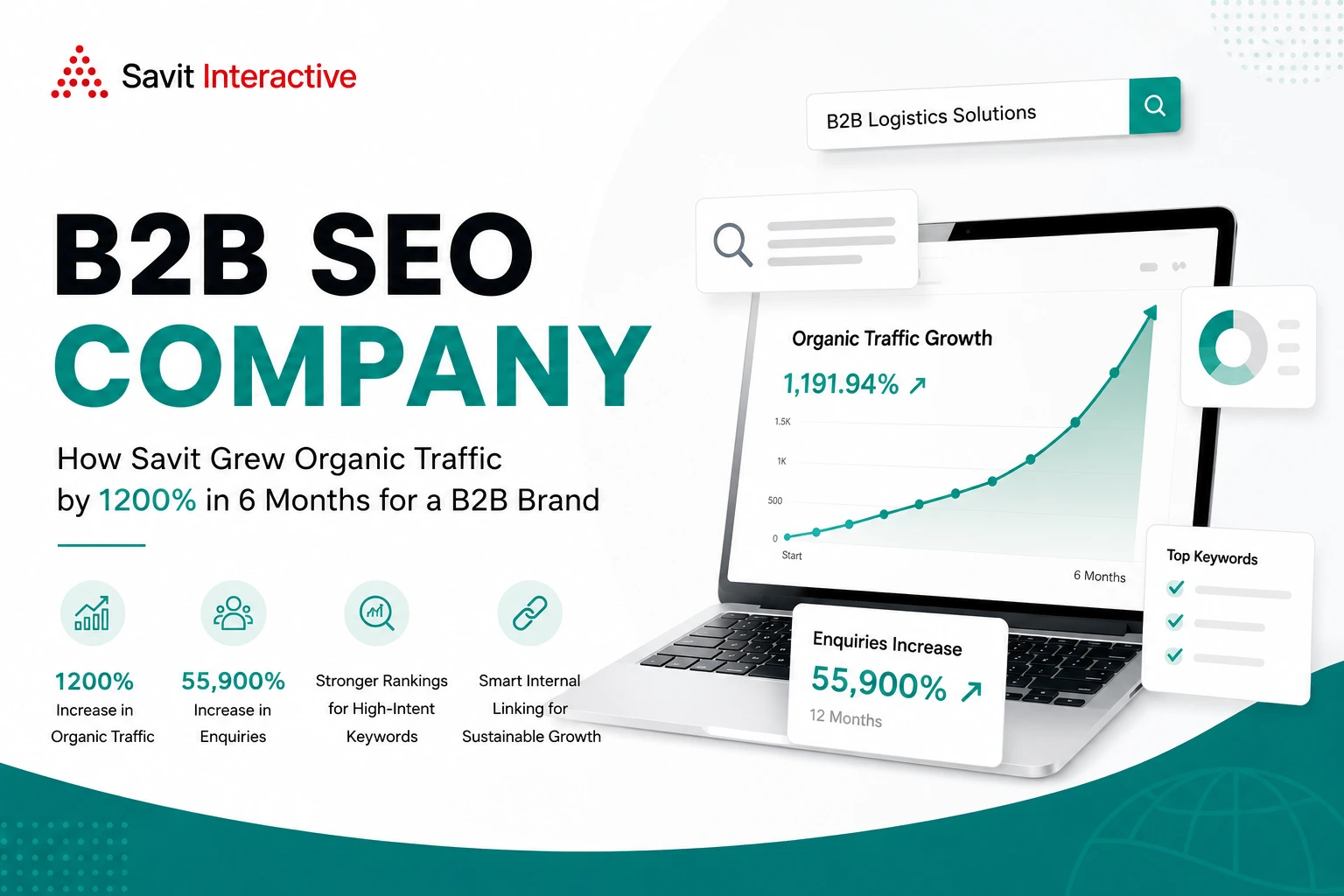
- TruKKer, a digital freight platform connecting businesses across India and the Middle East, grew organic traffic by 1,200% in 6 months and saw enquiry generation increase by 55,900% in 12 months after working with Savit.
- The strategy followed a clear sequence: fix the technical foundation, build content around commercial intent, map keywords to specific pages, and create an internal linking architecture that connected everything.
- This blog walks through the full engagement step by step, explaining what each action means and why it mattered.
- A separate takeaway section distils the strategy into actionable steps that apply to any B2B business looking to grow organic traffic.
When we began working with TruKKer, we were working with an established B2B business with a clear market proposition.
TruKKer is a cloud-based digital freight platform that connects businesses with transport solutions across India and the Middle East. The company organises a fragmented on-road logistics landscape through a technology-led platform built on transparency and reliability. Their customers are businesses that move goods over long distances, and their model is B2B.
We saw a business that had already built its market position through the quality of its product, direct relationships and operational scale.
What had not yet been fully developed was the organic search layer.
The website was serving people who already knew TruKKer. Our opportunity was to make it visible to the much larger audience searching for freight, transport and B2B logistics solutions without knowing the brand yet.
That distinction is important for B2B businesses.
Many strong B2B companies reach their early growth stages through referrals, partnerships, sales teams, events or existing networks. Their websites are often built to support people who already know the company. Search requires a different job.
Search asks the website to answer questions from people who may have never heard of the business.
That is where we saw the opportunity.
Over the next six months, we worked with TruKKer to build that organic search layer. Organic traffic grew by 1,191.94%, equivalent to roughly 12 times the starting level. Over 12 months, enquiry generation increased by 55,900%.
This case study explains what we changed, why we made those decisions and what we believe other B2B brands can take from the engagement.
What B2B Brands Need from SEO to Generate Leads
B2B SEO works differently from B2C. The audience is smaller, the intent is higher, and the buying process involves multiple stakeholders over weeks or months. To generate leads consistently, a B2B website needs to do three things well.
1. Be technically sound so search engines can find and read it.
This means clean URL structures, fast page load times, mobile responsiveness, and no barriers preventing Google’s crawlers from accessing important pages. Crawlers are the automated bots Google sends to read and index web pages. If they cannot access your content efficiently, none of the work that follows will show up in search results.
2. Have real content on every commercially important page.
Each service, product, or category page needs written content that explains what the page is about, who it is for, and what problem it solves. Without content, there is nothing on the page for Google to evaluate or rank.
3. Have a keyword strategy that maps buyer intent to specific pages.
B2B buyers search in patterns. They research a problem, then compare solutions, then evaluate providers. A well-structured B2B site has pages that meet the buyer at each of these stages, with each page targeting the keywords that match that stage.
Problem awareness
↓
Category / solution research
↓
Specific service search
↓
Provider comparison
↓
Brand or commercial search
↓
Enquiry
When these three layers are in place, a B2B website becomes a lead generation asset that compounds over time. When they are missing, the website serves its existing users well but stays invisible to the larger audience actively searching for the same solution. This is a common position for growing B2B brands, and it is exactly where TruKKer’s story begins.
Where the SEO Opportunity Sat for TruKKer
When we carried out the initial audit, we did not see a business that lacked substance.
We saw a business whose digital presence had not yet been built around organic discovery.
That created several clear opportunities.
The key pages had very little written content
The core service and category pages existed, but many had limited explanatory content.
From our perspective, this meant there were fewer opportunities for Google to understand the topic, match the page to relevant searches and assess its usefulness.
We therefore saw content expansion as one of the first commercial opportunities.
The URL structure could be clearer
Some URLs did not follow a logical hierarchy.
We wanted URLs to communicate meaning more clearly. A structure such as:
/services/freight-transport-uae/
gives users and search engines more context than a URL built around an opaque identifier.
That approach also aligns with Google’s guidance on descriptive URLs and logical site organisation.
Unused code was adding page weight
We found JavaScript resources that were not actively contributing to the experience but were still adding weight to pages.
We worked on removing unnecessary code and improving the technical efficiency of the site.
The point was not to chase a perfect speed score. It was to make the website faster, cleaner and easier to use while removing avoidable technical friction.
There was no supporting content layer
The absence of a substantial blog and resource section meant the website had fewer opportunities to capture research-stage queries.
That mattered because B2B buyers do not always begin with a service term.
They may search for a process, a problem, a market term, a comparison or a specific operational need before they ever search for a provider.
The starting traffic made the opportunity measurable
In Month 1, TruKKer received 248 organic visitors.
For us, that number was useful because it established a clear baseline.
We were not simply trying to improve a few positions on a ranking report. We were looking to build a search channel from the ground up and then connect that visibility to commercial outcomes.
The Strategy That Drove 1,200% Organic Traffic Growth
The strategy followed a deliberate sequence. Each step built on the one before it. Here is what we did and why.
Step 1: We fixed the technical foundation first
We restructured URLs into logical hierarchies, removed unused scripts to improve page speed, resolved crawl errors, and ensured every important page was accessible to Google’s indexing systems.
Why this came first: Content and keywords do not help if the technical infrastructure prevents Google from reading the pages. Fixing the foundation meant every piece of content we added from Step 2 onward could be indexed and ranked immediately.
The sequence looked like this:
Technical audit
↓
Crawl and indexing fixes
↓
URL and architecture improvements
↓
Page performance improvements
↓
Content expansion
↓
Keyword mapping
↓
Internal linking
↓
Authority and ranking growth
Step 2: We built substantial content on the category pages
We then worked through the existing service and category pages.
We expanded them so each page could answer three questions clearly:
What is this service?
Who needs it?
Why is it relevant?
The objective was to turn existing pages into genuine search landing pages.
Instead of creating dozens of disconnected articles and hoping some would rank, we strengthened the pages that had the strongest commercial connection to the business.
That gave us a cleaner route from search result to enquiry.
Step 3: We mapped keywords to pages based on intent
We researched search demand and assigned important keywords to specific URLs.
Each page had a defined role.
That helped us avoid keyword cannibalisation, where multiple pages target the same search and compete against each other.
Our mapping model was straightforward:
| Search stage | Example intent | Suitable page |
| Awareness | Understand a logistics problem | Guide or blog |
| Consideration | Explore freight solutions | Service or category page |
| Evaluation | Compare providers or options | Detailed service page or comparison content |
| Decision | Find a provider | Commercial landing page |
| Conversion | Request information | Contact or enquiry page |
This approach matters because keyword volume alone can be misleading.
A keyword with thousands of searches is not automatically more valuable than one with a smaller audience and strong buying intent.
We prioritised the searches that could contribute to business growth.
Step 4: We built a supporting blog and internal linking network
Once the commercial pages were stronger, we built supporting content around the wider topic landscape.
But we did not treat the blog as a separate publication.
We connected it to the commercial architecture.
A research article could link to a relevant service page. A market article could strengthen a category page. A detailed guide could connect several related commercial pages.
This created a network:
Blog A
/ \
/ \
Service A Service B
| |
Blog C Blog D
\ /
\ /
Category
Internal linking helped us make the relationship between these pages clearer.
Google’s SEO guidance notes that logical site organisation and clear links can help users and search engines understand how pages relate to each other.[2]
The important part was consistency. We kept building the network instead of treating each new article as an isolated asset.
Step 5: We went after high-value, competitive searches
We made a deliberate choice to pursue competitive keywords.
This is an important part of our B2B SEO thinking.
Lower-competition terms can provide quick wins, but the easiest keyword is not always the most valuable keyword.
We wanted searches with strong commercial relevance to TruKKer’s ideal customers.
That meant accepting a longer path to some rankings in exchange for pursuing terms with greater business value.
The strategy was therefore a balance:
Relevant enough to matter + competitive enough to create value + commercially aligned to justify the effort.
The Results: What Changed in 6 and 12 Months
SEO is a compounding channel. The early months showed indexing improvements and initial ranking gains. By month three, visible movement. By month six, the results were clear.
6-month results
| Organic traffic | +1,191.94% | Nearly 12x more people finding TruKKer through Google |
| Bounce rate | -64.45% | Visitors were engaging with the content, not leaving immediately. The right people were arriving and finding what they expected. |
| Clicks | +15.58% | More searchers seeing TruKKer in results were choosing to click through |
| Impressions | +32.25% | TruKKer was appearing in significantly more search results across its target keywords |
12-month results
Absolute traffic grew from 248 organic visitors in Month 1 to 4,629 visitors by Month 12, a 4x increase in real numbers on top of the percentage growth.
Enquiry generation increased by 55,900% within 12 months. This is the metric that matters most commercially. The organic traffic was not just volume. It was qualified. People actively searching for what TruKKer offers were arriving with intent and converting into business enquiries.
Why the bounce rate drop matters
A 64.45% reduction in bounce rate alongside a 1,200% traffic increase tells a specific story. We were not just driving more traffic. We were driving better traffic. Visitors arriving through organic search were finding content that matched their query, staying to engage with it, and taking the next step. When traffic and engagement grow together, it confirms the strategy is working on both quality and quantity.
The compounding effect
Months 1 to 3 showed foundational gains. Pages getting indexed, rankings entering the top 50. Months 3 to 6 showed the inflection point. Rankings entering the top 10, traffic multiplying. Months 6 to 12 showed full compounding. The internal linking network strengthened with each new blog post. Category pages accumulated authority. The site’s overall visibility grew month over month without additional investment beyond content maintenance.
How to Grow Organic Traffic for a B2B Brand
The TruKKer engagement gave us several principles that we believe can apply across B2B industries.
1. Fix your technical foundation before scaling content
If Google cannot efficiently crawl, render or understand important pages, additional content will have limited value.
Start with technical SEO, URL structure, indexation and site architecture.
2. Give every revenue-driving page enough content to compete
A service page should explain the service properly.
A product page should answer the questions a buyer is likely to have.
If a page represents a major commercial opportunity, it deserves enough useful information for Google and the buyer to understand its relevance.
3. Map keywords to pages according to search intent
One keyword should have one clear home.
Assigning keywords to specific pages helps avoid cannibalisation and creates a cleaner site architecture.
We also recommend mapping keywords by buying stage, because the person researching a problem needs different content from the person ready to contact a supplier.
4. Build an internal linking system, not isolated blog posts
Supporting content should strengthen commercial pages.
We use internal links to connect informational resources with service and category pages, creating clearer relationships across the website.
Every new piece of useful content should have a reason to exist within that network.
5. Target the searches that your ideal buyers actually use
We do not chase low-difficulty keywords simply because they are easier.
We look for the intersection of:
Search demand + buyer intent + commercial value + realistic opportunity.
That usually produces a smaller, stronger target set.
6. Treat SEO as a compounding investment
Paid traffic can be immediate. SEO generally takes longer to build.
But the pages created today can continue generating visibility months later.
As the website accumulates relevant content, useful internal links and stronger search authority, the value of previous work can continue to compound.
7. Measure commercial outcomes, not traffic alone
Organic traffic is an important indicator.
It is not the final outcome.
We recommend tracking:
- Organic enquiries
- Qualified leads
- Conversion rate
- Enquiry-to-opportunity rate
- Revenue influenced by organic search
- Cost per acquisition
- Rankings for commercial terms
- Organic engagement
A B2B website can attract thousands of visitors and still contribute little to the pipeline.
Conversely, a smaller stream of highly relevant organic visitors can produce significant commercial value.
What Every B2B Brand in the UAE Can Take from This
We see the TruKKer engagement as a clear example of what happens when a strong B2B business builds an organic search system around its actual commercial strengths.
The results were specific to TruKKer, but the framework is broader.
We started with the technical foundation. We strengthened commercially important pages. We mapped keywords to intent. We connected supporting content through internal links. We then pushed towards higher-value search terms and measured the impact through traffic, engagement and enquiries.
We believe that sequence can work for B2B companies across the UAE, including SaaS businesses, consultants, technology firms, manufacturers, professional services companies and B2B ecommerce brands.
We also believe the most important lesson is not the 1,200% number.
It is the process behind it.
Organic growth becomes much more predictable when every part of the website has a job, every target keyword has a destination and every content asset supports a wider commercial objective.
At Savit, we apply this same thinking through our B2B SEO approach.
We work with businesses that need more than higher rankings. We build search strategies around buyer intent, technical performance, content depth and the full B2B research journey. Our approach combines technical SEO, keyword and intent mapping, content strategy, internal linking, on-page optimisation and transparent measurement.
Our B2B SEO work is designed to connect search visibility with qualified enquiries and long-term growth, whether the goal is to strengthen a UAE market presence or expand into international markets.
The TruKKer engagement gave us a useful proof point for that philosophy: when the technical foundation, content strategy and commercial intent are aligned, organic search can become a substantial growth channel.
Talk to our B2B SEO team to explore where that opportunity may sit for your business.