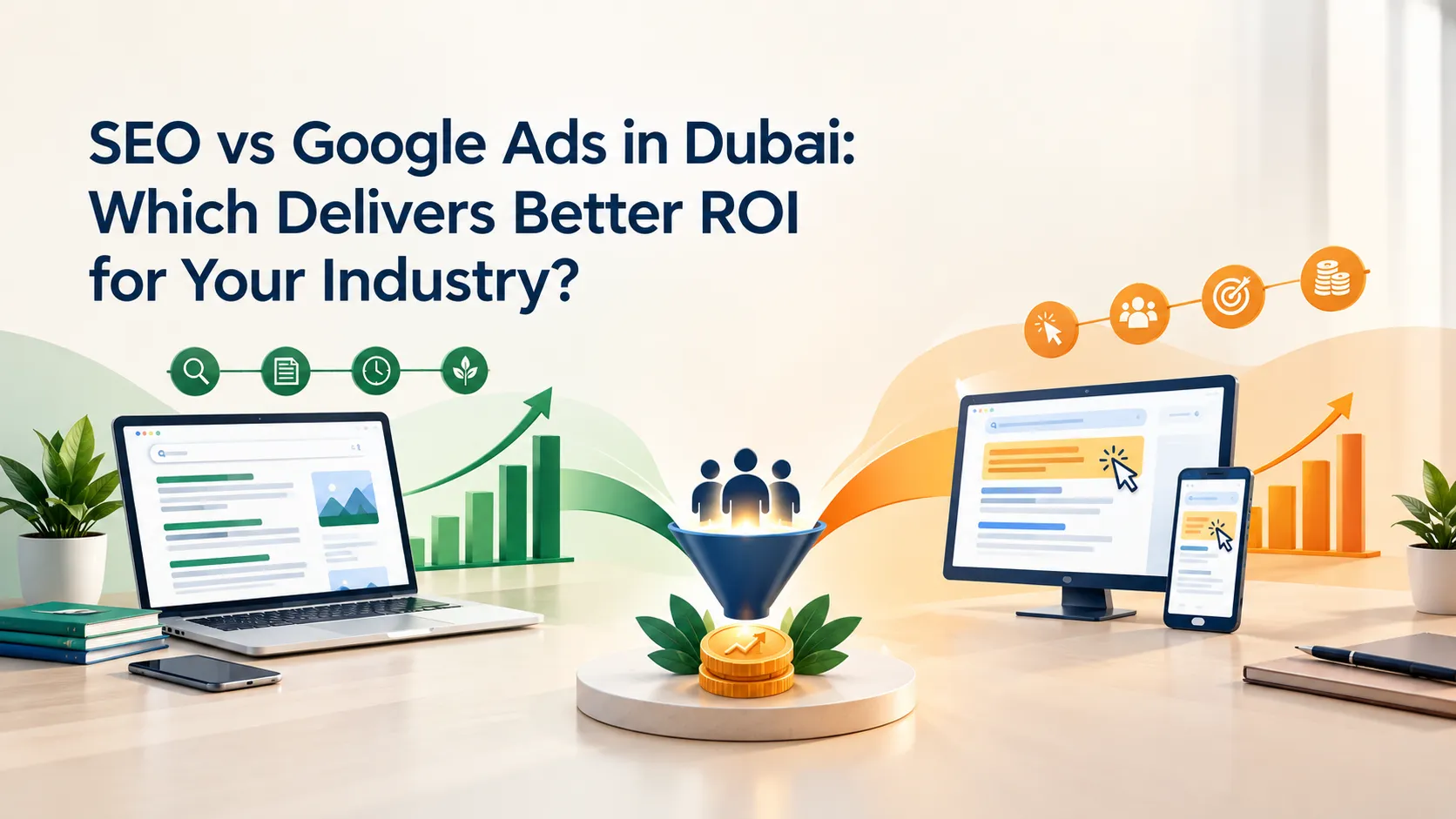
Both channels put your business in front of people searching in Dubai, but they buy very different things with your budget.
Key Highlights
- SEO and Google Ads solve different problems, so the better question is usually how to split budget between them rather than which one wins.
- Google Ads can generate enquiries within days, while SEO builds visibility that continues without paying for each click.
- ROI depends heavily on industry, average order value, sales cycle length and how competitive your search terms are.
- Regulated sectors in Dubai, including real estate and healthcare, must factor advertising permits and approvals into any paid campaign plan.
- Rankings and impressions are weak measures of return; leads, qualified enquiries, and revenue are better.
- Most businesses see the strongest results when paid search covers immediate demand while SEO builds a long-term organic base.
- Tracking has to connect both channels to actual enquiries, not just clicks, before any ROI comparison is meaningful.
Why the SEO vs Google Ads Question Comes Up So Often in Dubai
Dubai is an unusually competitive search market for its size. Local companies, UAE-wide brands and international businesses often chase the same customers, and many of those customers compare several providers before making contact.
That competition shows up in two ways. Paid search auctions for commercial terms can be expensive, particularly in property, legal, medical and financial services. Established websites usually compete for organic results for the same terms, with years of content behind them.
So there is a real trade-off for companies. Paid search buys visibility now, but the visibility ends when the budget ends. SEO takes months to build, but works for months after building. It is contingent upon the industry, the margin on each sale and how long the business can wait for a return.
How the Two Channels Actually Work
Google Ads is an auction. You bid on search terms, and your position depends on your bid, ad quality, and expected impact, so a better-written, more relevant ad can outrank a higher bid. You pay when someone clicks.
SEO earns placement rather than buying it. Google’s systems assess pages for relevance, quality, and usefulness, and local results are shaped mainly by relevance, distance, and prominence. No payment is involved, and there’s no way to guarantee a position.
The practical difference is control. With paid search from a reliable SEO agency in Dubai, you decide today which terms to appear for and can change it tomorrow. With SEO, you influence the outcome through technical health, content and authority, and the results build gradually.
What ROI Really Means for Each Channel
ROI comparisons are often messy because the two channels are measured over different time periods.
Google Ads is clean, and it does the math right there. The spend is known, the clicks are known, and with proper conversion tracking, the cost per enquiry and cost per sale are known too. The catch is the cost recurs for every click, and if competitors bid harder, the same result costs more next quarter.
SEO is more of a purchase than an investment. Spending is upfront on audits, technical fixes, content and authority building, and returns later. Once a page ranks, it can keep generating enquiries at no extra cost per visit, which is why long-term ROI calculations tend to favour organic search when done properly.
A fair comparison therefore needs a shared time horizon. Judging six months of SEO against six months of ads flatters paid search. Judging both over 24 months usually tells a more accurate story.
SEO vs Google Ads: A Direct Comparison
| Factor | SEO | Google Ads |
| How visibility is earned | Through technical health, content quality and authority signals | Through an auction combining bid, ad quality and expected impact |
| Speed to first results | Typically months, with early technical gains sooner | Days, once campaigns are approved and live |
| Cost behaviour | Investment in work, with no cost per click | Cost per click, repeating for every visit |
| What happens when you stop | Rankings decay slowly, and traffic often continues for a period | Traffic stops almost immediately |
| Control over targeting | Indirect, shaped by content and relevance | Direct, by keyword, location, device, schedule and audience |
| Best suited to | Building steady demand and capturing research-stage searches | Immediate demand, promotions, launches and testing |
| Main risk | Slow to show returns, and vulnerable to algorithm changes | Rising competition pushes costs up over time |
Here’s that section with colons after the bold lead-ins:
Which Delivers Better ROI in Your Industry?
The honest answer varies by sector, because purchase value, urgency and competition all differ.
Real estate: Commercial property terms in Dubai are among the most expensive in paid search, but a single completed transaction can justify a high cost per lead. Paid search works well for launches and specific communities, while SEO earns its keep through community guides, building pages and buyer content that keeps generating enquiries. One planning point applies to both channels: every property advertisement in Dubai needs a Trakheesi permit from the Dubai Land Department, with the permit number shown on the advert, so campaign timelines need to account for permit approval.
E-Commerce: Shopping campaigns can perform well when margins allow, and they are easy to measure. SEO tends to deliver better long-term returns on category pages, buying guides, and product content, particularly for repeat-purchase categories where lifetime value exceeds first-order value.
Healthcare: Paid search can be expensive for competitive treatment terms, but trust-driven SEO content tends to perform steadily over time. In Dubai, healthcare advertising is regulated and requires approval from the Dubai Health Authority, so advertising copy and claims need to be cleared before campaigns run.
Restaurants & Hospitality: Local SEO & Google Business Profile generally outperform paid search, as most discovery happens via Maps, reviews & nearby searches. For openings, promotions and event periods, paid search plays a more limited role.
B2B and professional services: Sales cycles are longer, enquiry volumes are lower, so last click undervalues both channels. SEO services in Dubai work well for detailed service pages, case studies and industry content, while paid search works well for high-intent terms and testing which propositions convert.
Education and training: Combined approach from the best pay per click advertising companies for seasonal enrolment cycles. Paid search covers intake periods, and SEO creates course and career content to attract prospective students all year-round.
How to Split Budget Between the Two Channels
There is no universal ratio, but a few principles hold in most markets, especially when working with a reliable Google Ads agency in Dubai.
- New websites lean paid first: A site with little authority will take time to rank, so paid search covers the gap while SEO foundations are built.
- Established sites lean organic: A site already ranking for some terms usually gets more from strengthening that position than from bidding on terms it could own.
- Protect high-intent terms: Where a term consistently produces qualified enquiries, appearing in both paid and organic results is often worth the overlap.
- Use paid data to guide SEO: Search term reports show which phrases actually convert, which is far more reliable than volume estimates when choosing content priorities.
- Review quarterly, not monthly: Auction costs and rankings both move, and a quarterly review avoids overreacting to short-term noise.
A 12-Month Plan for Running Both Together
Quarter 1. Make sure conversion tracking is correctly set up for both channels. Audit the website. Fix technical issues. Research keywords. Instead, run tight paid campaigns on the highest intent terms, not broad coverage.
Quarter 2. Publish priority service and location pages, strengthen internal linking and build local SEO. Use paid search data to refine which organic pages to prioritise, and pause paid terms that generate clicks but no enquiries.
Quarter 3. Review combined performance across both channels. Increase content in areas where we are seeing organic traction, and decrease paid bids on terms where organic rankings have gotten strong enough to carry the traffic.
Quarter 4. Refresh older content, go deeper into what’s working, and boost conversion rates on pages both channels drive traffic to. Plan the split for the coming year on a cost per qualified enquiry basis rather than channel preference.
These are planning ranges rather than guarantees, and results depend on competition, website condition, and how consistently the work is delivered. You can be assured of the best results when you get services from a reliable digital marketing company in Dubai.
How to Measure ROI Across Both Channels
Meaningful measurement needs the same definitions on both sides.
Don’t focus on raw conversions; focus on qualified leads, because a form completion from an unqualified prospect wastes your budget and adds no value. Record phone calls, including calls from Google Business Profile, since many Dubai enquiries start this way. Link enquiries to your CRM so you can trace closed revenue back to source. Look at assisted conversions, as customers often discover a business through organic search and convert later via a branded paid click, or vice versa. When choosing a PPC agency in Dubai, ask how it tracks enquiries, sales and the cost of acquiring each customer.
Also separate branded vs non-branded performance. Growth in branded searches from reliable SEO services in Dubai often comes from more marketing activity rather than SEO progress. Bidding on your own brand name can look very profitable but is mostly just capturing demand you already had. Get services from a professional search engine optimisation company in Dubai.
Mistakes That Waste Budget in Both Channels
- Judging SEO on ad timelines: Expecting organic results within weeks leads businesses to abandon work just before it starts paying off.
- Running ads without conversion tracking: Without it, optimisation is guesswork, and ROI comparisons are impossible.
- Bidding broadly on generic terms: Wide match types in competitive Dubai categories drain budget on irrelevant searches.
- Treating the two channels as rivals: Separate teams and separate reports hide the fact that customers move between channels.
- Ignoring the landing page: Both channels send traffic to the same pages, and a weak page wastes spend from both.
- Overlooking regulatory approvals: Advertising in regulated sectors without the required permits risks campaign rejection or listing removal.
- Accepting guaranteed ranking promises: No provider controls Google’s ranking systems, no matter what the pitch says.
Building Growth With Both Channels in Dubai
SEO and Google Ads are not competing answers to the same question. Paid search buys attention now, and SEO builds an asset that keeps producing later. The businesses that get the most from their budget treat them as one plan with two timelines, measured against the same definition of a qualified enquiry.
At Savit Interactive, we believe channel decisions should follow business goals, not habit. Our UAE operation supports businesses in Dubai and the wider Middle East, backed by the wider Savit Interactive Group’s experience across SEO, paid media, content, social media and web development. We suggest starting with proper tracking and a clear view of what a qualified lead is worth, then deciding how to divide budget between immediate demand and long-term visibility. That foundation makes both channels easier to evaluate and scale.
Footnotes and References
[1] Google Ads Help. “About ad position and Ad Rank,” Google explains that ad position is determined by Ad Rank, which combines bid amount, ad quality and expected impact rather than bid alone.
[2] Google Business Profile Help. “Tips to improve your local ranking on Google.” Google explains that local results are based mainly on relevance, distance and prominence.
[3] Google Search Central. “Creating helpful, reliable, people-first content.” Google recommends creating useful content for people rather than content made primarily to influence search rankings.
[4] Dubai Land Department. Trakheesi advertising permits. Property advertisements in Dubai require a permit issued through the DLD’s Trakheesi system, with the permit number displayed on the advertisement.
[5] Dubai Health Authority. Health advertising approvals. Healthcare advertising in Dubai requires prior DHA approval, and you should confirm current requirements with the authority.