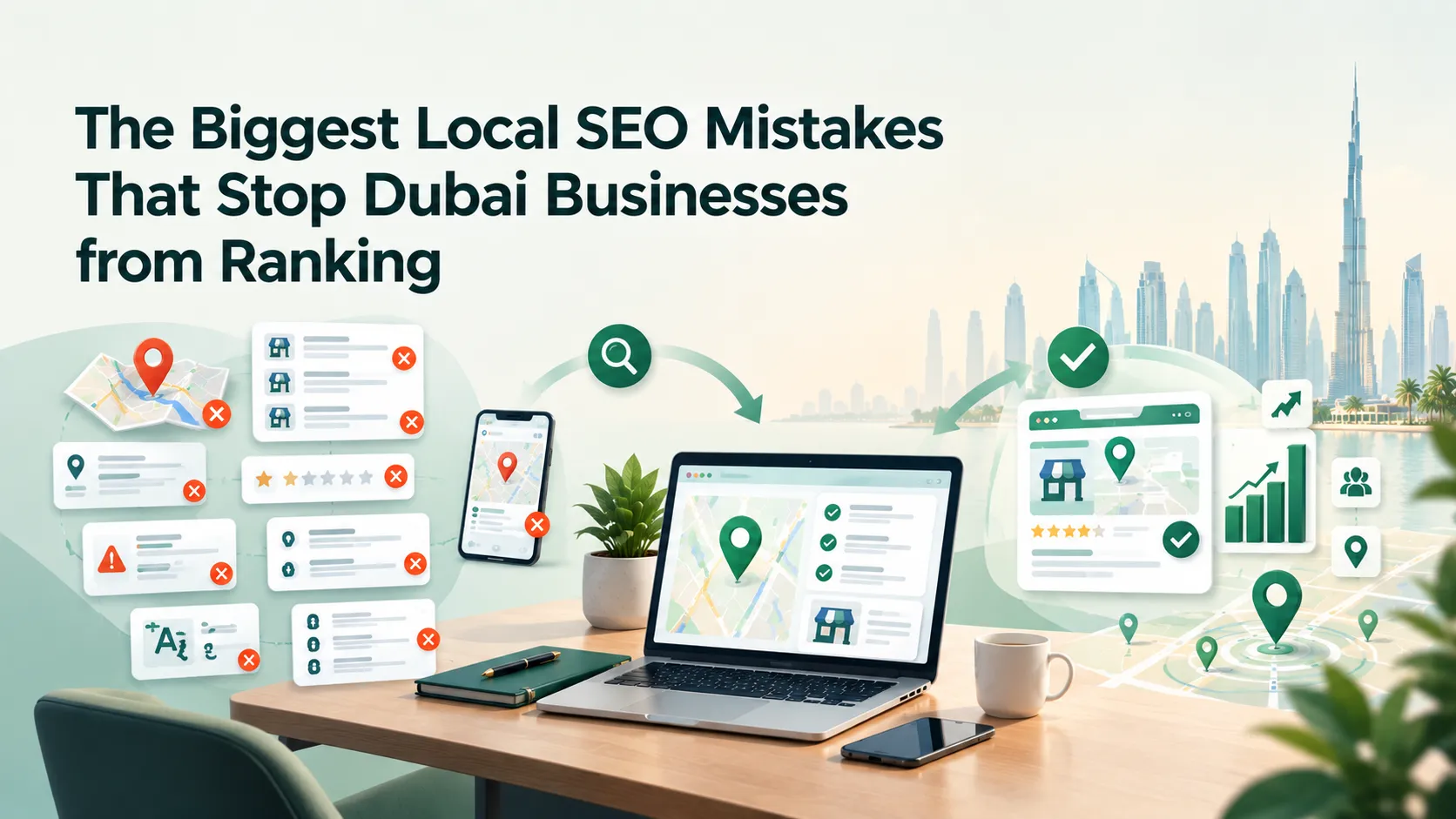
Most local visibility problems in Dubai are not caused by competitors outspending you. They stem from small, fixable errors in how a business is listed, described, and verified, and they often go unnoticed for months.
Key Highlights
- Google says local results are based mainly on relevance, distance and prominence, so incomplete business information limits visibility before any content work begins.
- Adding keywords to your business name breaches Google’s representation guidelines and can lead to suspension.
- Virtual offices and PO box addresses do not meet Google’s eligibility rules, which affects many businesses in Dubai’s free zones.
- Duplicate listings for branches, previous names or former addresses split your visibility across several profiles.
- Reviews matter, but incentivised or bulk-solicited reviews breach Google’s policies and can be removed.
- Dubai’s landmark-based addressing and Makani system make address accuracy and map pin placement more important than in many markets.
- Inconsistent English and Arabic business details across directories weaken the signals Google uses to recognise your business.
Dubai’s geography works against generic local SEO advice. Business districts are dense, buildings are often known by name rather than street number, and many customers search by community or landmark rather than by area name.
Addressing adds another dimension. Dubai uses a ten-digit system called Makani to identify building entrances, in addition to traditional addresses. Many businesses are located in towers shared by dozens of companies. This isn’t just about getting a map pin on the right entrance. It affects how customers arrive and leave.
Language compounds it. Customers search in English and Arabic, and business names are often transliterated inconsistently across platforms, making it harder for search systems to recognise all those mentions as the same business. This is where the expertise of the best local SEO company in Dubai can help, from maintaining consistent business information to strengthening your visibility across local search.
Mistakes With Google Business Profile
This is where most local SEO Dubai problems begin, because the profile carries more weight in map results than the website does.
Stuffing keywords into the business name: Adding service or location terms to the name breaches Google’s guidelines, which require the name to reflect the real-world name used consistently on signage, stationery and licensing. It can trigger suspension, and reinstatement takes time.
Wrong primary category selected: The primary category is a major relevance factor. Many businesses choose something generic when a specific category fits, or they pick something aspirational instead of their main service.
Leaving the profile half complete: Missing services, attributes, hours, description or photos all reduce how well Google can match your business to a search. Google’s own guidance points to complete information as a way to improve relevance.
Using an ineligible address: Profiles require a location that is staffed during stated business hours. Virtual offices, PO Boxes and co-working desks used purely as mailing addresses do not qualify, which affects many free zone businesses operating without a customer-facing office.
Placing the map pin carelessly: In multi-tower developments, an automatically placed pin often lands on the wrong building or the wrong side. Move the pin to the entrance customers actually use.
Neglecting hours during Ramadan and holidays: Special hours exist for a reason. Profiles showing normal hours during Ramadan or Eid create poor experiences and negative reviews.
Mistakes With Listings and Business Information
Consistency lets different systems recognise scattered mentions as one business.
Letting duplicates accumulate: Old profiles from previous owners, former addresses, branch listings created by staff and department-level listings all divide reviews and signals. Duplicates should be found and merged or removed.
Inconsistent name, address and phone details: A licence name in one place, a trading name in another and a slightly different address in a third weakens recognition. Pick one format and use it everywhere.
Mixed transliterations: Al Barsha, Al-Barsha, and AlBarsha may be the same place to a reader, but consistency helps systems connect your mentions. The same applies to business names containing Arabic words.
Using a mobile or VoIP number inconsistently: Use one primary number across all listings. You can add additional numbers as secondary, but the main one should never vary.
Ignoring local directories: UAE business directories, chamber listings and sector platforms contribute to prominence. Many businesses list on none of them.
Not updating after a move or rebrand: Outdated addresses linger for years across directories, and every stale listing pulls against the current one.
Mistakes With Reviews
Reviews influence both rankings and the decisions customers make after seeing you.
Buying or incentivising reviews: This breaches Google’s policies on fake engagement and can result in removal or penalties. It is also easy to spot when a business collects ten five-star reviews in one week and nothing before or after.
Review gating: Filtering customers so only the happy ones are asked to review publicly breaches platform policies and misrepresents the business.
Ignoring negative reviews: An unanswered complaint reads as indifference. A measured, factual reply frequently matters more to prospective customers than the complaint itself.
Replying with copied text: Identical responses under every review look automated and add nothing.
Not asking at all: Most satisfied customers never think to leave a review. A simple, genuine request at the right moment, with no incentive attached, is entirely legitimate.
Overlooking other platforms: Sector-specific review sites matter in hospitality, healthcare and property, and they often appear in branded search results.
Mistakes on the Website
The website supports local visibility, and a few errors undermine it repeatedly.
Duplicating location pages: Creating a dozen near-identical pages and swapping the community name produces thin content with little value. Each location page needs genuine, specific information.
Hiding the address and phone number: Contact details buried in an image or tucked into a footer script are harder for systems to read and harder for customers to use.
No embedded map or directions: In a city where people find buildings by landmarks, directions and a map help both users and search engines confirm the location.
Missing or inaccurate structured data: Organisation and local business markup should match what is visible on the page. Markup that contradicts the page causes problems rather than solving them.
Ignoring mobile experience: Most local searches happen on mobile, often while travelling. Slow pages and small tap targets cost enquiries at exactly the moment intent is highest.
Publishing in one language only: If a meaningful share of your customers search in Arabic, English-only pages leave those searches to competitors. Machine translation is not an adequate substitute for Arabic content written for Arabic search behaviour.
Mistakes in Measurement
You cannot fix what you are not tracking.
| What goes wrong | Why it matters | What to do instead |
| Judging success by rankings alone | Map results vary by searcher location, so there is no single ranking | Track calls, direction requests and enquiries |
| Not tracking calls from the profile | Many local enquiries never touch the website | Use call tracking that preserves NAP consistency |
| Ignoring Business Profile insights | The profile reports searches, views and actions separately from the site | Review profile performance monthly |
| Counting all traffic as local | Branded and non-local visits mask local performance | Segment by query type and location |
| Checking rankings from one location | Distance affects results | Test from several points across the city |
| No baseline before work begins | Improvements cannot be demonstrated | Record profile actions, calls and enquiries before changes start |
How to Fix These in a Sensible Order
Fixing everything at once makes it impossible to tell what worked. An affordable local SEO agency can help prioritise these fixes based on their likely impact, making it easier to measure what improves your local search performance.
Step one, eligibility and accuracy: Verify the profile, confirm the address qualifies, correct the business name to the real-world name, fix the map pin and complete every field.
Step two, duplicates and consistency: Find and resolve duplicate listings, then align name, address and phone details across your website, Business Profile and major directories.
Step three, reviews: Put a legitimate, ongoing review request process in place and respond to everything, including older reviews.
Step four, website support: Improve location and service pages with genuine detail, add structured data that matches the page, and make contact details prominent.
Step five, prominence: Build presence through relevant local directories, sector platforms, partnerships and coverage. This is the slowest part and the hardest for competitors to copy.
Step six, measurement: Establish a baseline, then review monthly against calls, direction requests and enquiries rather than positions alone.
What Reasonable Timelines Look Like
Category changes, profile fixes and pin placement can affect visibility in days or weeks because they change how well Google understands the business.
Duplicate resolution and directory consistency typically take effect in one to three months as corrected information spreads.
Volume and prominence build over a longer period. A business with few reviews and few local mentions should expect several months of consistent effort, not a quick change.
These are planning ranges of local SEO services in Dubai, not guarantees. Competition, category and how far the current setup has drifted all affect the pace.
Getting the Fundamentals Right
Dubai rewards local visibility with accuracy and consistency, not clever tactics. Most companies that do badly in map results are not being beaten by a better strategy. A category is out of place, a pin is on the wrong tower, three listings exist where there should be one, and a review profile goes unmanaged.
At Savit Interactive, we believe local SEO should start with an audit of what is already there, not new activity. Our UAE operation supports businesses in Dubai and the wider Middle East, backed by the wider Savit Interactive Group’s experience across SEO, paid media, content, social media and web development. We suggest beginning with your Business Profile, your listings and your review process, then building website and prominence work on top of that foundation. Fixing what is broken usually delivers more, and faster, than adding something new.
Footnotes and References
[1] Google Business Profile Help. “Tips to improve your local ranking on Google.” Google explains that local results are based mainly on relevance, distance and prominence, and that complete business information helps Google understand the business.
[2] Google Business Profile Help. “Guidelines for representing your business on Google.” Google requires business names to reflect the real-world name and prohibits adding unnecessary keywords, and sets eligibility rules requiring a location staffed during business hours.
[3] Google Maps. “Prohibited and restricted content policies.” Google prohibits fake engagement, including incentivised and solicited reviews that misrepresent a business.
[4] Google Search Central. “Creating helpful, reliable, people-first content.” Google recommends content created for people rather than primarily to influence search rankings.